Portuguese
  Spanish


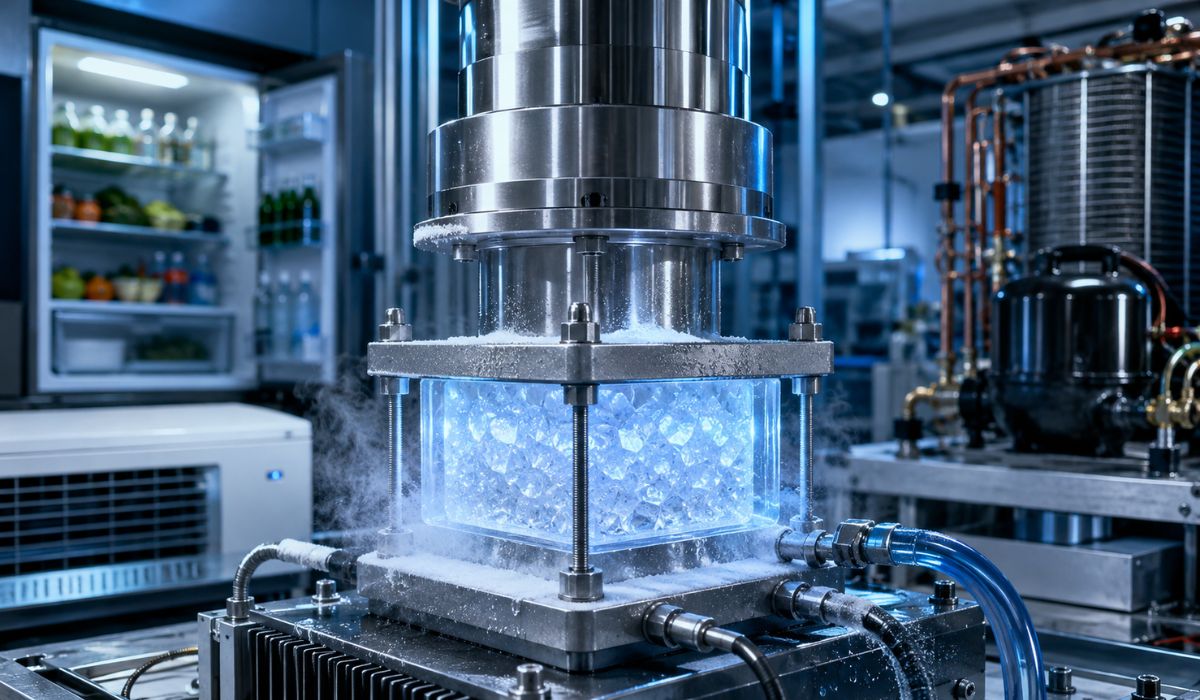


Cambridge startup bets on plastic crystals to transform refrigeration by replacing gases with solid materials that change temperature under pressure, in a technology still under development and initially aimed at commercial systems.
A startup linked to the University of Cambridge is working on a refrigeration technology that replaces gases with solid materials capable of changing temperature when pressed.
Barocal raised US$ 10 million in a seed round to advance the development of heating and cooling systems based on plastic crystals, a class of materials studied by researchers in the field of materials physics.
The proposal seeks to address a limitation of the systems used today in refrigerators, air conditioners, and industrial equipment.
-
She spent 73 years breathing inside an iron lung, survived the aftereffects of polio, and became the last woman in the United States dependent on the equipment before dying at 78 years old.

-
Brazilian students created a $1 filter using pine bark, cotton, and 3D-printed parts to clean cassava wastewater, reduce the toxicity of a hazardous waste, and transform contaminated water into biofertilizer.

-
Astronaut from Artemis II steps down after mission to the Moon and decision surprises after a record of 406,771 km, a historic 10-day journey, and an unprecedented achievement for Canada.

-
A fossil kept for years in a small museum in Montreal concealed 450-million-year-old soft tissue, a discovery that has only happened once before in history.


Conventional refrigeration largely works by vapor compression, a process in which refrigerant fluids circulate through the equipment, change physical state, and remove heat from an environment.
These fluids can leak during use, maintenance, or disposal of appliances.
According to Barocal, the goal is to replace gaseous refrigerants with organic solid materials.
The company states that its first prototypes already achieve performance comparable to that of compressors used in current refrigerators, but the technology is still under development and has no public commercial launch date.
The investment round included participation from World Fund, Breakthrough Energy Discovery, Cambridge Enterprise Ventures, and IP Group.
According to information released by Cambridge Enterprise, the commercialization arm of the University of Cambridge, the funds will be used for hiring, engineering development, and preparing the technology for commercial use.
How pressure refrigeration works
Barocal’s technology is based on the so-called barocaloric effect, a phenomenon in which certain materials release or absorb heat when subjected to mechanical pressure.
Instead of compressing a gas, as occurs in many current refrigeration systems, the equipment compresses a solid.
Physicist Xavier Moya, founder of Barocal and professor of materials physics at the University of Cambridge, explains the principle with a simple example.
In an interview with TechCrunch, he cited the behavior of an empty balloon when it is stretched and then released.
“If you stretch it, it gets hot. And then, if you wait, when you release it, it feels cold,” he stated.
In plastic crystals used in research related to the technology, molecules have mobility under normal conditions.
When the material is compressed, this movement is reduced.
Since heat is associated with the movement of atoms and molecules, the structural alteration allows the material to release heat.
When the pressure is removed, the process reverses, and the solid can absorb heat from the nearby environment.
In a refrigerator, this cycle would function as a heat pump.
The material would remove heat from inside the equipment and transfer it outside.
Barocal states that the system can use water to circulate around the materials and carry the heat to a radiator, without relying on conventional refrigerant gases.
University of Cambridge research gave rise to Barocal
Barocal is a spin-out from the University of Cambridge and was founded in 2019 by Xavier Moya.
Before the company’s creation, researchers were already investigating the use of plastic crystals as an alternative for solid-state cooling systems.
In 2019, a study published by researchers linked to Cambridge and other institutions described significant barocaloric effects in plastic crystals near room temperature.
At the time, the University of Cambridge reported that Moya was working with Cambridge Enterprise to evaluate ways to bring the technology to market.
The field is not limited to Barocal.
Caloric materials, in general, are studied because they can exchange heat when subjected to external stimuli, such as pressure, electric field, or magnetic field.
In the case of the British company, the focus is on barocaloric materials, which respond to pressure.
The scientific challenge is not just demonstrating that the material changes temperature.
To reach the market, the technology needs to repeat the compression and relaxation cycle many times, maintain stable performance, work in real equipment, and have a cost compatible with commercial applications.
Refrigerant gases and environmental impact
Vapor compression remains the dominant technology in refrigeration because it is widely known by the industry, has an established production chain, and offers adequate performance in different applications.
At the same time, the use of refrigerant fluids raises environmental concerns when leaks occur.
Some older refrigerants have been associated with ozone layer depletion.
Other substances, such as certain hydrofluorocarbons, do not have the same effect on ozone but can have a high global warming potential when released into the atmosphere.
For this reason, governments, researchers, and companies are seeking alternatives with lower climate impact.
In the system proposed by Barocal, the main refrigerant is solid.
According to the company, this characteristic reduces the risk of fugitive emissions associated with gas leaks.
The technology, however, still needs to undergo broader commercial validation before being compared at scale with currently used systems.
The replacement of gaseous refrigerants also depends on regulatory, industrial, and economic factors.
Refrigeration equipment needs to operate for long periods, undergo maintenance, comply with safety standards, and have a competitive cost for manufacturers and consumers.
Commercial systems should receive the technology first
Barocal states that its technology can be applied at different scales, but the initial focus is on larger commercial systems.
The company cites areas such as commercial refrigeration, building heating and cooling, and data center applications.
In an interview with TechCrunch, Moya said that the company is looking at larger commercial systems, where operational cost reductions can be realized more quickly.
The strategy indicates that the common household refrigerator should not be the technology’s first market.
This choice also reflects the industry’s demands.
In larger equipment, energy consumption, efficiency, and maintenance carry significant weight in purchasing decisions.
In the residential market, manufacturers need to meet requirements for price, size, noise, durability, and large-scale technical assistance.
Even in commercial applications, the company still needs to demonstrate that the materials withstand repeated pressure cycles, that the system maintains efficiency over time, and that the technology can be manufactured at scale.
These steps are part of the process of transforming a laboratory discovery into a product.
What changes in relation to the conventional refrigerator
The technology does not eliminate the need to remove heat from one environment and discard it at another point.
This principle remains central to refrigeration.
The difference lies in the medium used to perform this transfer.
In traditional equipment, the refrigerant fluid absorbs and releases heat by changing pressure and physical state.
In the barocaloric solution, a solid material changes its internal organization when compressed and relaxed.
Water, in this arrangement, acts as a heat transfer medium between the material and the radiator.
According to the company, the use of organic solid materials can reduce problems associated with leaks and allow for efficiency gains.
These claims, however, are part of Barocal’s own technological proposal and still depend on proof in commercial applications.
The research draws attention by bringing a physical phenomenon observable in simple objects, such as rubber and balloons, closer to an industrial application.
For this to work in refrigerators, the material needs to exhibit a strong, reversible, and wear-resistant thermal response.
Solid-state refrigeration remains in testing phase
Alternatives to vapor compression have been studied for years by research groups and companies.
Magnetic, thermoelectric, elastocaloric, and barocaloric systems are part of this field, but face barriers such as cost, efficiency, material stability, and adaptation to commercial equipment.
Barocal is trying to advance one of these routes based on plastic crystals.
The US$10 million investment indicates fund interest in a technology that still needs to demonstrate viability outside of prototypes and controlled tests.
For now, there is no public indication that domestic refrigerators based on this technology are close to reaching retail.
Development should first proceed with larger-scale applications, where energy savings and the reduction of refrigerant gases can have a more direct effect on costs and emissions.
Refrigeration is present in food chains, hospitals, laboratories, transportation, building climate control, and digital infrastructure.
Therefore, changes in this sector depend on technical validation, operational safety, and production capacity.