Portuguese
  Spanish


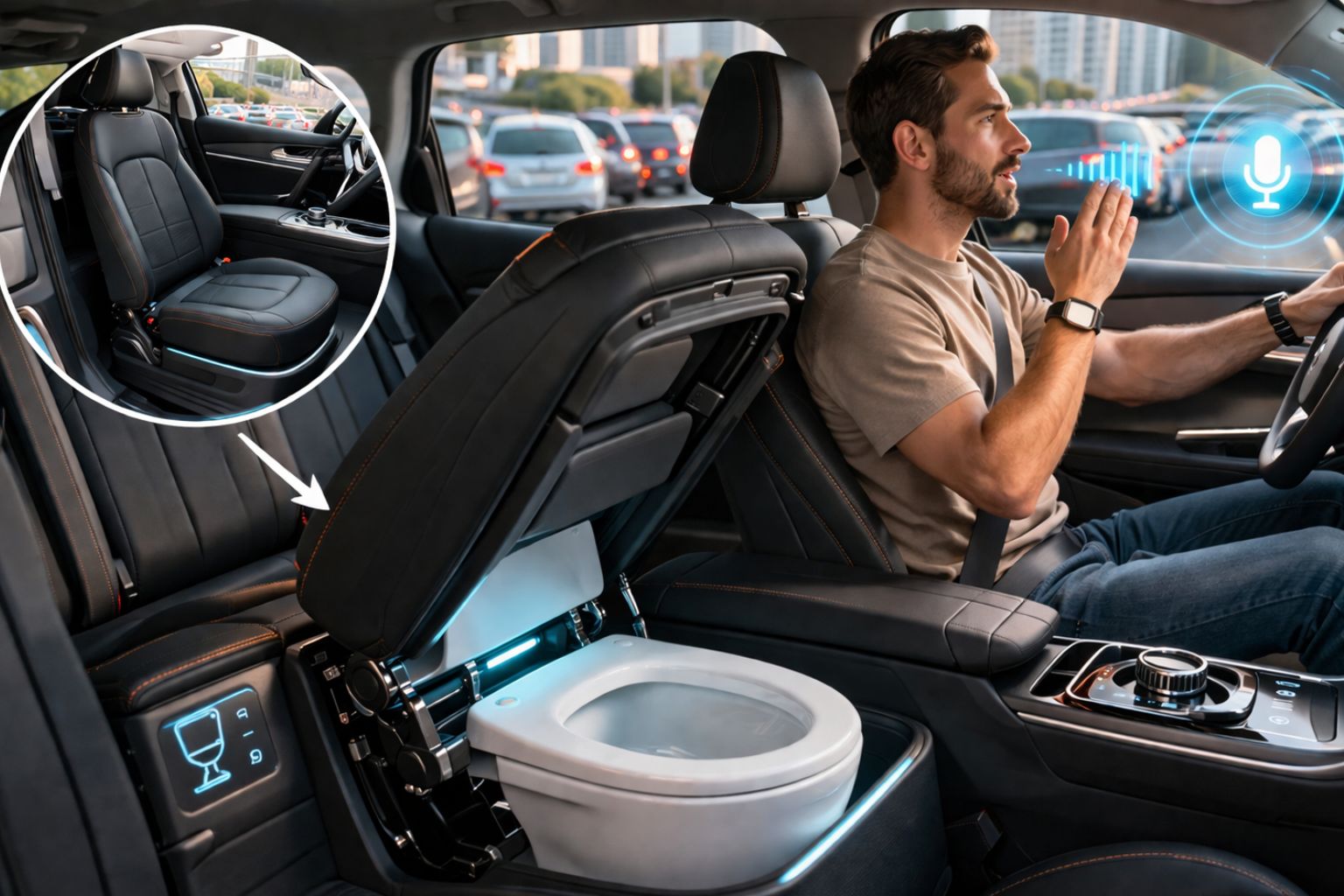

The Chinese automaker Seres received patent approval for a built-in toilet under a sliding car seat, activated by voice command with the phrase “start toilet function”. The system includes a fan for odor elimination, a removable waste tank, and a heating element that evaporates liquids and dries solid waste.
The Chinese automaker Seres has just patented something that most people did not think possible: a toilet hidden inside the car seat, which can be activated by voice command. The patent, approved in early April according to public records from the Chinese government, describes a system where the vehicle seat slides back and reveals a portable washbasin designed for use on long trips, camping, or situations where the driver lives in the car. To activate the mechanism, simply say “start toilet function” and the seat moves automatically, exposing the toilet that remains invisible during normal vehicle use.
The idea may sound absurd at first reaction, but it addresses a real problem. The Chinese automaker justified the creation by stating that the goal is to “meet the sanitary needs of users on long trips, during camping, or while living in the car”, a description that encompasses everything from truck drivers who spend days on the road to families facing hours of traffic jams in Chinese megacities without access to public restrooms. Seres, which has partnered with Huawei to develop its premium AITO line, has not yet announced any vehicle equipped with the system, and it is unclear if any production model will receive the innovation.
How the patented toilet by the Chinese automaker works

According to information from the portal StraitsTimes, the design described in the patent is more sophisticated than the initial idea suggests. The toilet is hidden under the passenger seat, which slides on tracks when the system is activated, revealing the toilet without compromising the internal space of the vehicle during normal use. Access can be done manually by pushing the seat back or by voice command, a functionality that the Chinese automaker integrated into the car’s control system.
-
The large jar blender has a rival: Oster Ultra Power bets on 1,000 W, six stainless steel blades, and two portable cups with leak-proof lids.

-
Tesla injected an additional $250 million into the German factory, doubled the battery cell target, and opened its own production line for startups.

-
No more TV stuck on the wall: Samsung The Freestyle+, the new projector with over 400 lumens projects on walls, floors, and ceilings, bringing cinema to any corner of the house.
-
A Japanese governor single-handedly stalled the construction of the world’s fastest train for nine years, and only now has he agreed to allow a tunnel excavated at a depth of 1,400 meters.


To address the most obvious issue, the odor, engineers from the Chinese automaker designed a dedicated ventilation system. A fan mechanism combined with an exhaust tube channels odors out of the car, preventing the vehicle’s interior from being compromised after use. Waste is collected in a removable tank that must be emptied periodically, and the system includes a rotating heating element that evaporates urine and dries other waste, reducing the volume of stored waste and minimizing the risk of bad odors between cleanings.
The context that explains why a Chinese automaker created a toilet for cars

The patent may seem eccentric from Brazil, but it makes sense within the Chinese automotive market. In recent years, Chinese electric vehicle manufacturers have introduced models filled with increasingly extravagant accessories in an attempt to stand out in a saturated market with over 100 brands competing for attention. Karaoke systems, mini-fridges, and even built-in hot stone massages in the seats, as offered by the automaker Nio, have become common and almost mandatory in the premium range.
The race for unusual features reached another level in 2025. BYD, the industry leader, announced an intelligent drone system mounted on vehicles available in all its models, while XPeng stated that deliveries of its “Land Aircraft Carrier,” a car that carries its own six-propeller flying vehicle, are expected to begin in 2026. In this context, the decision by the Chinese automaker Seres to patent a vehicle toilet is less about madness and more about competition: when karaoke and mini-fridges are already common, the next differentiator needs to be something that no one has offered yet.
Who the Chinese automaker’s toilet would be practically useful for
Besides the novelty appeal, the patent from the Chinese automaker addresses needs that are rarely discussed publicly. Truck drivers who drive 12 hours or more a day on highways with poor infrastructure face real difficulties in finding clean and safe restrooms, and a portable system integrated into the vehicle would eliminate the need for risky stops in isolated locations. The same applies to rideshare drivers who work long shifts in large cities and cannot leave their passenger line to look for a restroom.
The camping scenario mentioned by the Chinese automaker in the patent is also relevant. Electric vehicles are increasingly being adapted for use as “living vans” on long-distance trips, especially in China and the United States, where the “van life” movement is growing among young people who work remotely. A toilet integrated into the vehicle, with a ventilation system and removable tank, is a feature that makes the car more autonomous and eliminates dependence on external infrastructure during trips in rural or remote areas.
The technical and acceptance challenges that the Chinese manufacturer will face
Patenting the system is one thing; putting it in a production car is a completely different matter. The first challenge is hygienic: keeping a toilet inside a confined space like the interior of a vehicle requires that the ventilation system works perfectly under all conditions, including summer with temperatures above 40°C and winter with closed windows. Any failure in the exhaust system or in the waste tank could render the car unusable due to odor.
The second challenge is market acceptance. Even in a Chinese market that embraces eccentric innovations, convincing consumers to sit daily on a built-in toilet may be a psychological barrier that is hard to overcome. The issue of privacy also weighs in: using the system with passengers present would be uncomfortable for most people, which limits practical utility to situations where the driver is alone. The Chinese manufacturer Seres will have to decide whether the automotive toilet is a viable feature or just a defensive patent with no real intention of production.
What the patent of the Chinese manufacturer says about the future of cars
Regardless of whether the toilet makes it to dealerships or not, the patent of the Chinese manufacturer is symptomatic of a transformation in how the automotive industry thinks about the car. The vehicle is transitioning from being merely a means of transportation to becoming a mobile living space, with functionalities that previously belonged exclusively to homes, offices, and now, bathrooms. The trend of cars serving as kitchens, offices, cinemas, and bedrooms is already a reality in several Chinese models, and the toilet is just the logical extension of this philosophy.
For Brazilian consumers, who face hours of traffic in cities like São Paulo and Rio de Janeiro, the idea of a car with a built-in bathroom may seem absurd today, but the same consumers found a camera phone absurd 20 years ago. If the Chinese manufacturer can solve the technical and acceptance issues, the car with a toilet could become as common as the car with a minibar, which also seemed excessive until it became standard in premium models.
A Chinese manufacturer patented a hidden toilet in the car seat that activates by voice. Would you use it? Do you think it’s genius or completely unnecessary? Does this type of innovation make sense for Brazilian traffic? Leave your opinion in the comments.