






 Portuguese
  Spanish


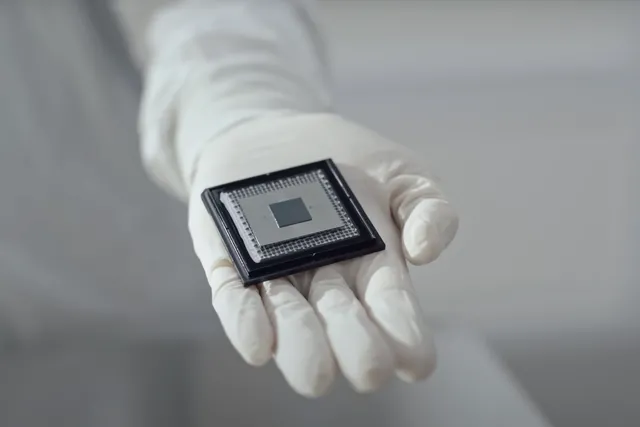

Google Unveils Revolutionary Chip Considered the Most Powerful in History. Experts Discuss Whether It Can Break Modern Cryptography and Transform Digital Security.
Quantum computers have long been pointed out as a potential threat to modern cryptography, but Google has made it clear that its new quantum chip Willow is still far from posing such a risk. In an interview with The Verge, Charina Chou, director and COO of Google Quantum AI, stated: “The Willow chip is not capable of breaking modern cryptography.”
What Is a CRQC?
A quantum computer capable of breaking modern cryptography is referred to as a CRQC (Cryptographically Relevant Quantum Computer).
This technology is considered a threat because it could compromise civilian and military communications, affect critical systems, and even undermine financial transactions online.
-
Pennsylvania Mine Creates Ice in Summer Heat and Melts in Winter, Turning a Mountain Crevice into a Reverse Natural Refrigerator

-
China Accelerates Global Expansion of Robotics: From Smart Vacuums to Industrial and Humanoid Machines, Millions Exported to Over 150 Markets
-
Polar Air Mass to Hit Brazil: Temperatures to Plummet in Nine States, Near Freezing in the South with Frost Risk Until Monday
-
Chinese “dark factories” produce electric cars 24/7 with minimal human intervention, as Zeekr assembles 800 units daily, raising concerns in Brazil.




In 2022, the White House recognized the potential risk of CRQCs and determined that U.S. agencies must adopt post-quantum cryptography (PQC) systems by 2035, to protect against possible advancements in this area.
Willow Is Far from Being a CRQC
Although Google claims that Willow is a significant advance in quantum computing, it does not qualify as a CRQC. According to Chou, the chip can solve in five minutes problems that would take the world’s fastest supercomputer billions of years.
However, with only 105 physical qubits available, it is far from reaching the millions of qubits necessary to break encryptions like RSA.
Google estimates that we are still at least 10 years away from developing a technology capable of breaking RSA, and that would require approximately 4 million physical qubits.
Chinese Researchers and RSA Cryptography
In recent years, Chinese researchers have claimed to have found methods to break RSA cryptography using smaller quantum computers with only hundreds or thousands of qubits.
However, security experts remain skeptical of these claims, highlighting the lack of practical evidence to support them.
Post-Quantum Cryptography
To defend against the potential threat of CRQCs, companies like Google are investing in post-quantum cryptography (PQC).
Since the Edward Snowden leaks revealed that the NSA was funding quantum research to decode codes, concerns about security have increased significantly.
In 2016, the National Institute of Standards and Technology (NIST) launched a competition to develop standards for secure quantum cryptography.
In August 2023, NIST finalized three algorithms and published the standards for integration into products and systems. The expectation is that more algorithms will be selected by the end of the year.
A Global Race for Security
The RAND Corporation highlighted in 2023 that the emergence of a CRQC would trigger a global race to upgrade communication systems.
As soon as the existence of this technology became public or plausible, organizations around the world would quickly adopt post-quantum cryptography to protect their information.
While the advancement of Willow represents a milestone in quantum computing, it does not significantly alter the timeline for the development of a CRQC.
For Google, the current focus is on strengthening security systems and preparing solutions that anticipate possible threats.
Meanwhile, modern cryptography remains secure, and the development of post-quantum security standards continues to be a priority for governments and companies worldwide.







Será 🤔 vamos aguardar