Portuguese
  Spanish


With a 45-year concession, Snake Island Port in Lagos will have a container terminal with a 910-meter quay, a 30-hectare yard, initial dredging of 16.5 meters, and expansion to 18 meters, in a project by MSC, Nigerdock, ITB, and DEME linked to an investment exceeding US$ 1 billion.
The Snake Island Port in Lagos entered a new phase after the MSC Group signed a 45-year concession with Nigerdock to develop a container terminal within the complex. The agreement also includes an engineering, procurement, and construction contract with ITB Nigeria Ltd. and the DEME Group.
The proposal by MSC aims at a logistical transformation in one of the most strategic regions of West Africa. The terminal is designed with a 910-meter quay, a 30-hectare yard, initial dredging of 16.5 meters, and the possibility of reaching 18 meters, allowing space for larger ships and more efficient operations.
Terminal in Lagos enters MSC’s billion-dollar strategy in Nigeria

The project is part of MSC Group’s investments in Nigeria’s infrastructure and logistics sector, totaling more than US$ 1 billion. The investment highlights the importance of Lagos as a maritime and commercial hub in a region with strong demand for cargo flow.
-
Brazil’s Port of Santos to Receive New $1.1 Billion Container Terminal, Tecon Santos 10, Set to Begin Operations in 2029

-
Ports without drivers and cabins already move containers like automated factories: robotic cranes, autonomous electric vehicles, and software transform giant terminals into 24-hour logistics machines.
-
About 300 American ports still breathe diesel from trucks, cranes, and locomotives, but they are now trying to electrify heavy machinery to clean the air for 31 million nearby residents.

-
A 220-meter giant powered in part by solar energy and lithium batteries has just unloaded nearly 5,000 Chinese cars at the Port of Itajaí. It is the first of ten Grimaldi super ships and the first in the world prepared to run on ammonia as fuel.


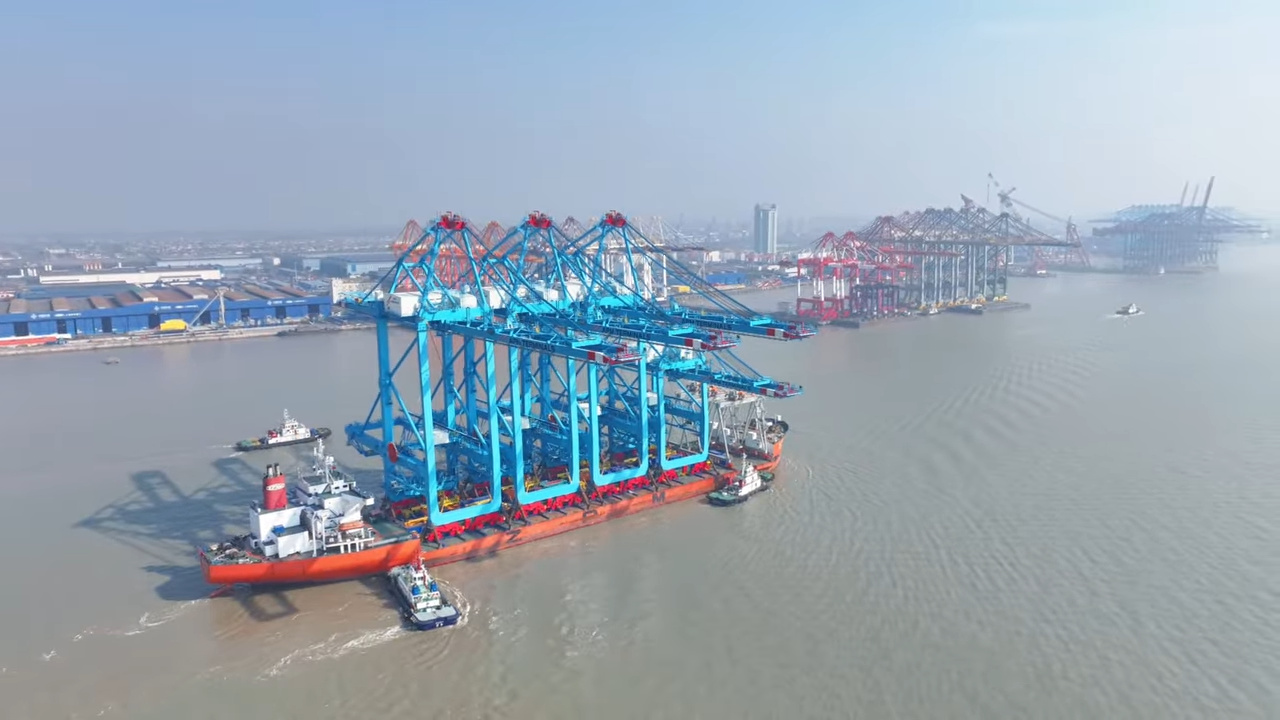


The new terminal will be built within Snake Island Port, known by the acronym SIP. The choice of the port in Lagos reinforces the city’s significance as a gateway for goods in one of the most relevant economies on the African continent.
The 45-year concession gives the project a long-term horizon. Instead of a one-off expansion, the initiative aims to structure a more robust logistical base, capable of serving importers, exporters, ocean-going vessels, and regional support operations.
In addition to MSC and Nigerdock, the EPC contract with ITB Nigeria Ltd. and the DEME Group indicates that the construction will involve companies specialized in heavy infrastructure execution. This format is essential in port projects that require dredging, quays, yards, and operational integration.
910-meter dock was designed for ocean-going ships and barges
The terminal will have a dock of 910 meters, a size that allows planning operations with different types of vessels. The structure was designed to accommodate Ship to Shore cranes, known as STS, and also Mobile Harbor Cranes, the MHCs.
These pieces of equipment are essential for moving containers with greater speed and predictability. In the case of Snake Island Port, the terminal is expected to serve both long-haul ships and barges, enhancing the connection between international maritime trade and regional distribution.
This combination of ocean-going ships and barges can make the port more flexible. In a region like Lagos, where logistics depend on integration between sea, yard, and internal transport, the ability to operate different flows can reduce bottlenecks and expand alternatives for cargo.
The design also indicates that the terminal was not just designed for the present. The scalable structure allows the port to prepare for larger vessels in the future, an important point in a naval industry increasingly pressured by scale, efficiency, and cost reduction per container.
Initial dredging of 16.5 meters can reach 18 meters

Depth is one of the most relevant points of the project. The terminal was designed considering an initial dredging of 16.5 meters, aligned with the existing depth of the navigation channel. This allows the new structure to be compatible with the operational conditions of maritime access.
MSC also foresees that the design is scalable to a final depth of 18 meters. In practice, this can allow the port to receive larger vessels, increasing its competitiveness on international container routes.
Deeper ports tend to operate larger ships with fewer cargo restrictions. When depth is limited, vessels may need to reduce weight, adjust scales, or rely on alternative terminals. Therefore, dredging is a decisive factor for the future role of Snake Island Port.
This type of intervention requires technical, environmental, and operational planning. Depth not only changes ship access; it also affects maneuvers, safety, channel maintenance, and how the terminal integrates with global maritime routes.
30-hectare yard increases container capacity
In addition to the quay and depth, the project includes a yard of 30 hectares. This area will be essential for storing, organizing, and moving containers before removal or shipment. In a modern terminal, the yard is as important as the berthing line.
The design also includes areas with potential for expansion and operation with hybrid Rubber Tired Gantries, the RTGs. These pieces of equipment are used for moving containers within the yard and can contribute to operational efficiency gains.
A port with a deep quay but insufficient yard would remain limited. Therefore, the 30-hectare area is crucial within the terminal’s strategy: it creates space to absorb volume, organize flows, and reduce internal congestion.
The use of hybrid RTGs also indicates a concern for more efficient operation. Although the source does not detail specific environmental goals for the terminal, the choice of this type of equipment suggests attention to operational performance and consumption during cargo movement.
Snake Island Port could gain weight as a global maritime hub

The MSC Group states that the initiative reflects confidence in Nigeria’s role in the region and its evolution as a maritime hub. This interpretation is important because Lagos already functions as one of the country’s main commercial centers, but still faces significant logistical challenges.
The new structure at Snake Island Port can increase the capacity to attract cargo, ships, and operators. If the terminal fulfills what has been designed, the port could gain strength as a connection point between Nigeria, West Africa, and global routes.
MSC’s scale also matters. The company is one of the leading global transport and logistics companies, with a presence in several countries and operating about 1,000 vessels. On the African continent, the company has been active for decades and maintains a network of offices in more than 45 countries.
This presence facilitates the integration of the new terminal into a larger logistics network. The project in Lagos is not isolated; it fits into an international network that involves navigation, ports, land transport, industrial clients, and import and export chains.
Investment promises jobs and increased local economic revenue
Diego Aponte, president of the MSC Group, stated that the advancement of the terminal with Nigerdock and partners demonstrates the company’s commitment to customers in Nigeria and across Africa. According to him, the structure should open opportunities, increase efficiency, and strengthen the Snake Island Port as a global maritime hub.
The expectation also involves the generation of local jobs and an increase in economic revenue. In large-scale port works, the impacts usually appear both in construction and future operation, involving engineering, transportation, maintenance, security, services, and logistics.
The MSC text highlights that the project adds to other long-term investments of the group in Nigeria. This reinforces that the terminal should not be seen just as a physical work, but as part of a larger business strategy in the country.
Even so, the result will depend on execution. Dredging, quay construction, yard implementation, equipment installation, integration with the channel, and operation with larger ships require technical coordination and delivery capacity within international standards.
Why the project draws attention outside Nigeria

The case draws attention because it combines three strong elements: long concession, billion-dollar investment, and large-scale port infrastructure. In a continent where logistical bottlenecks still limit part of the trade, a terminal of this size can have repercussions beyond Lagos.
Nigeria has a strategic position in West Africa, and Lagos concentrates intense economic activity. A deeper port more prepared for containers can help companies that depend on import, export, and regional distribution.
The possibility of receiving larger ships also changes the competitive reading. Terminals capable of operating large vessels can attract more efficient routes and reduce dependency on intermediate stops, provided that the land infrastructure keeps pace with this advancement.
The challenge will be to turn the port promise into real efficiency. A modern terminal needs to function both inside and outside the quay: access, storage, cargo release, internal transport, and logistical integration will be decisive in measuring the project’s impact.
New terminal can change the logistics scale of Lagos
A 45-year concession places Snake Island Port on a long-term development plan. The 910-meter terminal, planned depth, and 30-hectare yard indicate an attempt to reposition Lagos within African maritime logistics.
For MSC, the project expands its presence in a strategic market. For Nigeria, it could mean more port capacity, cargo attraction, and strengthening of foreign trade. For the region, the project could reinforce Lagos as a connection point between global ships and local chains.
The impact, however, will depend on execution, integration, and demand. Port projects of this scale are not sustained by engineering numbers alone; they need to deliver operational fluidity, predictability, and efficient connection with the real economy.
And you, do you think a port with a 910-meter quay and dredging for larger ships can transform Lagos into a stronger logistics hub in Africa, or can bottlenecks outside the terminal still limit this advancement? Share your opinion.