






 Portuguese
  Spanish


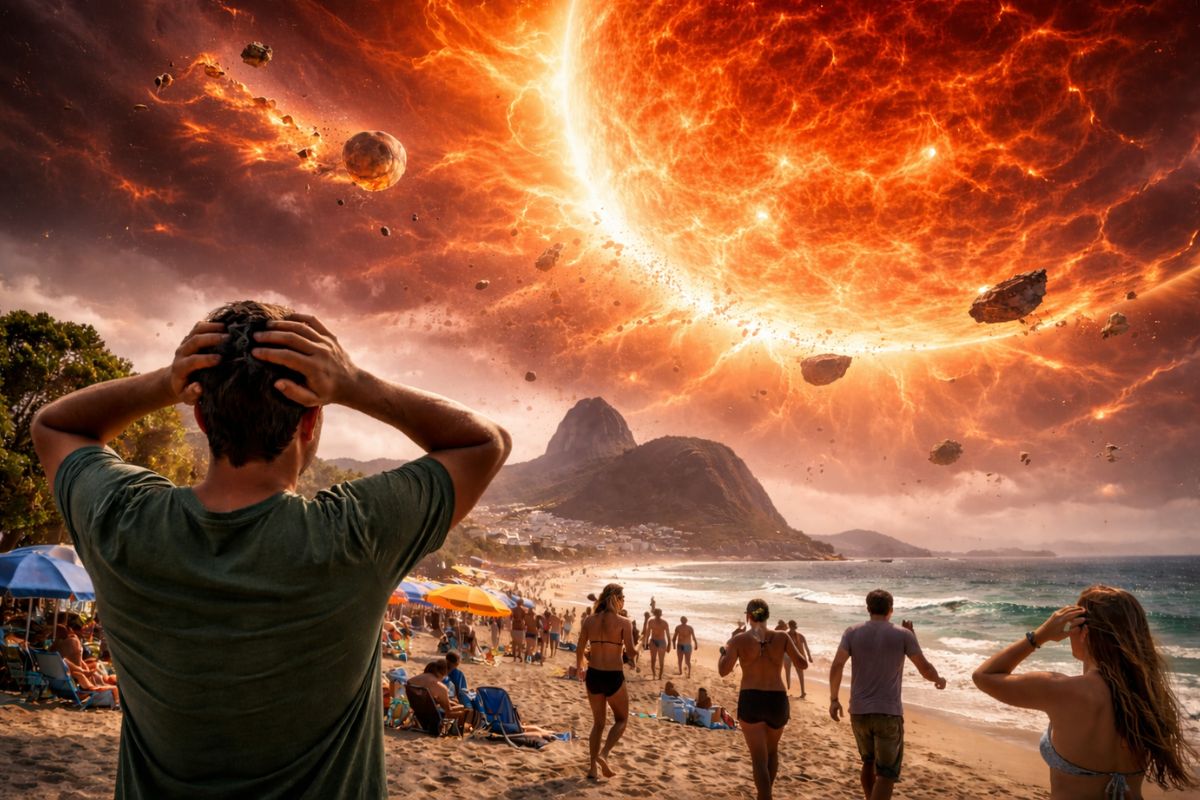


The Research of Scientists from the University of California Uses Hydrodynamic Simulations to Test Planetary Engulfment, a Scenario in Which the Sun, Upon Consuming the Hydrogen in Its Core, Becomes a Red Giant and Can Consume Mercury, Venus, and Possibly Earth in 5 Billion Years with Effects on Brightness for Millennia
In the debate about the planet’s fate, one point has become consensus within astronomy: the Sun does not remain stable forever. In this research, scientists from the University of California attempt to put numbers and physics in a scenario that is often treated as abstraction, planetary engulfment, and the message is clear: the cosmic clock does not stop.
The main calculation appears on a difficult-to-imagine scale, 5 billion years, but it has an immediate journalistic value. It helps understand why the Sun, over stellar evolution, can transform into a red giant capable of engulfing Mercury, Venus, and possibly Earth, also changing its own brightness for long periods and altering what is observed from afar.
What Is at Stake When It Comes to Planetary Engulfment
Planetary engulfment is the term given to the process in which a planet becomes enveloped by the outer atmosphere of its star.
-
Early Humans Made Beds Nearly 200,000 Years Ago in African Caves, Study Reveals

-
Japanese Smart Bike Detects Cyclist’s Intent to Turn and Potential Falls
-
METTL3 Protein Found to Play Crucial Role in Breast Cancer Metastasis, Surprising Scientists

-
Brazil’s Gaming Market Reaches $2.5 Billion, But Country Plays More Than It Produces


In the formulation used by scientists from the University of California, this comes into play when the Sun changes phase and begins expanding its outer layers, bringing the star’s limit closer to the nearest planets.
The term carries a special weight because it does not only describe a simple collision or instantaneous disappearance. It involves the transfer of energy between the star and the planet, friction and heating, with effects that can reshape the star’s behavior for some time.
This is why the research treats planetary engulfment as a dynamic event, not as a footnote detail.
When it is said that a planet can be engulfed, it is worth understanding the nuance: the star grows, the environment changes, and the planet begins to interact with a hot and dense medium.
The boundary between planet and star ceases to be a clean limit, and this intermediate zone is what hydrodynamic simulations attempt to represent.
Why the Sun Can Become a Red Giant
The central trigger is the exhaustion of hydrogen in the Sun’s core.
When this fuel runs out, the Sun enters a different evolutionary stage, and the most commonly used technical term for this phase is red giant, marked by expansion and changes in the internal balance of the star.
This means that the structure of the Sun ceases to be what we know today.
The research describes a process capable of provoking drastic changes in structure and brightness because the star begins to redistribute energy and matter on a large scale.
It is at this point that the phrase becomes concrete: the Sun becoming a red giant means having a much larger outer atmosphere than the current one, with a direct impact on Mercury and Venus and, ultimately, Earth.
The idea is not an immediate shock but a predictable physical change within the stellar life cycle.
How Hydrodynamic Simulations Attempt to Reproduce This Future
The cited study works with hydrodynamic simulations, a type of modeling that tries to reproduce the behavior of materials and gases under extreme conditions, such as those of an expanding star.
The proposal is to understand in more detail how the interaction with a planet can accelerate or modify stages of planetary engulfment.
These simulations are used because the phenomenon mixes gravity, heating, and gas movement, all at the same time.
Instead of treating the planet as a point and the star as an ideal sphere, the modeling attempts to capture the physics of the interaction, layer by layer, as a continuous process.
In practice, the simulation seeks to capture what happens when a planet begins to transfer energy to the Sun and, at the same time, suffers from the hot and dense environment of the outer layers.
The crucial point, emphasized in the research, is that planetary engulfment does not depend only on the star but also on the mass of the engulfed planet and the evolutionary stage of the Sun.
Mercury, Venus, and the Doubt that Remains About Earth
The scenario highlighted by scientists from the University of California places Mercury and Venus as direct candidates to be engulfed when the Sun becomes a red giant.
Earth appears as a possibility, not a certainty, and this distinction changes the tone of the debate about 5 billion years.
The word possibly matters because, in this type of simulation, the result depends on how the star-planet interaction evolves over time.
A detail of dynamics and energy can push the system toward different paths, and that is why the study avoids absolute certainties about Earth.
Even so, the projection has a symbolic effect because Earth is about 4.5 billion years old. This places the discussion on a continuous timeline: a planet with billions of years of history may, in billions of years, face the final phase of its star.
On a human scale, all of this is unattainable; on a cosmic scale, it is a relatively short interval.
What Happens to Brightness When a Planet Is Engulfed
The simulations indicate that engulfed planets undergo profound changes due to the energy exchanged with the Sun.
Depending on size and composition, the effect can vary, and the research points out that the interaction between the star and the engulfed planet may result in an increase in the Sun’s brightness for thousands of years.
This part of the study matters because it provides a type of observable signature.
If brightness changes over a prolonged period, astronomers may better interpret signals from other stars that are in similar evolutionary phases, with varied planetary systems.
The leadership of the work is attributed to Ricardo Yarza, and the emphasis lies in the idea that evolved stars may increase brightness according to the mass of the engulfed planet and the evolutionary stage of the Sun.
Planetary engulfment, in this framework, ceases to be just a fate and also becomes a mechanism capable of altering what is seen in the sky.
Why Speaking of 5 Billion Years Still Affects the Present
The distance of the timeframe often anesthetizes. However, by placing 5 billion years as a reference, scientists from the University of California shed light on a fact that rarely enters everyday conversation: the Sun is an evolving system, and the current stability is just a phase.
The research also connects to a larger effort to understand how stars change and how planets survive, migrate, or disappear over time.
The study mentions that observations of various planetary systems help predict variations in stellar behavior and their possible consequences.
At its core, the discussion is less about fear and more about understanding Earth’s place in a vast universe. When the term planetary engulfment arises, it carries a harsh reminder: the conditions that allow oceans, atmosphere, and life depend on a star that is also changing.
In 5 billion years, the Sun becoming a red giant may be the chapter that concludes the story of the inner planets.
Science is often accused of looking too far ahead, but here the technical detail has a simple effect: it helps understand what the Sun may become and why planetary engulfment has become a topic of hydrodynamic simulations.
If the timeframe is 5 billion years, the immediate impact lies in how we think about Earth and the fragility of the scenario that seems permanent.
In the end, the question is not when this will happen, because the number is already set, but what this idea provokes today. Do you think the Sun becoming a red giant is an inevitable fate for the inner planets, or does the hypothesis of Earth escaping still make sense to you? What evidence, or what discovery, would truly change your mind?




Eu aprendi a confiar em Deus;mas os homens tem também a capacidade de estudar e prever um possível problema antes do acontecimento,o que foi escrito anteriormente pelos profetas, assim como os cientistas que a meu modo de ver também são profetas! Então tudo está nas mãos de Deus…
Trump ainda vai acabar iniciando uma terceira guerra mundial
Porque temeis, o que estiver que acontecer, acontecerá, seja feita a vontade de Deus.