Portuguese
  Spanish


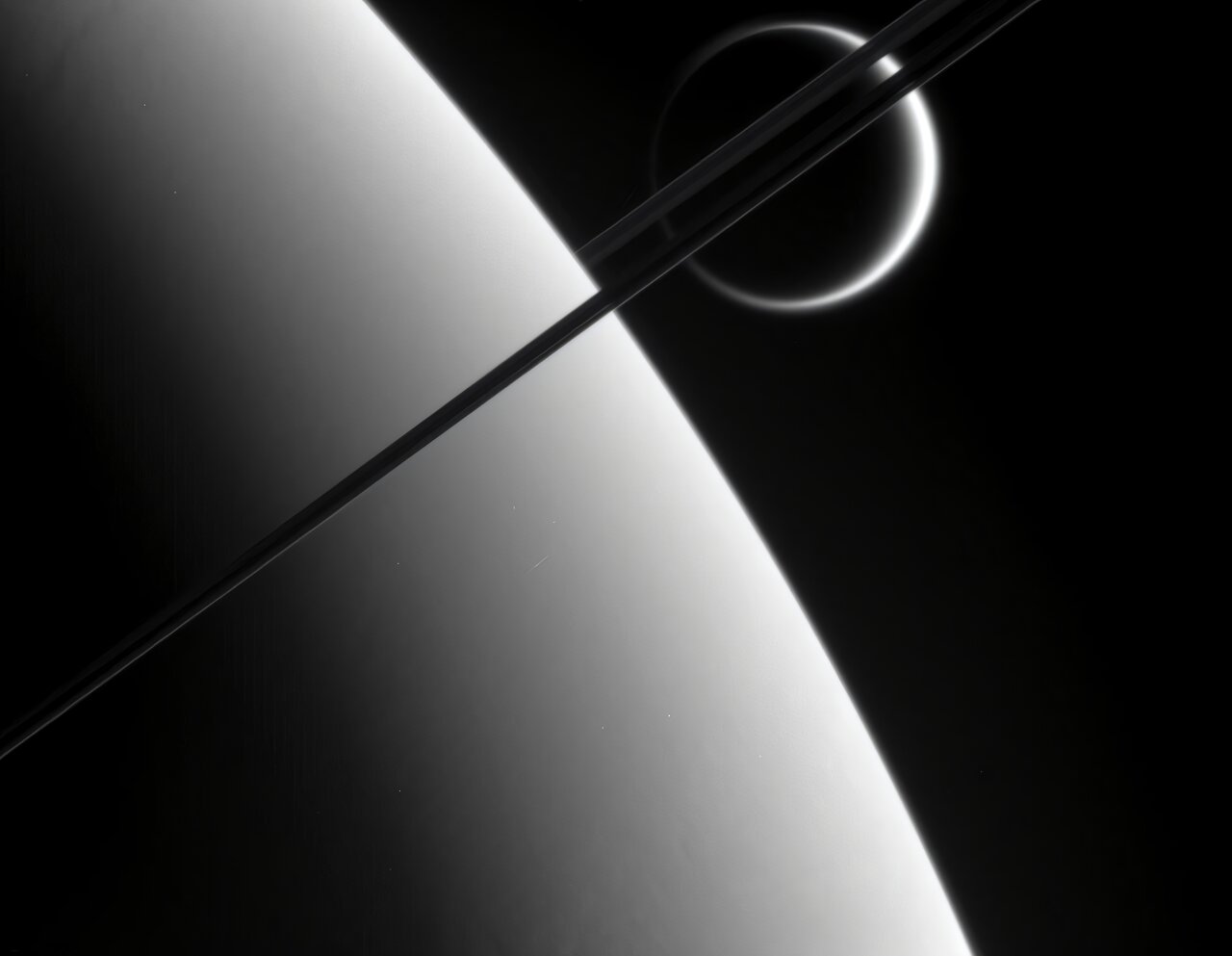


Study Led by the SETI Institute Uses Computational Simulations and Data from the Cassini Mission to Indicate That Titan, Saturn’s Moon, May Have Formed from the Merging of Two Ancient Moons in an Event Associated with the Formation of the Rings Estimated to Be Around 100 Million Years Old
Titan, Saturn’s moon, may have formed from the merging of two ancient moons, according to a study led by the SETI Institute and accepted in the Planetary Science Journal, which also links the event to the origin of the rings estimated to be around 100 million years old.
Recent research suggests that Saturn’s bright rings and its largest moon may have originated from collisions between moons in the system. Although the 13 years of the Cassini mission expanded knowledge about the planet, new measurements have raised questions about the age of the rings and Titan’s orbit.
The work is led by scientist Matija Ćuk from the SETI Institute. The research has been accepted for publication in the Planetary Science Journal, and the preliminary version is available on the arXiv server under DOI 10.48550/arxiv.2602.09281.
-
A young Kenyan engineer collects plastic waste from the streets and transforms it into robots that translate physics lessons into sign language in real-time, a machine made with old bottles that teaches what was missing to deaf children left out of science.

-
What is the dark substance found in the sand of Ipanema Beach? Civil Police conduct an examination, collect samples of the material, and initiate an investigation to identify the composition, clarify the origin, and verify if there was an environmental crime.
-
The beer that was hidden for 3,000 years has returned to the world: scientists find yeast preserved in Ancient Egyptian vessels and recreate a pharaoh’s drink to discover the lost taste of an ancient civilization.
-
NASA spotted a giant “surfboard” crossing the Moon’s orbit at 11,500 km/h, and the truth behind the mysterious object required a 0.338 millisecond photo to be revealed.




Saturn’s Moon and the Hypothesis of the Merging of Two Ancient Moons
The study proposes that Titan, Saturn’s moon, is the result of the merging between a proto-Titan, nearly as large as the current moon, and a smaller proto-Hyperion. This hypothesis connects the formation of the moons to the origin of the planet’s rings.
Near the end of the mission, Cassini measured the internal mass distribution of Saturn, responsible for governing the slow precession of the planet’s rotation axis. For decades, it was believed that Saturn’s precession period coincided with that of Neptune.
This coincidence would allow gravitational interactions between Saturn and Neptune to gradually tilt the planet, making its rings distinctly visible. However, Cassini’s final trajectory indicated that mass is more concentrated in the center than previously thought.
As a result, the precession rate no longer corresponded to that of Neptune. To explain the deviation, researchers from MIT and UC Berkeley suggested that Saturn may have had an extra moon, which was subsequently ejected after an approach with Titan and fragmented to form the rings.
Simulations Point to Collision with Titan and the Role of Hyperion
The SETI Institute team used computational simulations to evaluate whether an extra moon could approach Saturn enough to form the rings. The most probable outcome pointed to a collision between this moon and Titan.
Hyperion, a small and irregular moon of Saturn, has a synchronized orbit with Titan. According to Ćuk, simulations showed that when the extra moon became unstable, Hyperion frequently got lost, surviving only in rare cases.
The researchers concluded that the Titan-Hyperion coupling is relatively recent, with some hundreds of millions of years. This period coincides with the disappearance of the extra moon, suggesting that Hyperion may have formed from fragments generated in the merge.
If the extra moon merged with Titan, the fragments would have been produced near Titan’s orbit. It is in this region that Hyperion would have formed, according to the simulations presented in the study.
Consequences for the Orbit, Craters, and Inclination of Iapetus
The model indicates that the merge erased much of the impact craters on Titan. This would explain the reduced number of craters currently observed on Saturn’s moon.
Titan’s eccentric orbit, which is becoming more circular quickly, also suggests a recent disturbance associated with proto-Hyperion. Before the merge, Proto-Titan could have resembled Callisto, from Jupiter, with craters and no atmosphere.
The team also identified that Proto-Hyperion inclined Iapetus’s orbit before disappearing. This effect would help solve a long-standing mystery about the tilt of Saturn’s distant moon.
These elements reinforce the idea that the system underwent a two-stage instability involving ejection, merging, and orbital reorganization.
Formation of the Rings and Orbital Resonance
The origin of the rings is also linked to collisions between medium-sized moons close to Saturn. Members of the SETI Institute team had proposed this hypothesis over ten years ago.
Simulations from the University of Edinburgh and NASA’s Ames Research Center corroborated the idea. The results showed that most debris would regroup to form new moons, while a fraction would be scattered inward, creating the rings.
For years, it was believed that the collision between inner moons was triggered by the Sun. New research indicates that the process is more related to merging with Titan and the orbital evolution of Saturn’s moon.
Titan’s eccentric orbit can destabilize inner moons when their orbital periods become a fraction of Titan’s period, in a phenomenon called orbital resonance. In this scenario, the orbits align, and the gravitational influence increases.
The expansion of Titan’s orbit may occasionally create these proportions. The outcome for smaller moons can be catastrophic, causing orbital stretching and collisions between neighbors, generating debris.
Although the exact timing of this second cataclysm is not defined, it likely occurred after Titan’s merge. This is compatible with the estimated age of the rings, around 100 million years.
Dragonfly Mission May Test the Hypothesis in 2034
The NASA Dragonfly mission is expected to reach Titan in 2034. The nuclear-powered octacopter will analyze the geology and chemistry of the surface of Saturn’s moon.
The mission may identify evidence that Titan resulted from a massive collision with another moon half a billion years ago. If confirmed, the hypothesis would reinforce the scenario that the Saturnian system underwent recent violent events.
The pre-publication of the study, titled “Origin of Hyperion and the Rings of Saturn in a Two-Stage Instability of the Saturnian System,” was made available in 2026 on arXiv. The work details the simulations and the dynamic scenarios analyzed.
According to the authors, Saturn’s moon may have been shaped by processes of orbital instability and merging, altering the understanding of the evolution of its rings and its inner moons.
This article was prepared based on a study led by Matija Ćuk of the SETI Institute, accepted for publication in the Planetary Science Journal, and made available in pre-publication on arXiv (2026), under DOI: 10.48550/arxiv.2602.09281.