Portuguese
  Spanish


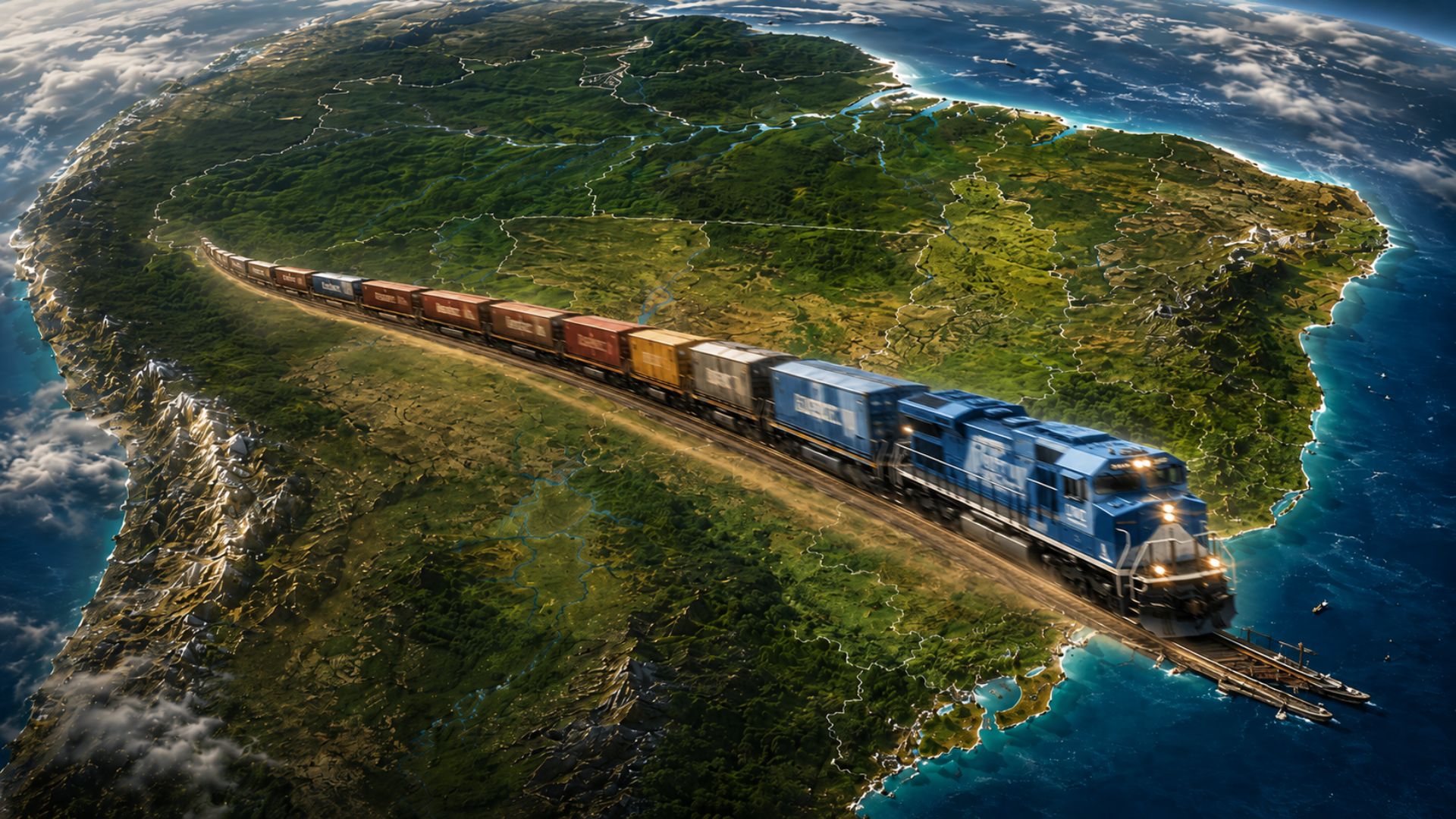

The public contribution, however, is just the tip of a much larger project: the concession foresees around R$ 89.2 billion over 57 years. And there is a strict condition, the federal money only comes out if the winner operates the entire stretch to São Paulo. The line was abandoned by Rumo, whose 1996 contract now expires in June 2026.
The Union will contribute R$ 3.6 billion to revive the Malha Oeste, a 1,625-kilometer railway now practically abandoned that connects Corumbá, in Mato Grosso do Sul, to Mairinque, in the interior of São Paulo. The resource is part of a new concession project recently approved by the National Land Transport Agency, ANTT, which promises to reconnect the Midwest to the Port of Santos and the borders with Bolivia and Paraguay.
The approval of the technical studies, legal documents, and the Grant Plan took place on May 21, 2026, during a meeting of the ANTT board. Now, the Malha Oeste project moves on to analysis by the Ministry of Transport and the Federal Court of Accounts, TCU, before the auction, scheduled for the second half of this year. The railway is seen as a logistical corridor strategic for the flow of production from the Brazilian Midwest.
What is the Malha Oeste and why it matters

With about 1,625 kilometers in length, the Malha Oeste cuts through Mato Grosso do Sul and São Paulo, passing through cities like Campo Grande and Três Lagoas, and connects Corumbá to Mairinque. Due to its geographical position, the line functions as a corridor for cargo transport from the Midwest and as a commercial link with two neighboring countries, Bolivia and Paraguay, which gives it great strategic value.
-
Brazil’s Defunct Railway Network Leaves Over 100,000 Properties Abandoned for Nearly 30 Years, Facing Neglect and Safety Risks as Government Struggles to Regulate Assets Amid Degraded Stations and Unlawful Use

-
Belo Horizonte’s Beltway Project Risks Losing $5 Billion to Metro Expansion if Court Doesn’t Act Soon; State Government Plans New Lines with IDB Support

-
Brazil to Auction 9,000 km of New Railways, Aiming to Attract $28 Billion by 2026

-
Brazil Plans $160 Billion Investment to Revitalize Railways and Reduce Reliance on Long-Distance Trucking


The project foresees the connection of the tracks with the Port of Santos, the largest in Latin America, and also mentions a possible future integration with the ports of Rio de Janeiro and Espírito Santo through the Ferroanel, a project that could be executed as a complementary investment. The contract also establishes that the winning company may take over the Ponta Porã Branch, but at its own financial risk.
The R$ 3.6 billion from the Union and its conditions

To provide predictability to public accounts and ensure the continuity of works, these transfers will be made annually and in stages, with a ceiling of R$ 500 million per year, in as many installments as necessary until reaching the total amount.
However, there is an important condition attached to this money. The federal contribution will only be released if the concessionaire modernizes and operates the entire section, between Corumbá and Mairinque, or up to Bauru, also in São Paulo. If the company decides to explore only the shorter and more profitable section, between Corumbá and Três Lagoas, there will be no release of public funds, in a mechanism that seeks to prevent the winner from keeping only the most lucrative part of the network.
The number that goes beyond the contribution: R$ 89 billion
Here is a point that deserves attention to avoid confusion. The R$ 3.6 billion is just the portion that the Union puts in to recover the network, and not the total value of the project. According to the concession studies, the investment planned over the entire contract amounts to about R$ 89.2 billion, distributed over 57 years, in one of the largest railway proposals ever structured in the country.
This billion-dollar amount is divided into two major fronts: approximately R$ 35.7 billion in infrastructure, such as tracks, locomotives, wagons, and buildings, and about R$ 53.5 billion in operationalization, which includes maintenance and vehicles over the decades. To support these commitments, the future concessionaire may rely on BNDES financing of up to 80% of the investments, which helps to make a project of this magnitude feasible.
A railway abandoned by Rumo
The current state of the Malha Oeste explains why recovery is so necessary. The railway was being operated by Rumo, whose concession contract, signed back in 1996, expires in mid-2026. In recent years, however, the company has practically abandoned the line, ceasing to maintain and transport cargo on most of the route, which is now degraded and unused in several sections.
Currently, the operation is only viable in specific sections, linked to the transportation of ore in the Corumbá region and cellulose in Três Lagoas. In 2025, Rumo attempted to reach an agreement to renegotiate the concession and return part of the railway, but the TCU vetoed the proposal, understanding that the project required a complete overhaul compared to the original 1996 contract. It was from this veto that the government began to structure the new auction.
The uncertainty that still hangs over the auction
Despite the progress, an important question remains open and could define the success of the project. The Ministry of Transport has not yet decided whether to auction the entire West Network at once or to divide it into three distinct sections, in an attempt to attract more investors. The division could make parts of the railway more attractive, but raises the question of who would be interested in the less profitable sections.
There is also another significant challenge for the future operator: the construction of the São Paulo Ferroanel, a railway bypass estimated at around R$ 6 billion. Add to this the race against time, as the current contract with Rumo ends in June 2026, and the government needs to avoid the service being left without a defined operator. These are uncertainties that still need to be resolved before the railway can actually resume operations.
The new concession of the West Network represents an ambitious attempt to resurrect a strategic railway corridor that had been forgotten, reconnecting the Midwest to ports and South American borders. With Union support, planned billion-dollar investments, and the promise of taking cargo off the highways, the project has the potential to transform the region’s logistics. Now it remains to overcome the stages in the Ministry of Transport and the TCU, define the auction format, and finally find someone willing to invest in the revival of the tracks.
Do you believe that the West Network will indeed come to fruition this time and resume transporting cargo between Mato Grosso do Sul and São Paulo? Do you think the public investment of R$ 3.6 billion is justified to recover the railway? Leave your comment, share your thoughts on railway investment in Brazil, and share the article with those who follow logistics, infrastructure, and agribusiness in the Midwest.