





 Portuguese
  English
  Spanish
  4 min of reading
  0 comments


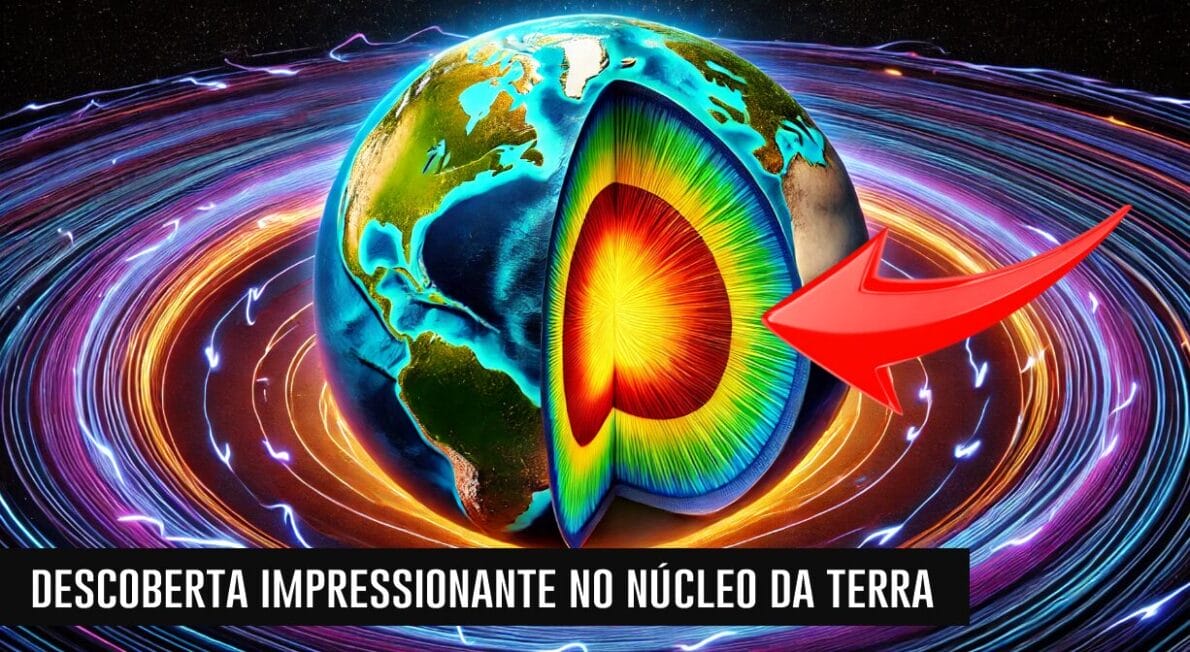
The Earth’s Core, More Than 5,100 Km Deep, Is Finally Being Unveiled by Physicists. Learn More About the Discoveries That Are Revealing Hidden Secrets of the Heart of Our Planet.
At 5,100 km deep, at the center of our planet, lies the Earth’s core, a solid sphere primarily composed of iron and nickel.
This unknown part of the planet plays a vital role in maintaining conditions on the surface, including the creation of the magnetic field that protects us from solar radiation. Without it, life on Earth might never have existed.
Despite the importance of the inner core, many mysteries regarding its formation and age remain unanswered. Now, mineral physics is helping us get closer to solving this puzzle.
-
Government releases new shoulder function on roads: side lane gains solar plants capable of supplying 100% of road operation using tolls, roofs, and technical areas without altering the asphalt in Kiato, Greece

-
Capable of hitting vessels hundreds of kilometers away at supersonic speed and drastically reducing enemy reaction time, the BrahMos arrives in Vietnam under an agreement that includes pilot training by India and aims to create a deterrent arc in front of the disputed islands with China.
-
Influencer reports alleged UFO sighting in Paraná, goes viral with millions of views, and says he lives between fascination and fear after mysterious phenomenon

-
Sedentary lifestyle advances silently in Brazil while millions ignore one of the biggest risk factors for cancer and other serious diseases.




CC BY-SA )
The Role of the Earth’s Core in the Magnetic Field
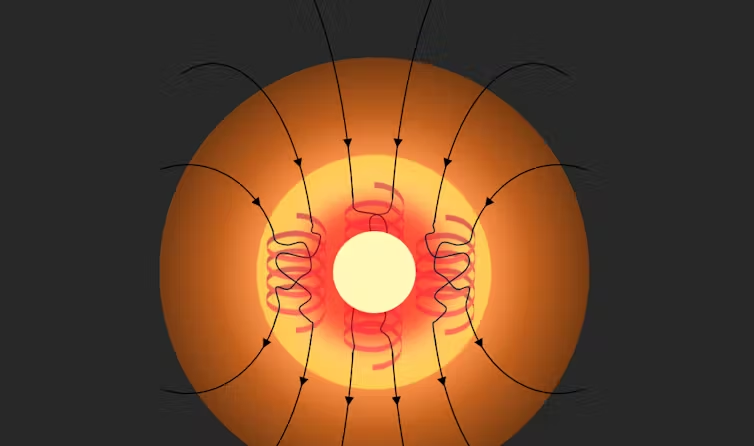
The inner core, essential for the formation of the Earth’s magnetic field, which acts as a protective shield against solar radiation, may have been fundamental in creating the conditions that allowed life to emerge and prosper billions of years ago.
What we know is that the inner core was not always solid. Initially, it was liquid, but as the Earth cooled over billions of years, the core began to solidify, expanding outward.
This transformation released elements like oxygen and carbon, which cannot remain in a hot solid state.
These elements create a buoyant liquid at the bottom of the outer core. The liquid then mixes with the liquid outer core, generating electrical currents and, through the dynamo effect, creates the magnetic field that protects the planet.
This magnetic field not only prevents harmful solar radiation from reaching the Earth’s surface but is also responsible for phenomena like the auroras — the northern lights that shine in the sky thanks to the functioning of this invisible dynamo at the heart of our planet.
The Crystallization Process of the Core
Understanding how the magnetic field evolved throughout Earth’s history depends on simulating the thermal state of the core and mantle. These models help geophysicists understand how heat is distributed and transferred within the Earth.
The current consensus is that the solid inner core emerged when the liquid surrounding it cooled to its melting point and began to freeze. However, this freezing process is not as simple as it seems.
Scientists have explored the concept of “supercooling,” a phenomenon that occurs when a liquid is cooled below its freezing point without becoming a solid. This occurs with water in the atmosphere, which can reach temperatures of -30°C before turning into hail, and it also happens with iron in the Earth’s core.
Theoretical models suggest that about 1,000 Kelvin of supercooling is required to freeze pure iron in the core. However, the cooling rate of the core, being approximately 100 to 200 Kelvin per billion years, makes this scenario highly unlikely.
If the core had been supercooled by 1,000 Kelvin, the inner core should be much larger than it is today. On the other hand, if this temperature was never reached, the inner core might not even exist.
Recent Advances and Physical Opportunities
To resolve this paradox, mineral physicists are conducting experiments with pure iron and mixtures of other elements to determine the level of supercooling needed to initiate the formation of the inner core. While studies are still ongoing, significant advances are being made.
One of the most recent discoveries suggests that the presence of carbon and unusual crystal structures may reduce the need for excessive supercooling.
This indicates that the chemical composition of the core may play a more important role than previously thought in the solidification process.
If the inner core was able to form with less than 400 Kelvin of supercooling, it could explain why the inner core exists in the form we see today.
The Impact of Not Understanding the Inner Core
Understanding the formation of the inner core has significant implications. Previous estimates suggest that the inner core is between 500 and 1,000 million years old, but these assumptions did not take into account the phenomenon of supercooling.
If we consider even a modest supercooling of 100 Kelvin, it could mean that the inner core is much younger than we previously believed, possibly several hundred million years younger.
These questions are not only relevant for understanding the Earth as a whole but could also have implications for scientists studying the relationship between the magnetic field and mass extinction events in the paleomagnetic record.
Until we can fully understand the history of the Earth’s magnetic field, it will be difficult to accurately assess its role in creating conditions favorable for life on the planet.
The study of the Earth’s inner core is still in its early stages, and much remains to be discovered.
Through advances in mineral physics and geophysical models, we are beginning to unveil how the inner core formed and how it shaped the magnetic field that protects our planet to this day.
While many questions still need answers, each new discovery brings us closer to understanding the mysteries of the Earth’s heart and the vital role the inner core plays in the habitability of our world.






Be the first to react!