





 Portuguese
  English
  Spanish
  5 min of reading
  0 comments


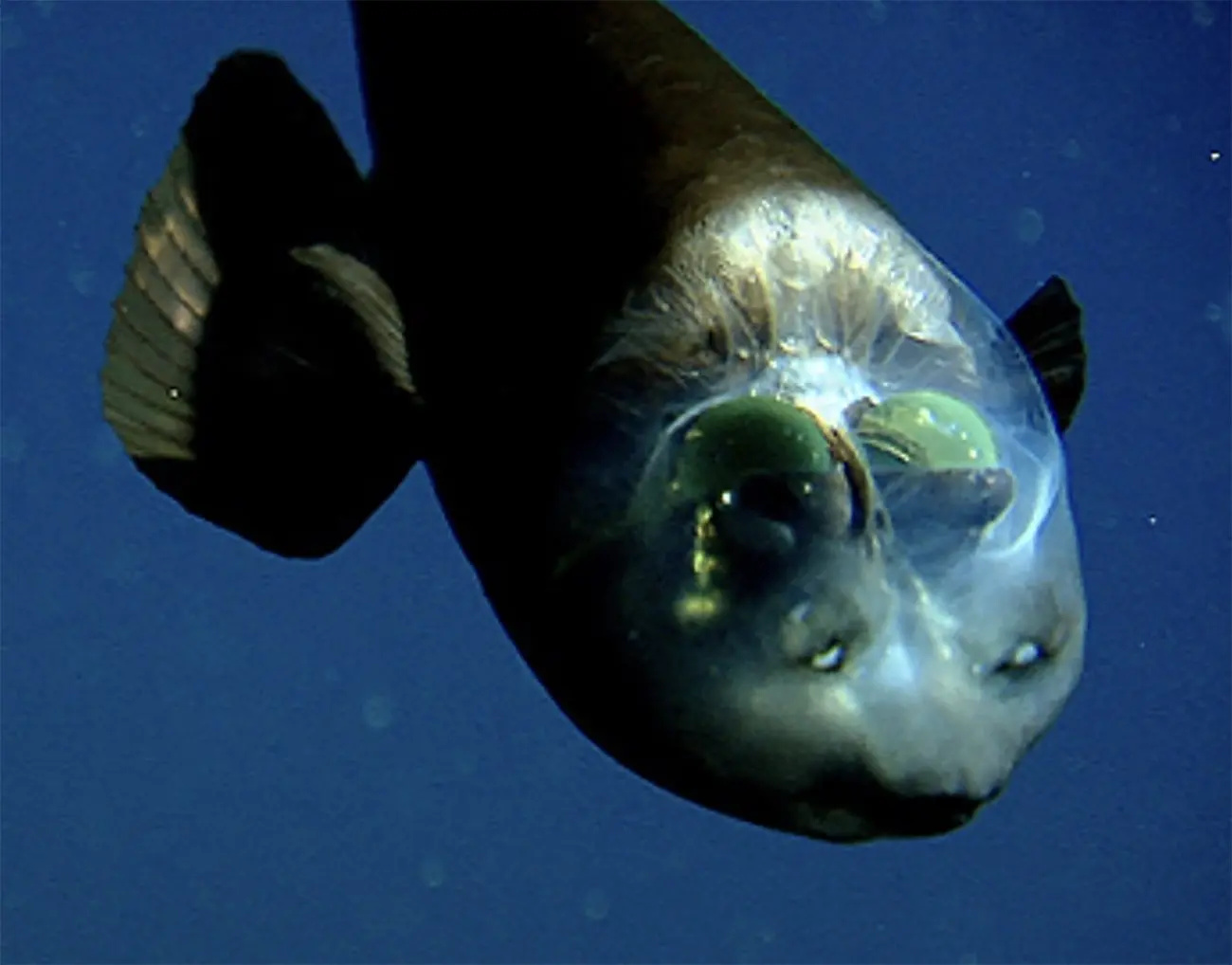
Macropinna Microstoma Fish Filmed at 650 Meters Has a Transparent Head and Tubular Eyes That Rotate, Revealing Extreme Adaptations to Oceanic Darkness.
The deep ocean is the largest unexplored environment on the planet. It is estimated that more than 80% of its volume has not yet been directly visualized by humans. In this hidden world, illuminated only by flashes of bioluminescence and filtered by kilometers of water, creatures so improbable emerge that they seem to have come out of science fiction. In one of these recent expeditions, researchers recorded a fish with a transparent head and eyes that rotate within the skull like periscopes at a depth of approximately 650 meters. The animal, known as Macropinna microstoma, reveals a visual system so specialized that it is rewriting our understanding of how life sees in the dark of the ocean.
Few people know, but this fish has been known to science since 1939, although only as dead specimens that had been damaged by nets. It was only with the use of remotely operated submarines that it was possible to film it alive in its natural habitat, capturing anatomical details that changed everything thought about it.
Macropinna Microstoma: The Deep-Sea Fish with a Transparent Head
The Macropinna microstoma belongs to the Opistoproctidae family, a group of fish adapted to extremely deep ocean zones. Its most striking feature is the transparent skull, which acts as a sort of fluid dome, allowing internal structures to be exposed to external view.
-
Colombian creates a machine that mimics human lungs, captures CO₂, nitrogen dioxide, and sulfur dioxide from the air, and transforms pollution into biodegradable raw material for bags, packaging, and coatings.

-
Lake Erie began to turn green, and NASA satellites revealed a stain that doubled in a few days: it was neither paint nor dirt, but something gigantic advancing over one of the largest lakes in North America.
-
Nicknamed Pemba, a humanoid robot from Unitree braved the extreme cold and altitude to reach the summit of the Chimborazo volcano at over 6,000 meters, with an eye on Everest, even though it had to be carried by the team on the steepest parts of the ascent.
-
Government authorizes and state acquires first machine guns in history: Israeli weapons used in more than 60 countries arrive with a record package of R$ 338 million, 3,200 weapons, 1,245 vehicles, and armored vehicles for special operations.




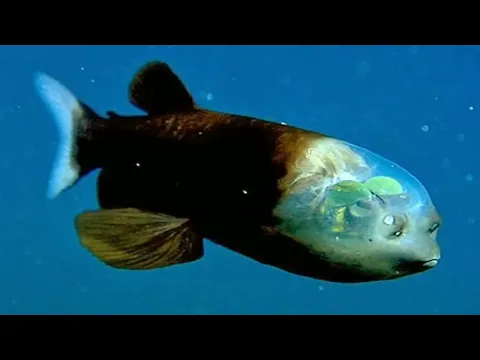
Inside this cranial dome, the eyes are large green cylinders facing upward, capable of pivoting forward when the animal decides to capture prey.


What makes this impressive is that, for decades, it was believed that the small black spots on the front of the face were the eyes. In fact, they are olfactory organs. The true eyes were hidden within the translucent head, protected by a gelatinous fluid.
This extreme adaptation is not an evolutionary whim but a direct response to the environment. At depths of over 2,000 to 3,000 meters, sunlight does not reach.
The remaining light comes from bioluminescent animals, such as jellyfish, copepods, and lanternfish. To locate prey, the Macropinna needs maximum sensitivity, and its tubular eyes function as photon collectors, filtering green light to distinguish faint silhouettes above it.
Depth, Bioluminescence, and the Evolution of an Extreme Visual System
The depth at which this fish lives, between 600 and 850 meters, according to records from NOAA and MBARI, occupies the so-called mesopelagic and bathypelagic zones, where the scarcity of energy shapes life in radical ways.
In this environment, organisms need to:
- conserve movement
- maximize photon capture
- avoid invisible predators
- detect prey with minimal light
This is why many exhibit large eyes, transparent bodies, and specialized pigments. In the case of Macropinna, the green pigments in the eyes serve to block diffuse brightness and highlight direct bioluminescent emissions, allowing them to distinguish prey such as siphonophores and small crustaceans.
Another peculiarity is the rotational field of vision. While most fish have laterally positioned eyes, this one can point them upwards to locate silhouettes and turn them forward to attack. This versatility is a fine adjustment between perception and predation, functioning almost like an optical camera mechanism.
The Filming That Changed Understanding of the Species
Although described over 80 years ago, Macropinna remained an enigma until the first high-depth filmings, conducted by remotely operated vehicles (ROVs) from institutions such as MBARI — Monterey Bay Aquarium Research Institute in California.
These filmings revealed unprecedented details:
- the transparent skull filled with fluid
- the upward-oriented green cylindrical eyes
- the rotational movement of the eyeballs
- the static behavior near siphonophore colonies
The behavior is especially fascinating. Instead of chasing prey, the Macropinna hovers almost motionless, using its pectoral fins as stabilizers. From this position, it scans the environment and makes quick strikes when it identifies prey caught by the stinging tentacles of siphonophores, a way of “taking advantage” of the work of the gelatinous colony without suffering its damage.
The filming also confirmed that the transparent dome protects the eyes from poison and stinging tentacles of these organisms, something that could not be deduced from the analysis of preserved bodies alone.
Why This Fish Challenges Knowledge About the Deep Ocean
The scientific importance of Macropinna lies not only in its bizarre aesthetics but in what it represents for the evolution of vision and for the ecology of the depths.
First, it demonstrates that evolution can create highly refined optical systems far from sunlight. Second, it shows that transparency — common in small organisms — can also arise in larger vertebrates as a defensive and sensory strategy. Third, it exposes how the food web of the depths is complex, involving interactions between gelatinous organisms, crustaceans, and specialized fish.
Finally, it reinforces a fundamental point: we are still far from understanding deep ocean biodiversity. Many estimates indicate that over a million marine species have yet to be described, especially in the abyssal zones.
Life in the Dark: An Ongoing Evolutionary Laboratory
The Macropinna microstoma is just one example of how life finds radical solutions to physiological problems. Other fish have developed:
- chemical lanterns
- expansive jaws
- telescopic mouths
- translucent teeth
- bioluminescent camouflage
These adaptations transform the deep ocean into an evolutionary laboratory, where extreme environmental pressures create organisms that defy human expectations.
The case of Macropinna reinforces that we do not know only a little but perhaps almost nothing about the planet’s vast ecosystems. It is no exaggeration to say that every expedition with robots brings new species, new behaviors, or new ideas about evolution.
The fish with a transparent head and eyes that function like periscopes is not just a visual curiosity; it is a reminder that the Earth holds deep mysteries just a few kilometers below the surface. While telescopes observe galaxies, ROVs and submersibles unveil an equally unknown internal universe.
And in the face of creatures like Macropinna microstoma, the question that remains is simple and powerful: if this exists at the bottom of the ocean, what else have we not yet seen?





-

-

-

-

-

-

39 people reacted to this.