Portuguese
  Spanish


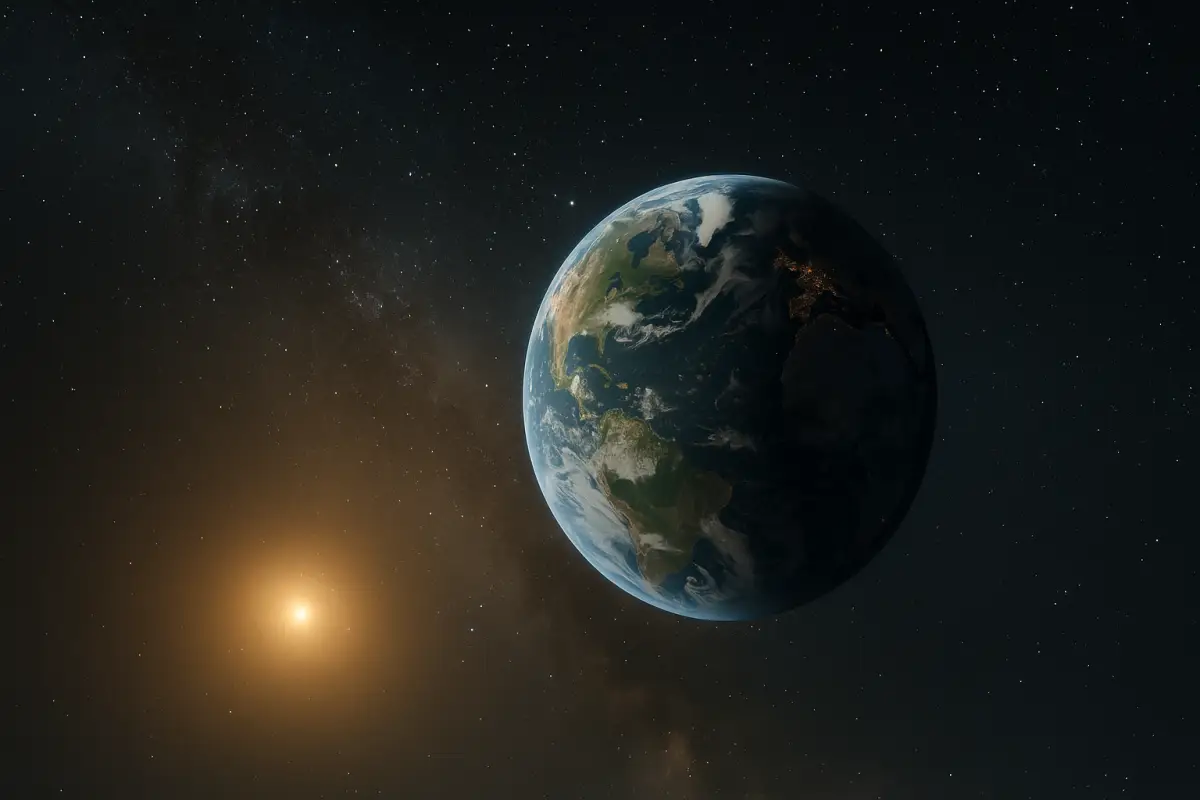

Can Earth Be Ejected from the Solar System? New Study Reveals a Disturbing Future for the Planets
Imagine looking up at the sky billions of years from now and realizing that planet Earth is no longer part of the solar system. It sounds like science fiction, but this is a real possibility, pointed out by scientists in a study that has just gained prominence. During the long journey we make through the galaxy, our system periodically passes through regions where other stars cross its path. And these visits, even from afar, can completely disrupt the order of the planets around the Sun.
A team of researchers decided to investigate to what extent these cosmic approaches can affect the stability of the system we know. And the results are, to say the least, surprising.
Passing Stars: An Invisible Danger on Earth’s Path
During its journey through the galaxy, the solar system travels vast distances and inevitably passes near other stars. Although these encounters are rare and, most of the time, distant, the gravitational force involved can have profound and lasting effects.
-
Scientists Confirm “Greening” of Antarctica: Ice on the World’s Coldest Continent Turns Green as Mosses Multiply Over Tenfold in Four Decades

-
Animal Thought Extinct for 130 Years Reappears in Brazil, Exciting Scientists with Rare Comeback
-
German Sailor Found Mummified on His Boat in the Philippines, Leaving Scientists Puzzled by an Unbelievable Detail
-
Brazilian Couple Trades Motorhome for “Houseboat” Adventure on Historic Welsh Canal with Unique Challenges


According to a study published in the respected journal Icarus, previous simulations underestimated the impact of these stellar encounters. Now, with more refined models and a larger volume of data, scientists have discovered that the risk of planetary destabilization is higher than previously thought.
“The passage of stars can alter the stability of planets and Pluto, as well as the secular architecture of giant planets, over the next 5 billion years,” the researchers state in the article.
How Many Cosmic Encounters Can We Expect?
The study estimates that the solar system will have about 19 encounters with stars for every million years per parsec (the equivalent of 3.26 light-years) it travels. When this projection is extended over the next 5 billion years, the chances of gravitational chaos increase.
According to the simulations, in about 2% of the scenarios, some planets end up being ejected into interstellar space, a lonely and freezing destiny.
Earth Is in the Danger Zone
The most attention-grabbing part? Our planet Earth is not immune to this scenario. The study points out that there is a chance of 0.2% (or 1 in 500) that Earth could be ejected from the solar system or collide with another planet. Although the number seems small, on astronomical scales, it is a considerable probability.
The case of Mars is even more delicate. The Red Planet has a chance of 0.3% of colliding with another celestial body or being thrown into deep space.
Pluto and Mercury: The Most Vulnerable
Not all planets are in the same situation. For example, Pluto is already in a naturally unstable orbit and has a 5% chance of losing its stability entirely due to the influence of a star passing relatively close.
The case of Mercury is even more extreme. Being very close to the Sun and completing very rapid orbits, it spends much of its time gravitationally interacting with its neighbors. As a result, its probability of becoming unstable has risen from 50% to an impressive 80% in the new simulations.
The Danger Is Closer Than Previously Thought
An important discovery from the study is that these planetary ejections are not just a risk for a very distant future. On the contrary, the influence of passing stars could be the most critical factor for instability in the solar system over the next 4 billion years.
“Even distant encounters, with approaches of over 10,000 astronomical units, can generate significant disturbances in the orbits,” the authors explained. In other words, it doesn’t require a star to directly invade our space for the effects to be felt.
How This Changes Our View of the Solar System
Until recently, it was believed that the solar system was a fairly stable place, with greater risks only in the context of collisions with asteroids or comets. This new study shows that interaction with other stars, although more subtle, may represent an even greater long-term risk.
“What we are realizing is that our system is more vulnerable than we thought, and that galactic interactions play a fundamental role in this balance,” says astronomer Nathan A. Kaib, a planetary dynamics expert and one of the authors who has explored similar topics.
What If Earth Were Ejected?
If the Earth were to be expelled from the solar system, the outcome would be bleak. Without the energy from the Sun, temperatures would plummet rapidly to hundreds of degrees below zero. Our atmosphere would freeze, and life as we know it would not survive.
Furthermore, the journey into interstellar space would be chaotic. The gravity of the remaining planets and nearby stars could further alter our planet’s trajectory.
A Reminder of Cosmic Fragility
This study serves as a powerful reminder: although the solar system has existed for over 4.5 billion years, its stability is not guaranteed forever. Galactic dynamics are complex, and the future of our planets may depend on unpredictable encounters with stars that cross our path.
As astrophysicist Scott Tremaine of the Institute for Advanced Study in Princeton recently highlighted in an interview with The Guardian, “The galaxy is a place in constant motion. No planetary system, not even ours, is isolated from this context.”
And what do you think of this scenario? Did you enjoy learning more about the hidden dangers of our journey through the galaxy? Leave a comment with your opinion or share this article with friends curious about the cosmos.