Portuguese
  Spanish


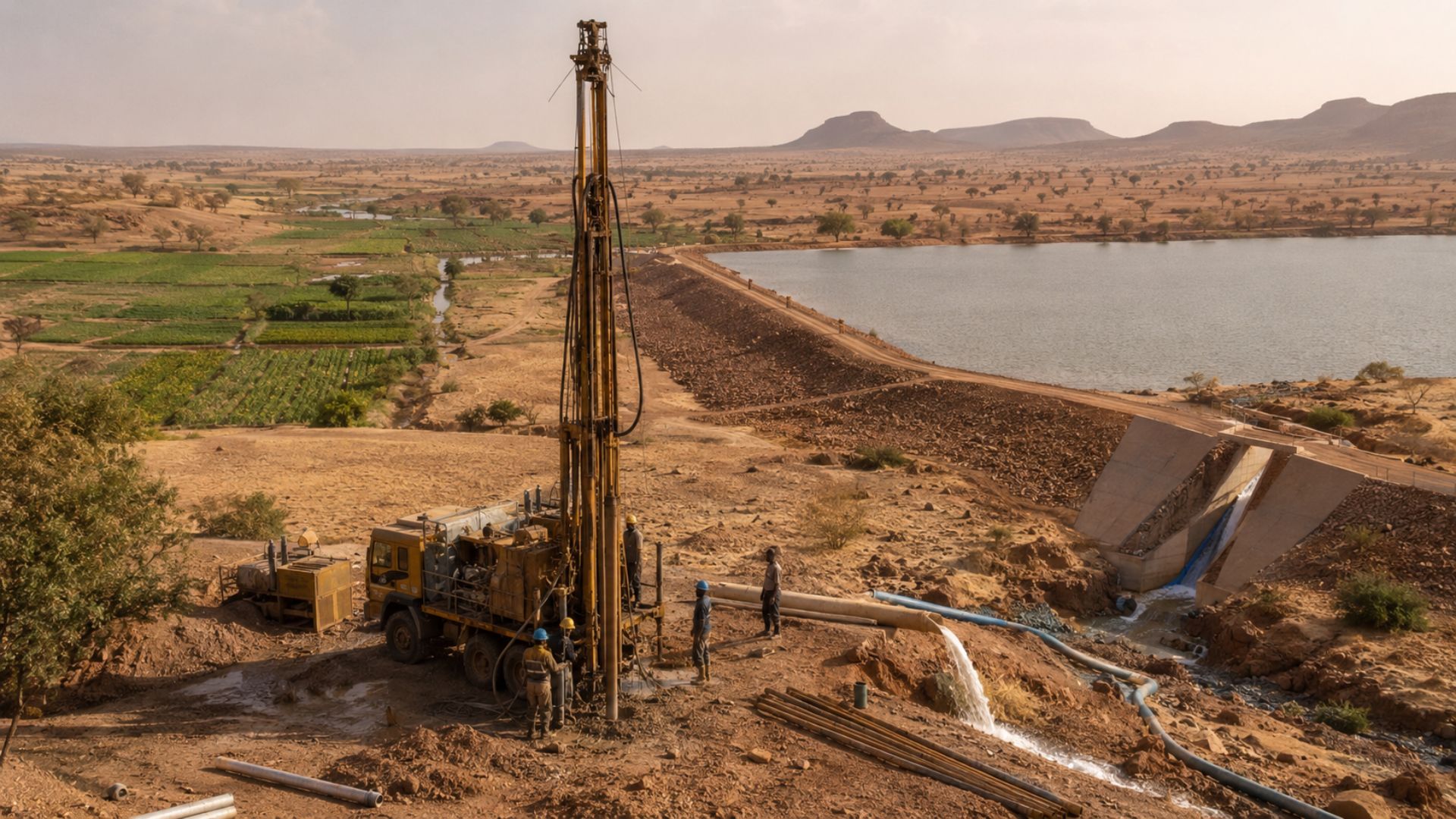


The bet is based on concrete scientific data: a mapping conducted by the UN atomic agency with 13 countries confirmed large reserves of good quality under the Sahel. The six-year plan also foresees 788 hectares of irrigation and 80 local water committees, but it faces warnings about over-exploitation and the difficult independent verification of official numbers.
Burkina Faso launched a $145 million project to rehabilitate 35 dams and drill deep wells in search of groundwater stored for millennia under the arid soil of the Sahel. The six-year plan is presented by the government of Captain Ibrahim Traoré as a path towards so-called water sovereignty, that is, the country’s ability to ensure its own water supply without relying on external funding and systems.
Approved by the Council of Ministers in 2025, the initiative is described by the government as a direct response to the country’s water crisis, exacerbated by climate change, desertification, and increasingly unpredictable rainfall patterns. Burkina Faso is a landlocked nation prone to drought, where more than 80% of the population depends on agriculture and livestock, but historically struggles with the lack of reliable drinking water, especially in rural areas.
What the water project foresees
According to the Burkinabe government, the project brings together a set of actions that go beyond simply opening wells. Among the announced goals are the rehabilitation of 35 large dams, many built decades ago and deteriorated by years of neglect, as well as the development or restoration of about 788 hectares of irrigated lands, with modern techniques that would allow cultivation throughout the year, not just during the rainy season.
-
72-Year-Old Man Spends Six Years Building a Rotating House for His Wife, Completing a Full Turn in 22 Seconds

-
Chinese Residential Building Surrounded by Circular Overpass After Residents Reject Compensation

-
After 79 Months and $145 Million Investment, Nepal Set to Open First 2.7 km Road Tunnel to Ease Traffic in Kathmandu Valley

-
In China, 23 Families Spent Over 4 Years Carving a 1.2 km Road Through a Cliff to Overcome Isolation and Transform a Remote Village

The plan also foresees replenishing 15 strategic reservoirs, creating 15 new fish farming tanks to increase protein production, restoring 5,000 hectares of degraded lands to combat desertification, and installing 80 community water committees. These committees are designed to ensure that resource management is in the hands of local populations, not distant structures, and there is also a proposal for a national water fund to finance future projects.
The science behind the hidden water
The most solid point of this story lies in science, not in political rhetoric. The existence of large water reserves under the Sahel was confirmed by extensive work from the International Atomic Energy Agency, the IAEA, linked to the UN. Between 2012 and 2017, the agency trained and equipped scientists from 13 African countries, including Burkina Faso, to map groundwater using isotopic techniques based on nuclear technology.
Published in May 2017, the study analyzed five major transboundary aquifer systems, including the Liptako-Gourma-Upper Volta system, which is located right under Burkina Faso, as well as the Lake Chad, Senegal-Mauritania, Taoudeni basins, and the Iullemeden system. The conclusion was encouraging: there are large quantities of good quality water, suitable for human consumption, with pollution still limited. It is important to highlight, however, that this mapping is the result of international cooperation among the 13 countries, and not a discovery of the current government of Burkina Faso.
Water and sovereignty: the political reading


Ibrahim Traoré, an army captain who came to power through a coup in September 2022, makes a point of linking the water project to a broader discourse of national sovereignty. The central idea, advocated by the government, is that a country does not build independence only with speeches, but with its own infrastructure, and that water is the foundation to ensure food security without relying on external aid or loans with imposed conditions from outside.
This project is part of a larger strategy. The government claims to have launched an agricultural offensive, with the distribution of tractors and water pumps, and even announced that the country had achieved food self-sufficiency and harvested record cereals. However, it is worth noting that much of these numbers come from official sources and still lack independent verification, partly due to restrictions on the press and the closing of the political space in the country, which advises treating them as government claims, and not as fully proven facts.
The risks and challenges of the plan
As promising as it seems, the project faces real obstacles that deserve attention. The first is the scale: the 788 hectares of irrigation to be restored represent only a fraction of the country’s agricultural potential, which has thousands of hectares still unused. In other words, the investment is significant, but it is far from solving Burkina Faso’s water deficit on its own.
There is also an important technical warning: groundwater is not infinite. The IAEA hydrologist responsible for the study warned that governments need to protect this resource from pollution and overexploitation, because the situation can change quickly. The case of Libya’s Great Man-Made River, which draws water from desert aquifers and is already showing signs of depletion, serves as an example that pumping fossil water without careful management can compromise reserves for future generations.
Governance and Stability at Stake
Another challenge lies in governance. Studies on community-managed irrigation systems in Burkina Faso have already pointed out persistent problems, such as water waste and low productivity, showing that building infrastructure is only part of the journey. Without solid and well-managed institutions, even new dams and wells may not deliver the expected results over time.
Finally, there is the issue of political stability. Traoré’s government has already faced coup attempts, dissolved parties, and restricted press freedom, raising doubts about the continuity of long-term projects in a scenario of concentrated power. All this occurs amidst insurgencies that have displaced more than a million people in the country, making the environment even more fragile for the execution of projects that depend on years of continuity.
Burkina Faso’s water project is a fascinating example of how science, infrastructure, and politics intertwine. On one hand, there is a concrete and proven fact: there is a lot of good quality water under the Sahel, mapped by an international agency. On the other, there is a government that decided to act on this knowledge, but whose results still need to be independently confirmed and whose sustainability depends on careful management and stability. More than celebrating or discrediting, the case invites us to closely follow one of Africa’s most daring development experiments today.
And you, what do you think of Burkina Faso’s gamble to seek water deep in the desert to try to ensure its water sovereignty? Do you believe that such projects can transform arid regions, or are the challenges too great? Leave your comment, share your thoughts on the topic, and share the article with those interested in water, Africa, and sustainable development.