Portuguese
  Spanish


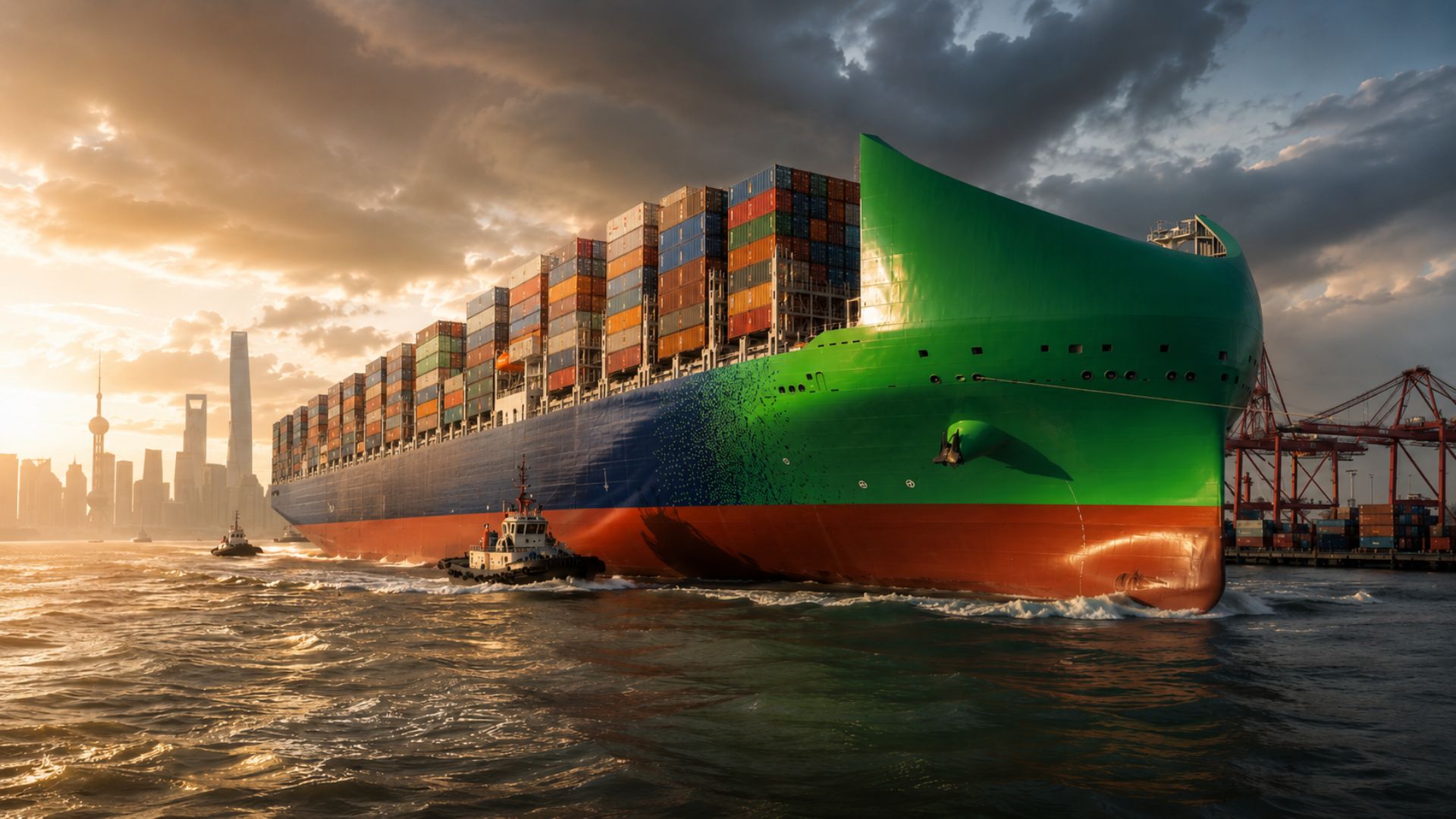


The world’s largest LNG dual-fuel container ship has begun its maiden voyage from the Port of Yangshan, Shanghai, heading to Northern Europe. Named CMA CGM Notre Dame, the 400-meter-long and 62-meter-wide giant carries up to 24,212 standard containers and is the first of ten ships of the same class that CMA CGM will receive between 2026 and 2028. The 18,600-cubic-meter liquefied natural gas tank ensures autonomy for the complete route between Asia and Europe without the need for refueling.
According to information from CGTN, the world’s largest liquefied natural gas-powered container ship departed Shanghai on its maiden voyage to Northern Europe, ushering in an era where sea giants operate with cleaner fuel on a commercial scale. The CMA CGM Notre Dame is 400 meters long, 62 meters wide, and 75 meters high, dimensions that make it one of the largest moving objects ever built by humans. The transport capacity is 24,212 TEUs, an acronym for twenty-foot equivalent units, and the ship is part of the French Asia Line route, a strategic service of the French company that connects major Asian ports to Northern Europe.
The world’s largest LNG container ship is the first in a series of ten identical ships that CMA CGM will receive between 2026 and 2028. The vessel was built by Hudong-Zhonghua Shipbuilding, a subsidiary of the Chinese state group CSSC, and represents the French company’s most ambitious bet on decarbonizing maritime transport. Rodolphe Saadé, CEO of CMA CGM, stated that the decision “reinforces France’s role as a global maritime power and reaffirms the group’s commitment to sustainability, innovation, and operational excellence.”
The dimensions of the largest LNG container ship

To understand the scale of the CMA CGM Notre Dame, just compare its numbers with known references. The largest LNG container ship is 400 meters long, equivalent to four football fields lined up. Its width of 62 meters and height of 75 meters make it, when docked at a port, resemble a 25-story building lying on the water.
-
DNA Analysis Reveals How Five Cattle Survived Over 130 Years on a Deserted Brazilian Island

-
Private Spacecraft Intercepts Another for First Time in History During U.S. Space Force Mission Completed 11 Hours Early with Rocket Launched in Record 16 Hours

-
Scientists Predict Earth’s Habitable Lifespan: 1.8 Billion Years Before Oceans Evaporate and Sun Forces Planet Out of Life Zone
-
LG Unveils XBOOM Stage 501 Portable Speaker with 25-Hour Battery, AI Karaoke, and Sound by will.i.am in Brazil


The capacity of 24,212 TEUs means that the ship can transport more than 24,000 standard containers in a single trip.
Of these, 1,600 are connections for refrigerated containers, essential for transporting perishable foods, medicines, and products that require controlled temperatures. The ship also features intelligent energy management systems to optimize consumption in refrigeration operations.
The LNG tank that eliminates refueling

The most impressive technical feature of the largest dual-fuel container ship is its 18,600 cubic meter liquefied natural gas tank. This capacity ensures autonomy to complete the route between Asia and Europe without the need for LNG refueling, eliminating logistical stops that would delay the trip and increase operational costs.
The dual-fuel propulsion system allows the ship to operate with both LNG and conventional fuel, offering operational flexibility in ports that do not yet have liquefied natural gas refueling infrastructure. When operating on LNG, the vessel reduces sulfur dioxide and fine particle emissions by 99%, nitrogen dioxide emissions by 85%, and CO2 emissions by up to 20%, performance that far exceeds international regulatory limits.
The route that connects Asia and Europe with the largest container ship
The CMA CGM Notre Dame operates on the French Asia Line, the most emblematic route of CMA CGM. The scale of the largest LNG container ship includes the ports of Pusan in South Korea, Tianjin, Ningbo, Shanghai, and Yantian in China, Singapore, Southampton, Dunkirk, Hamburg, Rotterdam, and Algeciras in Europe, as well as Port Kelang in Malaysia.
The route serves corridors considered essential for supplying global supply chains. Simultaneously with the launch of the Notre Dame, a new direct and fast route between Shanghai and the west coast of the United States was also inaugurated, reducing delivery time to just 18 days. The two routes reinforce Shanghai’s position as one of the main global maritime transport hubs.
What the largest container ship changes in global transportation


The entry into operation of ten 24,212 TEU LNG-powered ships represents a transformation in international maritime logistics. Maritime transport accounts for 80% of world trade and 3% of global greenhouse gas emissions, and ships like the Notre Dame are the sector’s most concrete attempt to reduce its environmental footprint without sacrificing cargo capacity.
For Brazilian exporters of soybeans, iron ore, meat, and coffee who rely on CMA CGM ships to access European and Asian markets, the arrival of larger and more efficient vessels may mean more competitive freight rates and more reliable routes. The world’s largest LNG container ship is not just a feat of naval engineering: it is a sign that maritime transport is entering a new phase where size and sustainability must go hand in hand.
Can you imagine a 400-meter ship carrying 24,000 containers crossing the ocean without refueling? What impresses you the most: the dimensions, the 99% reduction in sulfur, or the LNG tank’s autonomy? Tell us in the comments.