Portuguese
  Spanish


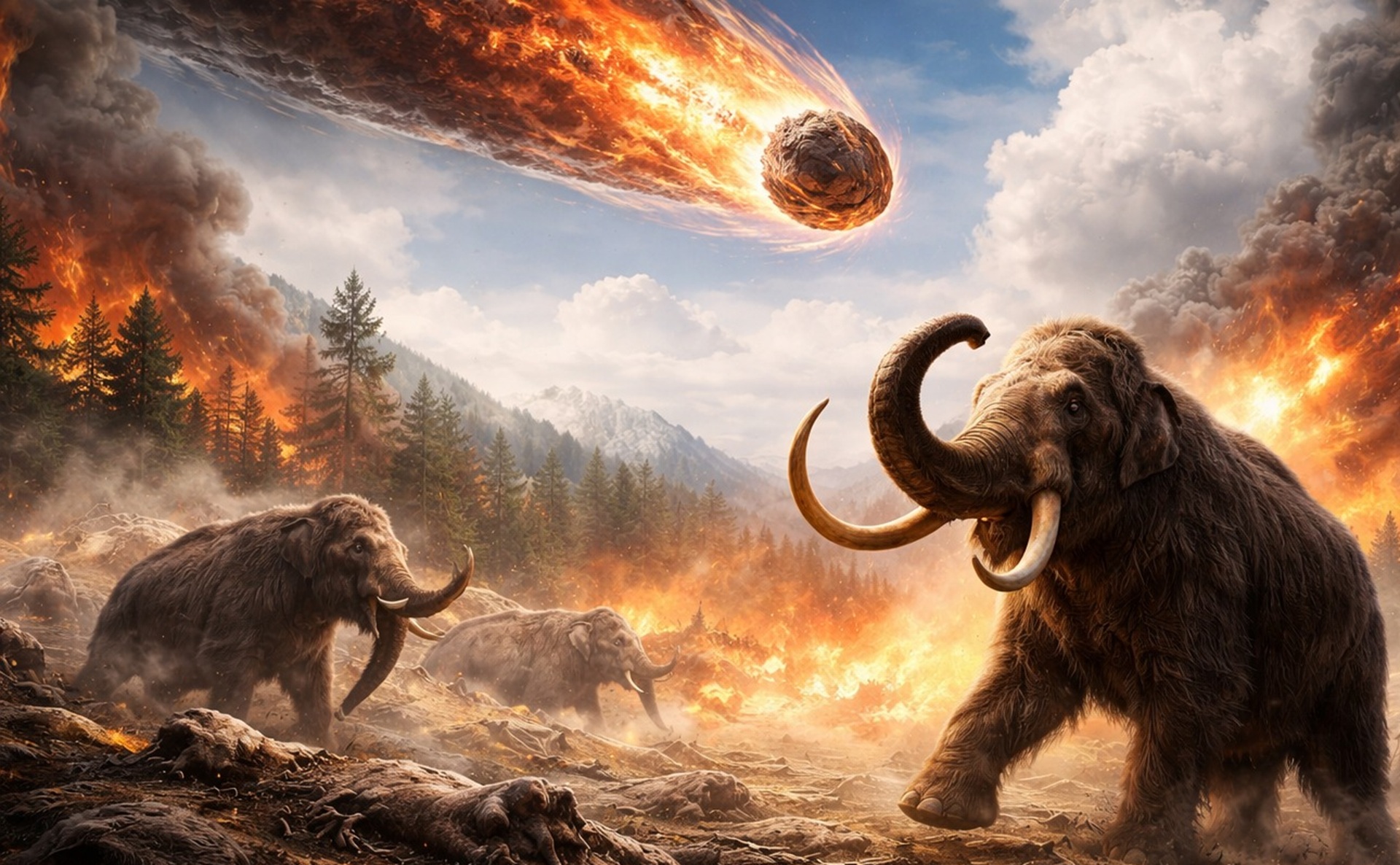


New Scientific Study Analyzes Sediments, Rare Minerals, and Archaeological Vestiges in Three Sites in North America and Points Out That Air Explosions of Comet Fragments, Occurred About 13,000 Years Ago, May Have Caused the Simultaneous Disappearance of Mammoths, Megafauna, and Clovis Culture, as Well as Triggering the Abrupt Cooling of the Recent Dryas
A study led by James Kennett, from the University of California, Santa Barbara, points out that air explosions of comet fragments, about 13,000 years ago, may explain the simultaneous disappearance of megafauna, Clovis culture, and the abrupt cooling of the Recent Dryas.
At the end of the last Ice Age, rapid changes profoundly altered life on Earth. Gigantic animals, which had survived for thousands of years, abruptly disappeared from the North American landscape. The phenomenon occurred in a surprisingly short time frame.
Almost at the same time, the Clovis culture, known for its distinctive stone tools, ceased to appear in the archaeological record of North America. This temporal coincidence prompted decades of scientific debate about possible causes.
-
Pennsylvania Mine Creates Ice in Summer Heat and Melts in Winter, Turning a Mountain Crevice into a Reverse Natural Refrigerator

-
China Accelerates Global Expansion of Robotics: From Smart Vacuums to Industrial and Humanoid Machines, Millions Exported to Over 150 Markets
-
Polar Air Mass to Hit Brazil: Temperatures to Plummet in Nine States, Near Freezing in the South with Frost Risk Until Monday
-
Chinese “dark factories” produce electric cars 24/7 with minimal human intervention, as Zeekr assembles 800 units daily, raising concerns in Brazil.





For a long time, gradual climate change was considered insufficient to explain such rapid and widespread losses. New evidence, however, reinforces a hypothesis that previously seemed extreme and difficult to support with indirect data.
Air Explosions of a Fragmented Comet
The research suggests that a large comet disintegrated upon entering the Earth’s atmosphere. Instead of hitting the ground and forming a crater, its fragments exploded in the air, releasing shockwaves and extreme heat over extensive areas.
This type of event is classified as a low-altitude air explosion.
According to the authors, such phenomena can devastate entire ecosystems without leaving obvious marks on the surface, making it difficult to identify them in the traditional geological record.
The study was conducted by an international team that analyzed microscopic evidence preserved in ancient sediments. The approach avoided searching for craters and focused on mineral signals compatible with cosmic impacts.
Archaeological Sites and the Moment of Rupture
The researchers examined three sites associated with the Clovis culture: Murray Springs in Arizona; Blackwater Draw in New Mexico; and Arlington Canyon in the California Channel Islands.
At all locations, the sediments correspond to the exact period when the large Ice Age animals and Clovis tools disappeared. These sites are considered classic references in the study of these extinctions.
According to Kennett, the three sites were central to documenting both the end of megafauna and the associated human cultural collapse. The stratigraphic coincidence reinforces the search for a common event capable of explaining both phenomena.
Impacted Quartz as Key Evidence
At the three sites, the team identified impacted quartz, a rare form of mineral grain altered by extreme pressures and temperatures. This type of alteration is not produced by common fires, lightning, or volcanic eruptions.
The grains exhibit characteristic microscopic fractures, formed only under conditions associated with cosmic impacts. In some cases, there is the presence of melted silica within the fractures, indicating exposure to intense heat.
To confirm the origin of these structures, scientists used electron microscopy and cathodoluminescence. The analyses showed that the grains were subjected to conditions far beyond normal terrestrial processes, reinforcing the impact hypothesis.
Abrupt Cooling and the Beginning of the Recent Dryas
The evidence coincides with the onset of the Recent Dryas, a period marked by a sudden return to cold conditions following the onset of post-glacial warming. Temperatures dropped rapidly and remained low for about a thousand years.
This cooling disturbed ecosystems across large areas of the Northern Hemisphere. Various theories have attempted to explain the phenomenon, but the study supports that comet explosions may have been the initial trigger.
According to the hypothesis supported by Kennett, widespread fires released large amounts of smoke and soot into the atmosphere.
This material would have blocked sunlight, leading to a severe and prolonged winter.
Black Mat, Rare Metals, and Signs of Fire
One of the main pieces of evidence associated with this scenario is the presence of what is called the black mat, a dark layer of sediments found in various locations in North America and parts of Europe. It indicates carbon-rich deposition.
This layer suggests extensive burning on a continental scale. In addition, scientists identified elevated concentrations of rare elements such as platinum and iridium, common in comets and asteroids but unusual in the Earth’s crust.
Other materials associated with impacts include nanodiamonds, microscopic metallic spherules, and melted glass. These components form when minerals melt and cool rapidly after extreme energy exposures.
Why Is There No Visible Large Crater
The absence of a crater has always been an obstacle to the acceptance of the hypothesis. The study argues that air explosions release energy above the surface, causing widespread destruction without leaving permanent scars on the ground.
Computational simulations with hydrodynamic modeling showed that low-altitude explosions can generate shock patterns identical to those observed in the analyzed quartz. The results are consistent with the data collected at the sites.
According to Kennett, different levels of impacted quartz are expected in the same event. Some grains show a high degree of impact, while others exhibit more subtle changes, a pattern consistent with multiple air explosions.
Consequences for Animals and Human Societies
With devastated ecosystems, a sharp drop in temperatures, and food scarcity, the large animals of the Ice Age faced extreme conditions. The human populations associated with the Clovis culture also suffered significant environmental stress.
The study concludes that the cosmic event likely acted as a determining factor in the extinction of North American megafauna and the collapse of the Clovis techno-complex. The combined evidence makes the scenario difficult to ignore.
The results were published in the journal PLOS One, reinforcing the scientific debate on how events from space may have decisively shaped the history of life on Earth.