






 Portuguese
  Spanish


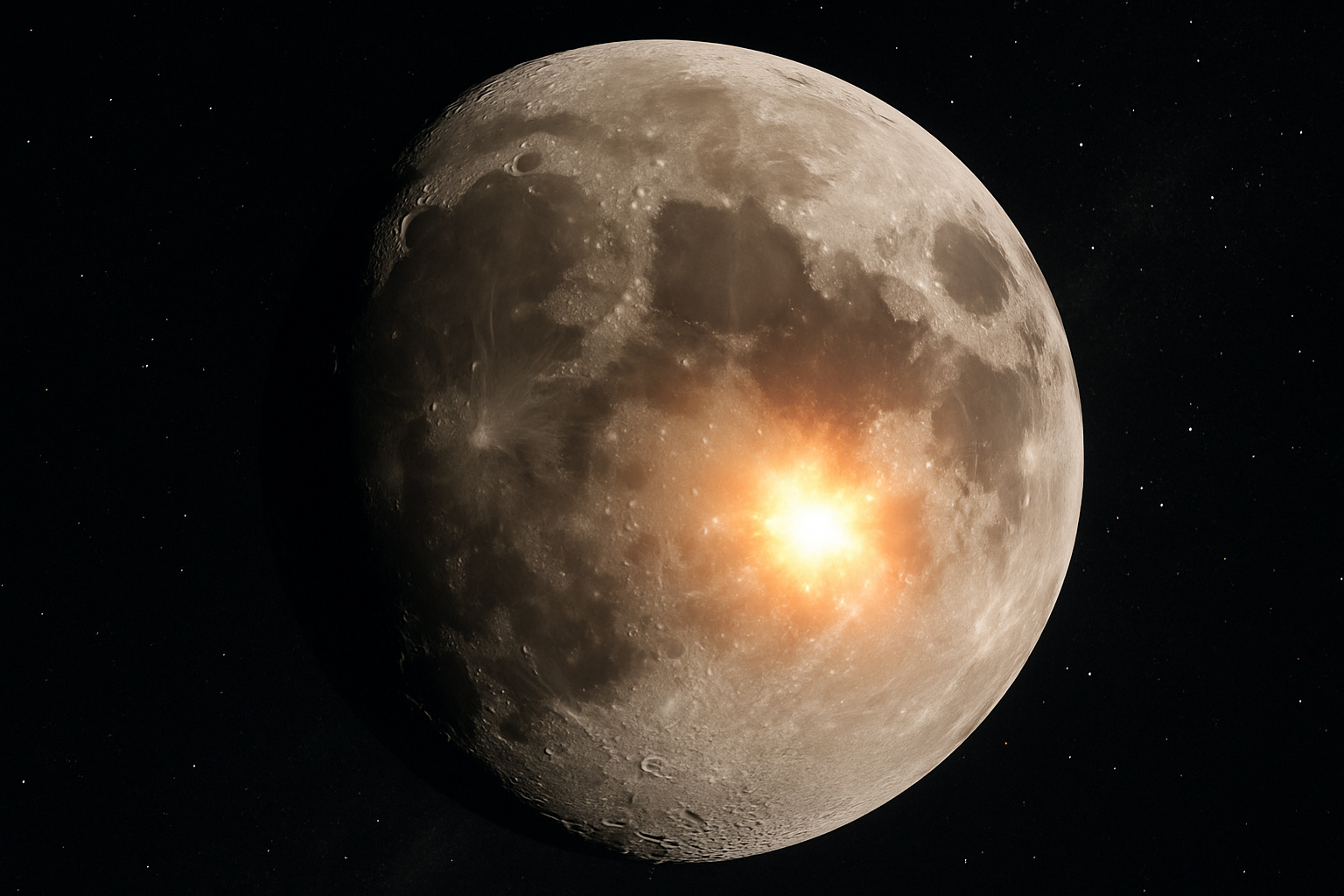


Two Consecutive Lunar Impacts, Recorded by Japanese Astronomer, Help Scientists Calculate the Frequency of Asteroid Collisions with the Moon
In less than two days, two intense flashes illuminated the surface of the Moon, sparking enormous curiosity among astronomers and space enthusiasts. These phenomena occurred on October 30 and November 1, 2025, and were recorded by Daichi Fujii, curator of the Hiratsuka City Museum in Japan, using automated homemade telescopes.
According to Fujii, the impacts reached speeds close to 96,500 km/h, releasing energy comparable to that of conventional explosives. Therefore, these events, even though brief, provide valuable information about the frequency and behavior of asteroids that collide with the Moon. In addition, the data obtained helps scientists understand similar risks on Earth.
Consecutive Impacts Confirmed by Japanese Telescopes
The flashes were observed simultaneously in different locations in Japan, which ruled out any cosmic ray interference. The first impact occurred east of the Gassendi crater, which has a diameter of 112 km, and the second west of the Oceanus Procellarum, also known as “Ocean of Storms”, a vast volcanic plain.
-
Nearly 40% of Treated Water in Brazil is Lost Before Reaching Homes; Companies Use Satellites, AI, Helium, and Innovative Tech to Improve Access in Remote Areas

-
Steel Sphere Cylinder Achieves 14% Damping in Tests, Functions Without Sensors or Electricity, and Can Reduce Vibrations in Skyscrapers, Bridges, and Sensitive Equipment with US Patent Registered
-
Artist’s 15-Meter Lighthouse in the Mojave Desert, 160 km from the Sea, Intrigues Visitors with 19 km Range After Years of Bureaucracy

-
Bluetti AC70 Solar-Powered Station: Powers Fridge and Wi-Fi During Blackouts, Delivers 1,000W, 3,000 Charge Cycles, Priced at $900


According to Juan Luis Cano, an engineer at the European Space Agency’s Near-Earth Object Coordination Center (ESA), “the impact flashes appear genuine and are above average in brightness”. Thus, the simultaneous observation by multiple telescopes reinforced the events’ authenticity.
The Origin of Asteroids and the Scientific Relevance of Impacts
These collisions, although lasting only a few seconds, are fundamental for studies on the Moon and the Solar System. Fujii believes that the objects may have come from the Taurid meteor shower, associated with Comet Encke, famous for including large fragments.
Thanks to these records, scientists can improve models on the frequency and intensity of lunar impacts. This knowledge is important for planning future missions and permanent lunar bases. Both NASA and private companies are studying strategies to ensure safety in future space settlements.
“Understanding the frequency and energy of impacts is essential to protect future lunar colonies,” explained Fujii in an interview with The New York Times. Since 2011, he has recorded over 60 similar events, reinforcing the value of continuous monitoring.
Consequences for the Future of Lunar Exploration
Currently, NASA faces budget constraints that have reduced some activities, but its planetary defense observatories continue to operate and collect data on near-Earth bodies. Meanwhile, the ESA could not observe the flashes due to high daylight luminosity in Europe during the impacts.
These events confirm that the Moon is a dynamic body, constantly hit by micrometeorites and asteroids. Thus, it serves as a natural laboratory to understand cosmic collisions and predict future risks. Furthermore, the discoveries reinforce the need for space protection strategies, especially in light of advancing human exploration beyond Earth.
Continuous Monitoring and Alert for the Future
In general, astronomers state that each flash is an opportunity to learn about the history of the Solar System. Thus, constant monitoring of the Moon allows for predicting threats and protecting future lunar and terrestrial structures.
Consequently, these two flashes, separated by only 48 hours, represent much more than mere curiosities. They are evidence of the intense activity in space and the ongoing impact of celestial bodies.


