Portuguese
  Spanish


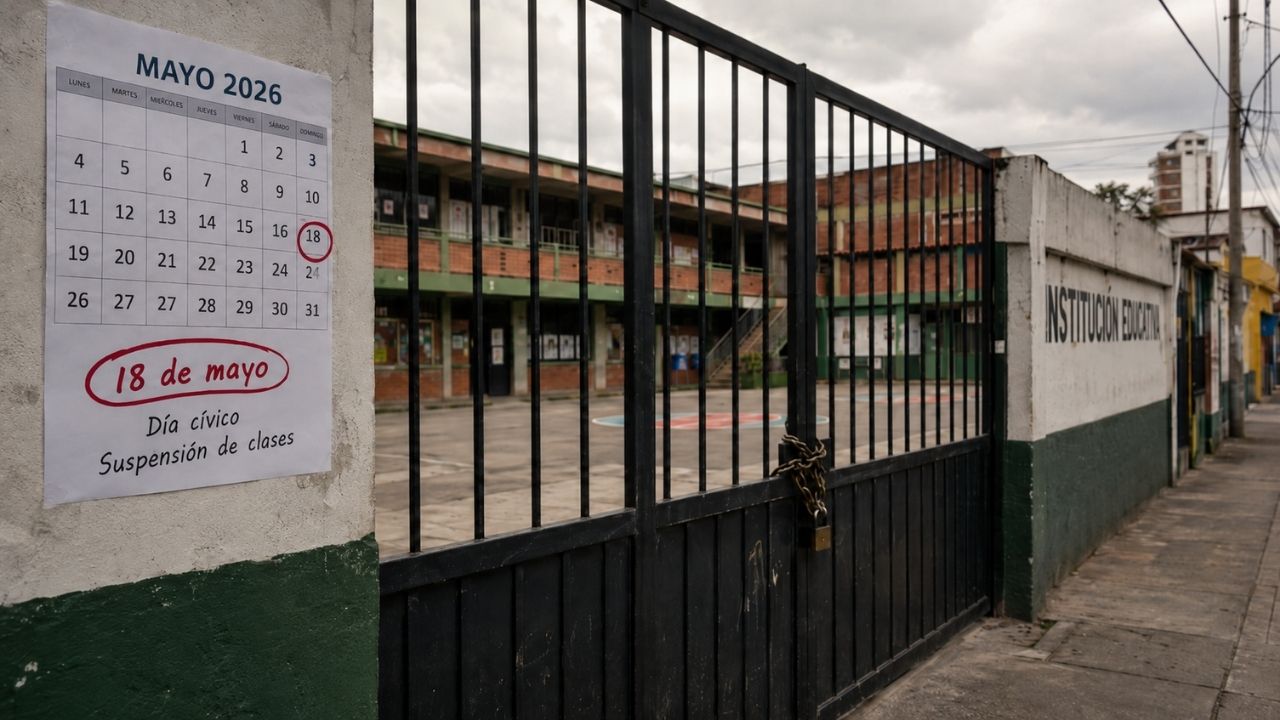

Colombia will halt school activities on May 18 due to the national Ascension Day holiday, suspending primary and secondary education nationwide and reinforcing a planned school calendar to maintain predictability, rest, and reorganization without make-up classes.
Colombia will have a day of empty classrooms nationwide on the upcoming May 18, as the government has determined the suspension of classes in all schools due to the national Ascension Day holiday. The halt affects preschool to high school, in urban and rural areas, and completely interrupts academic calendar activities on that date.
According to the portal Diário do Comércio, the detail that makes the decision more significant than a simple school break lies in how the holiday is applied. In the country, the religious celebration is adjusted by the so-called Emiliani Law, a mechanism that transfers certain dates to the following Monday, creating a new long holiday weekend with predictable impact on families, students, education networks, and academic routine.
School closure affects the entire country and halts education en masse

The suspension announced by the Ministry of Education is not limited to a specific region or an isolated stage of education. The closure applies to all schools and covers different levels of basic education, from preschool to high school, in both urban and rural areas.
-
At a depth of 5,000 meters, where there is no sunlight, researchers found ancient DNA preserved in the mud of the South Atlantic and discovered signs of organisms that did not match known records.

-
At 77 years old, a retired woman who never tires of learning completes her second degree in design in Ceará and moves people by revealing the help of her 98-year-old mother in the final project.
-
China’s masterstroke: a plant capable of regrowing even when buried by sand helps to recover more than 7,300 hectares of desert with 5 million seedlings, roots over 10 meters deep, and rainfall below 150 mm per year.
-
Portugal placed 1.4 million m³ of sand in the Algarve, spent 14.9 million euros to recover 6.7 km of beaches between Quarteira and Garrão, and is now trying to gain 37.5 meters of shoreline before the sea advances again.



In practice, this means a national interruption of classes on a single date, within an officially foreseen schedule. As May 18 enters the calendar as a mandatory suspension, educational institutions must halt their activities without the need for last-minute improvisation.
This type of halt is noteworthy because it does not stem from a crisis, strike, or extraordinary event. It is an institutionalized break, incorporated into the regular functioning of the Colombian educational system and organized in advance.
The new long holiday weekend arises from a rule that adjusts the calendar without disrupting the academic year’s rhythm
The most curious part of the measure lies precisely in the calendar’s engineering. Ascension Day has religious origins, but in Colombia, its observance follows a legal logic that alters the perception of the date in the daily lives of the population.
Under the Emiliani Law, holidays that might fall on various days are transferred to the following Monday. The result is the formation of more predictable long weekends throughout the year, creating continuous periods of rest and facilitating the organization of school life, domestic tourism, and family routines.
In this case, the commemoration will be observed on May 18, making the day an official break in the educational system. It is this shifting of the holiday to Monday that helps explain why classrooms will be empty in a planned manner, and not merely by calendar coincidence.
Without make-up, the break is already an official part of the education networks’ schedule
Another important point is that the suspended day will not be made up, precisely because it is already foreseen in the national schedule. This changes the interpretation of the news. It is not an unexpected disruption to the school calendar, but an interruption absorbed by the official operating rules of the academic year.
According to educational authorities, classes are expected to resume normally on Tuesday, May 19, or according to the specific calendar of each education network. Nevertheless, the government advises parents and students to confirm any local adjustments with each institution.
This predictability is one of the pillars of the model adopted in the country. By distributing holidays throughout the year in an organized manner, the system seeks to avoid major disruptions to the academic rhythm and provide clarity to school communities about when there will be a break and when content will resume.
The decision affects families, urban routine, and school planning beyond the school gate
When all schools stop at the same time, the impact goes beyond the classroom. The suspension alters commuting dynamics, reorganizes domestic routines, and interferes with the planning of families who need to adjust work, childcare, and daily commitments.
There is also a direct effect on the management of education systems. With the already planned break, school boards and secretariats can organize the calendar in advance, reducing uncertainties and avoiding last-minute adjustments to compensate for the holiday.
From a social point of view, the model also reinforces a logic of collective rest. Instead of scattered and unpredictable breaks, the country concentrates certain holidays on more functional dates, which broadens the effect on circulation, leisure, and the organization of public life.
Colombia’s case helps illuminate how other countries reorganize the school year
The Colombian model also stands out because it shows an attempt to balance rest and pedagogical continuity. Instead of leaving the calendar subject to random breaks, the rule seeks to distribute pauses more rationally throughout the year.
In Brazil, the logic is different, but the challenge is similar. Legislation requires a minimum of 200 school days per year, which forces education systems to reorganize the calendar whenever there are holidays or longer breaks. In 2026, several Brazilian systems are also undergoing structural changes, such as the increasing adoption of the quarterly model in place of the bimonthly one.
Among the adjustments mentioned for the Brazilian calendar are a shorter July recess, the inclusion of a break in October known as Teacher’s Week, and an increase in school Saturdays to compensate for holidays. In some systems, the school year also tends to end before December.
What this break reveals about education, planning, and predictability in the calendar
The suspension of classes on May 18 draws attention because it reveals a system that tries to reconcile tradition, rest, and school organization without improvisation. By transforming a religious date into an official long holiday, Colombia not only closes schools for one day but reaffirms a policy of predictability that shapes the routine of millions of students and families.
This topic deserves attention precisely for this reason. In times of school calendars pressured by pedagogical changes, holidays, and institutional reorganizations, decisions like this show how the design of the school year goes far beyond counting classes. It defines social rhythms, distributes breaks, and helps measure how each country chooses to balance teaching, rest, and collective planning.