






 Portuguese
  Spanish


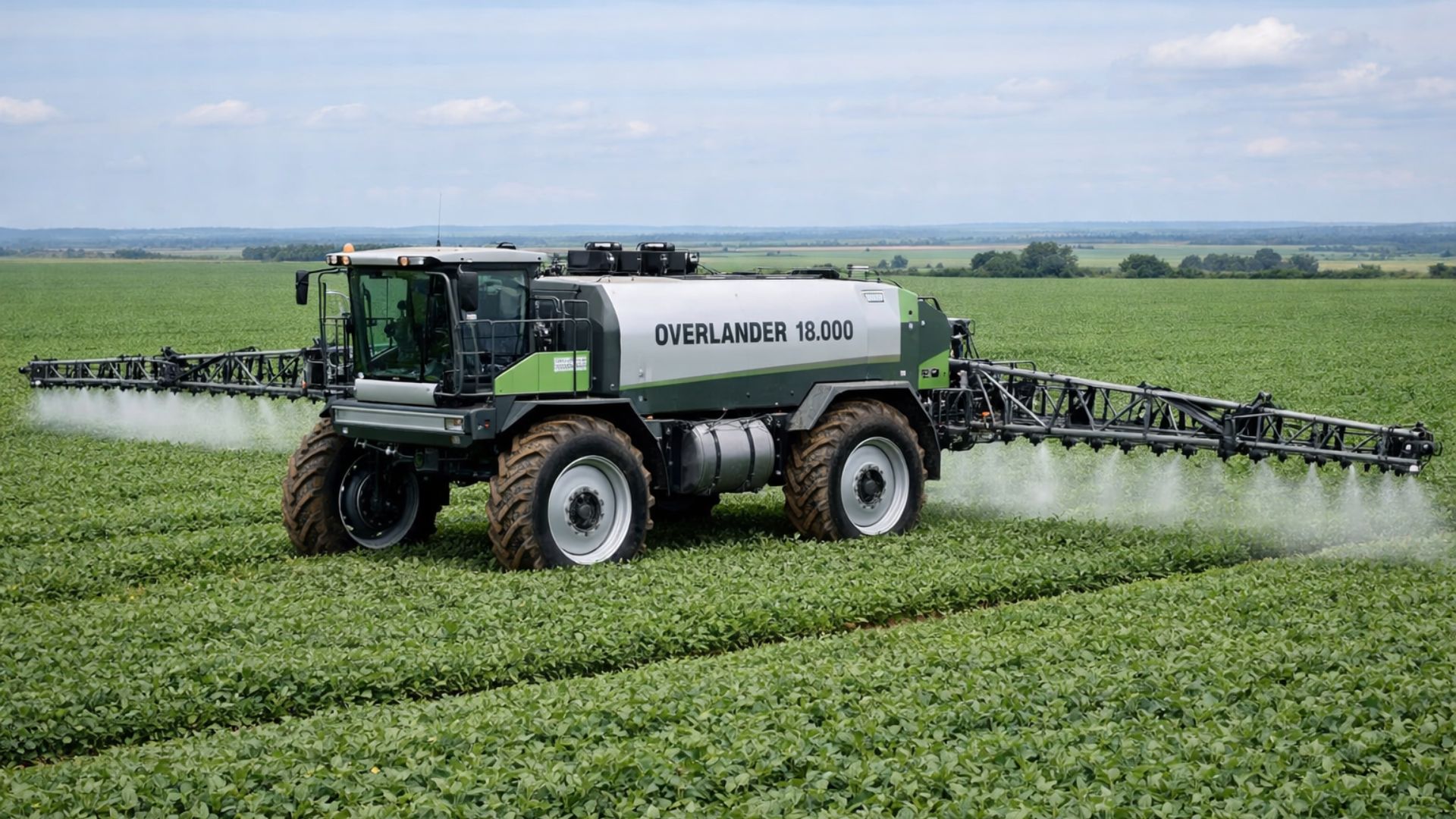


Extreme Capacity And 42-Meter Bar Place The Overlander 18,000 Among The Largest Sprayers In The Country, With A Design Focused On Reducing Downtime, Expanding Covered Area And Maintaining Application Control On Large Properties. Hybrid Architecture And Field Tests Reinforce The Scale Of This Agricultural “Colossus”.
An 18,000-liter self-propelled sprayer with a 42-meter boom puts Brazil on the radar of extreme scale agricultural machines.
The Overlander 18,000, developed by Incomagri in partnership with the German Nexat, combines tank dimensions and volume typical of equipment designed to operate for long periods without frequent stops, a decisive point when spraying needs to progress across large areas with regularity and precision.
What stands out, besides its size, is the way this project combines tank capacity, structure, and propulsion in a single platform.
-
ispace Pays SpaceX $50 Million to Hitch a Ride on Starship, Aiming for a Shared Commercial Route to the Moon by 2030

-
Solar-Powered Cell Tower to Connect 10,000 Residents on Remote Brazilian Island, Reducing Diesel Dependence
-
Snowman-shaped asteroid captured by Hayabusa2 probe during flyby just 10 km away

-
Scientists Discover Clue in Rodent Brains Explaining Why Early Childhood Memories Fade Over Time


According to Revista Cultivar, it is the largest sprayer in Brazil and one of the largest in the world, designed for large-scale operations with a focus on operational efficiency, as the unit was conceived to reduce the need for refueling and increase hourly output.
Tank of 18,000 Liters And Spraying Logistics

The tank configuration helps explain why the model has gained “colossus” status in the field.
According to Revista Cultivar, the Overlander 18,000 uses two stainless steel tanks of 9,000 liters, totaling 18,000 liters of capacity, in addition to two additional 1,000-liter reservoirs for system cleaning.
The adoption of stainless steel in the tanks appears to be a design choice aligned with robustness and durability, while the auxiliary reservoirs indicate a practical concern for sanitation processes and product exchange, an inevitable part of the spraying routine in professional environments.
This scale changes the rhythm of operation for a simple reason: the larger the volume available on board, the longer the machine can stay in the field before returning for refueling.
In scenarios where the logistics of water and product depend on long movements or fixed refueling points, each stop represents loss of time, reorganization of the team, and additional fuel consumption.
A tank of this capacity is usually interpreted as an attempt to make spraying a more continuous process with fewer interruptions.
42-Meter Boom And Automatic Height Control
The working width is another number that summarizes the impact of the Overlander 18,000.
A 42-meter boom defines, in practice, how many strips of land the machine covers with each pass.
In spraying, increasing the width is a direct way to increase the area covered per hour, reducing the number of parallel routes needed to cover an entire field.
At the same time, long booms bring their own challenges because any oscillation, terrain variation, or change in speed can alter the height of the nozzles in relation to the target.
That’s why, in this model’s case, Revista Cultivar highlights that the equipment adopts a stabilization system and automatic height control, a combination that aims to keep the boom in the proper position throughout the movement.
Nexat Hybrid Architecture And Two 550 Hp Engines
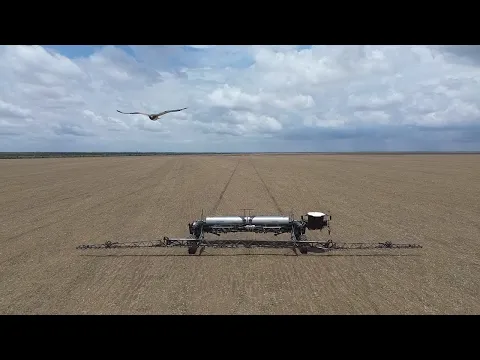

The project also stands out for its energy base and for how power reaches the wheels.
According to Revista Cultivar, the Nexat system in the Overlander 18,000 operates with two 550 hp diesel engines, embedded in a hybrid architecture.
In this arrangement, the wheels are driven by electric motors associated with super reducers, aiming to deliver high torque and more precise movement control.
In practical terms, it means that the machine was designed to handle the weight of the loaded unit and the traction demands in the field, without relying solely on a conventional mechanical transmission.
Incomagri And Nexat Partnership And Tests In Luís Eduardo Magalhães
The partnership between Incomagri and Nexat appears as a central part of the path that led to this configuration.
Revista Cultivar notes that the cooperation was driven by the technical assessment of Nexat’s engineering team regarding the robustness and technological level of the self-propelled sprayers from the Brazilian manufacturer, and that this relationship resulted in the development of the Overlander 18,000.
Also according to the publication, the equipment was field-tested in Luís Eduardo Magalhães, in western Bahia, a detail indicating that the project has moved from paper to being observed in a real operational environment.
Incomagri already had a history with the Overlander line in smaller capacities, and the arrival of an 18,000-liter model suggests a clear shift in the portfolio level.
In spraying, jumps in capacity and width are not usually just “more of the same” because they alter the way to plan application, logistics of refueling, movement within the area, and input management.
This includes decisions about how to position support points, how to organize traffic to avoid overlaps or failures, and how to make the most of the window of suitable conditions for application, such as wind and humidity.
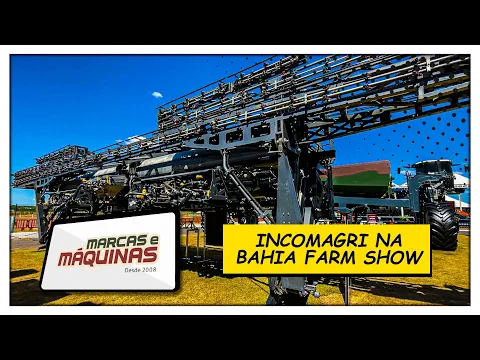
Global Scale And The Goal Of 56-Meter Booms
The 42-meter boom also reinforces an important characteristic of this type of machine: it needs to be efficient without compromising control.
The wider the width, the greater the importance of solutions that help maintain consistent height and reduce variations that can affect application quality.
The mention of automatic height control and the stabilization system, therefore, is not a peripheral detail but part of the package that seeks to transform size into repeatable results in the field.
Another point that helps gauge the ambition of the project is the disclosed intention to further extend the range.
Revista Cultivar reports that Incomagri plans to develop a version with 56-meter booms, which would place the equipment in an even rarer category, where the working width becomes as significant a differentiator as the tank capacity itself.
The existence of this goal signals that the proposal is not just to have a large sprayer, but to explore how far engineering can go while maintaining control, operational safety, and application consistency.
The interest in machines of this scale is not limited to Brazil because the logic behind them is universal: reduce unproductive time and increase the area covered per hour without sacrificing stability and precision.
By combining an 18,000-liter tank, a 42-meter boom, and a propulsion system described as hybrid, the Overlander 18,000 fits into a broader trend of mechanization that combines scale and embedded electronics, seeking to transform repetitive tasks into more monitorable processes, with more control over speed, boom height, and machine response in different terrain conditions.
If a sprayer of this size already operates as a mobile piece of infrastructure in the field, what will be the next practical limit for colossal agricultural machines without losing efficiency along the way?



Tbm gostaria de saber…
Olhei bastante mas não vi quantas ekitares a máquina pulveriza por dia gostaria de saber