






 Portuguese
  Spanish


The Torifune asteroid was photographed in impressive detail by JAXA’s (Japan Aerospace Exploration Agency) Hayabusa2 probe, revealing a unique “snowman” shaped structure. The operation, completed last Sunday, July 5, 2026, marks an important achievement in space exploration by bringing the spacecraft as close as 10 km from the object’s surface at high speed.
This encounter represents the first goal of the agency’s extended mission, which continued the spacecraft’s activities after the successful return of samples from the Ryugu asteroid to our planet in 2020.
From scientific legacy to the new target
The trajectory of Hayabusa2 has been recognized worldwide since its launch in 2014. After bringing nucleobases found on the Ryugu asteroid to Earth — key pieces for understanding DNA and RNA — the probe continues to provide vital information about the origin of life in the Solar System.
-
Scientists Discover Clue in Rodent Brains Explaining Why Early Childhood Memories Fade Over Time

-
Revolutionary Fan Model Offers Pedestal or Tabletop Use, Wireless Operation, 20-Meter Airflow, and 24-Hour Battery Life for Indoor and Outdoor Cooling
-
Chinese Scientists Develop Green Technology Turning Agricultural Waste into 50,000 Tons of Biochar Annually, Now Eyeing Aviation Fuel

-
The World’s First Smartphone, Released in 1994, Would Cost the Equivalent of an iPhone 16 Plus Today




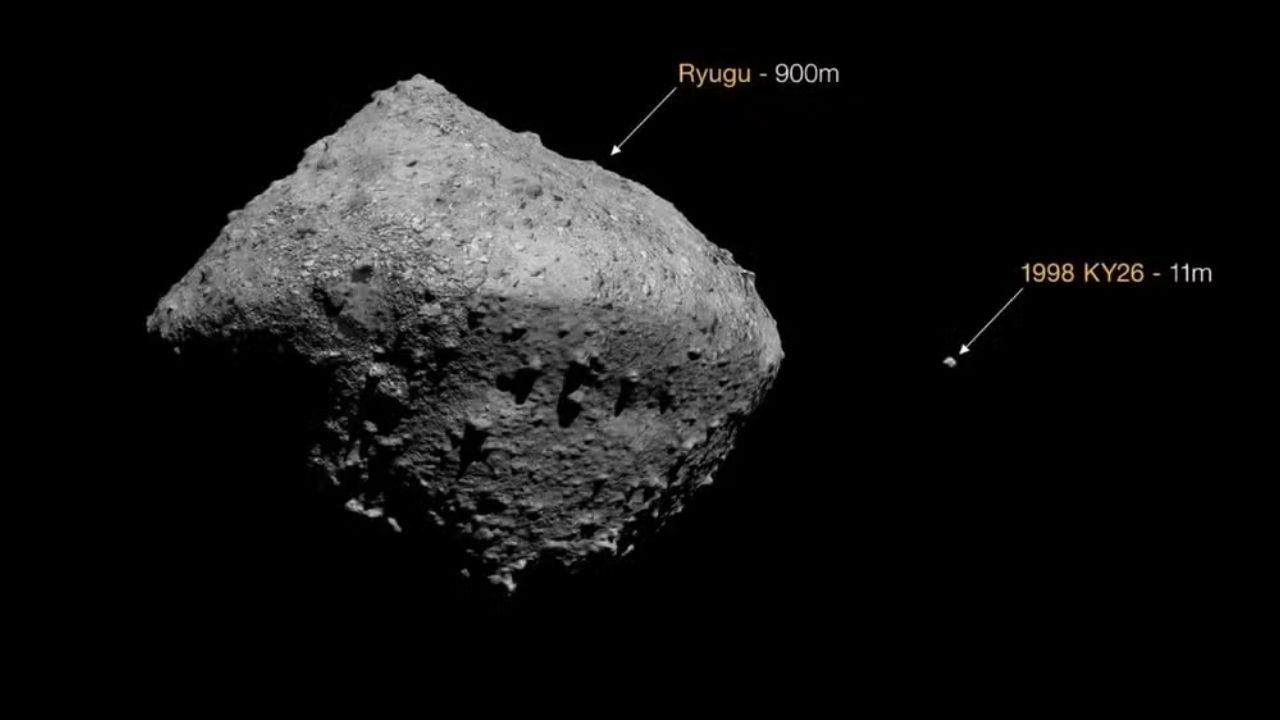
The next chapter of this journey is already set: the destination will be the 1998 KY26 asteroid, which is only 11 meters in diameter. Arrival at the target is scheduled for 2031, when the agency intends to perform an unprecedented scientific landing to analyze the composition of small space rocks.
Technical characteristics and the “snowman” shape
The peculiar shape of Torifune, described as a “bilobed object,” results from two large masses joined by a narrow strip of terrain.
For astronomers, this configuration is an indication of the celestial body’s geological past, suggesting a possible slow collision between two smaller asteroids that, instead of fragmenting, permanently fused.
Reference data on Torifune:
- Diameter: about 450 meters.
- Orbit: completes a revolution around the Sun every 383 days.
- Rotation: completes a full rotation on its own axis every five hours.
- Location: it is approximately 100 million kilometers from Earth and poses no risk of impact, despite belonging to the Apollo group.
The probe’s technology and thermal analysis
To conduct this observation, the probe used a combination of cutting-edge instruments. While the optical camera (ONC-T) ensured visible light recordings, the mid-infrared camera (TIR) allowed researchers to measure the temperature and thermal inertia of the surface.
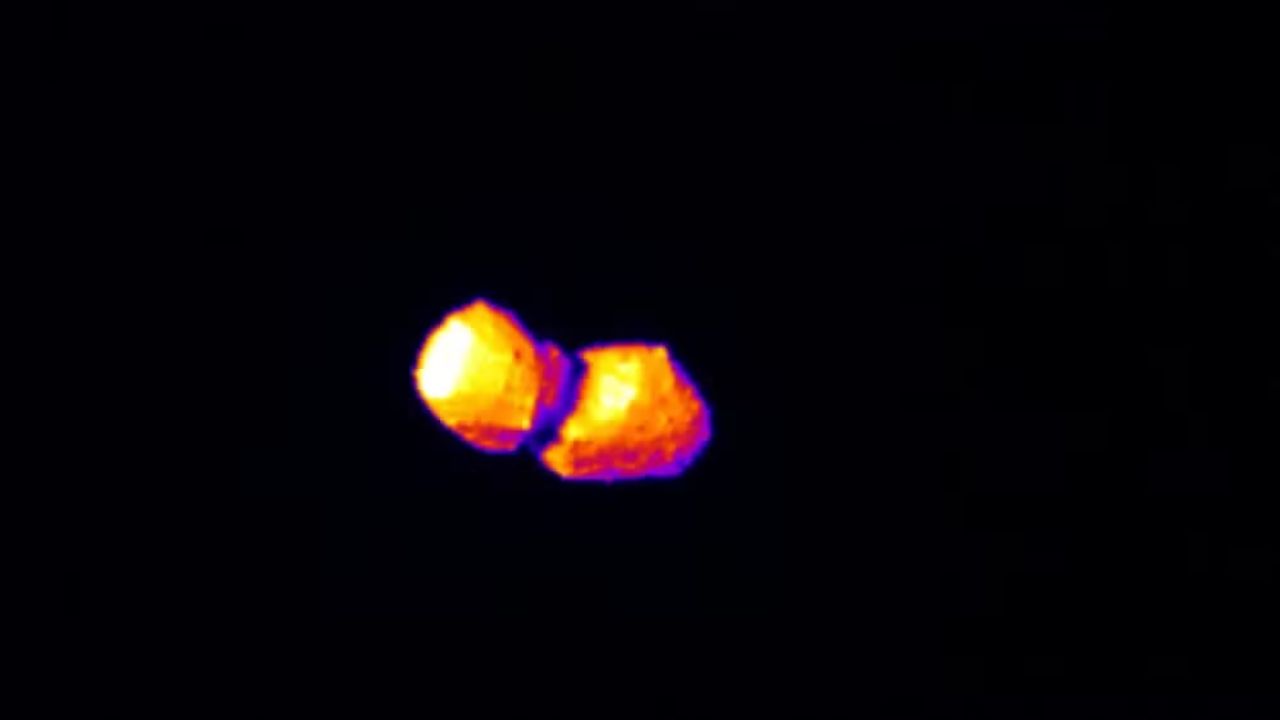
These measurements are essential to understand the terrain’s roughness and the size of the rocky grains present on the asteroid. The infrared images showed a clear thermal contrast, with sunlit parts having much higher temperatures than shaded areas.
JAXA highlighted that, despite the precision of the maneuver initiated back in June, only a portion of the data was transmitted, with the remaining material awaiting the next communication sessions between the spacecraft and Earth.
Extreme precision in space navigation
The maneuver required a high level of rigorous control, with the probe adjusting its trajectory based on constant observations until the final moments of approach. This success reaffirms JAXA’s technical mastery in conducting operations in distant environments.
“We are pleased to announce that we have successfully obtained images and scientific data from the asteroid Torifune,” declared the agency in an official statement on Monday (6). The result obtained reinforces the strategic role of unmanned missions in expanding knowledge about the dynamics and evolution of the smallest objects in our planetary system.
With information from Revista Galileu


