






 Portuguese
  Spanish


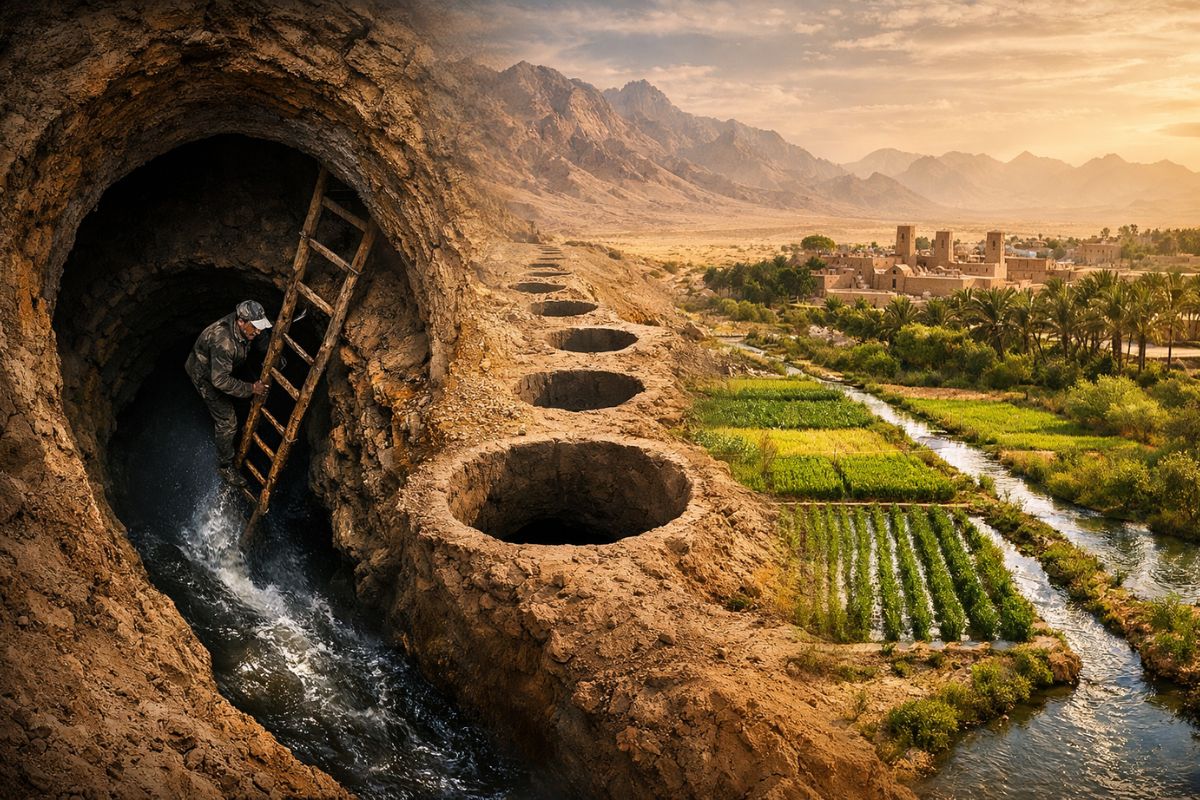


In The Iranian Desert, An Underground Engineering Of 3,000 Years Transformed Scarcity Into Permanence With 46 Thousand Qanats And Up To 350 Thousand Km Of Gravity Galleries; However, In A Few Decades, Electric Pumps, Deep Wells, And Dams Inverted The Water Logic And Pushed Communities Into A Structural Crisis Of Difficult Reversal.
In the desert of Iran, water and time have always walked hand in hand. In a territory with regions receiving less than 50 mm of rain per year and without permanent rivers in vast areas, survival depended on a technical response as simple as it was sophisticated: capturing groundwater and conducting it by gravity, without pumps, without fuel, without haste.
For about 3,000 years, this logic sustained cities, agriculture, and daily life. What seemed an unlikely scenario for thriving turned into a laboratory of ancient climate engineering. Today, however, the country faces a severe water crisis precisely as modern extraction technologies gained scale and displaced the system that imposed natural limits on water use.
How The Desert Was Transformed By An Engineering That Worked With The Natural Limits

The basis of the system was the qanat (also called canat): a subterranean gallery excavated to capture water from aquifers in higher areas and transport it to inhabited or agricultural zones.
-
Billionaire says the most valuable skill will help overcome job elimination caused by AI, following Bill Gates’ fears

-
A Dutchman created a ‘box’ that makes trees grow in the desert almost without water and without irrigation: the invention has already brought seedlings to dozens of countries and achieves up to 90% survival where common planting did not exceed 10%.

-
Abandoned warehouse hid a giant collection of rare computers, with over 2,000 artifacts from the 1930s to the 1980s.
-
Scientists warn that melting ice is triggering an alarming chemical transformation in preserved areas, and the first signs are already concerning researchers worldwide.





The choice to keep the water below the surface was not a technical detail, it was a climate strategy. In the desert, reducing evaporation is as decisive as finding the source.

This hydraulic design stemmed from a keen reading of the territory. Experts identified discreet signs of hydric recharge on slopes and mountains, where rain infiltration fed the aquifer. Instead of “forcing” the water to exit, the system followed the natural behavior of the aquifer, transforming scarcity into continuity.
The result was a silent, persistent infrastructure adapted to the arid environment. While other solutions relied on constant energy, the qanat depended on a stable physical principle: difference in altitude. Gravity did the work every day, for centuries.
The Technique Behind The Tunnels: Millimeter Precision, High Risk, And Hereditary Knowledge

The construction began with the mother well, a vertical shaft that reached the water table. In some cases, the depths were extraordinary, such as in Gonabad, with more than 300 meters. From the consumption point, the horizontal tunnel was excavated toward the mother well with controlled inclination, usually between 1:500 and 1:2,500. Slight inclination prevented flow; excessive inclination increased erosion and risk of collapse.

Along the route, ventilation wells were opened every 20 to 50 meters. These wells allowed the removal of sediments, ventilated the excavation, and created access for maintenance. Seen from above, they form the lines of “craters” aligned that cut through the Iranian desert, a visible mark of an invisible network.
Those who carried out this work were the muqanis, professionals who inherited techniques from generation to generation. It was a high-risk activity: collapses, toxic gases, and sudden flooding upon aquifer rupture. It was not just engineering; it was a matter of life and death, sustained by technical discipline and field experience.
Scale And Impact: Kilometers Underground That Supported Cities And Agriculture

Estimates vary, but Iran has something on the order of tens of thousands of qanats, frequently cited around 46 thousand systems. The combined length exceeds 250 thousand km and can reach 350 thousand km, a scale comparable to planetary distances when summed over millennia of manual excavation.

Among the emblematic cases, the qanat of Gonabad, constructed between 700 and 500 BC, is about 33 km long, has 427 ventilation wells, and remains active after 2,700 years, supplying human consumption and irrigation. In Yazd, the Zarch Qanat reaches approximately 71 km. In Kashan, hundreds of systems still irrigate traditional crops, such as pomegranates and roses, with a strong reliance on local agriculture.

This model was not restricted to Iran. Similar technologies appear in more than 34 countries, with regional names and adaptations. In Oman, the aflaj; in North Africa, equivalent underground capture systems; in the corridor of the ancient Silk Road, analogous solutions in dry environments. The Persian idea became a global language for coexistence with the desert.
The Breaking Point: Deep Wells, Dams, And Uncontrolled Extraction
The turning point came in the 1960s, with the expansion of dams and drilling of deep wells powered by electric pumps. The promise was predictable: more water, faster, for more people. In the short term, productivity increased. In the long term, the logic changed completely.
The qanat is self-regulating: it only extracts what the aquifer can naturally replenish in the accessed layer. If the recharge drops, the flow drops. On the other hand, the deep well can continue extracting beyond the replenishment. When the physical limit disappears, the limit depends only on human decision, and that decision often comes too late.
The accumulated effects are significant: reduced flow in part of the systems, abandonment of historical structures, and loss of water security in urban and rural areas. In Tehran, for example, hundreds of qanats existed as a supply base in the recent past, but most have ceased to operate. The country still maintains a relevant contribution from qanats to agriculture and supply, but under increasing pressure from prolonged droughts and over-extraction of aquifers.

Recognized Heritage, Fragile Governance, And Disappearing Knowledge
In 2016, 11 Iranian qanats were inscribed as World Heritage by UNESCO, recognizing the technical and cultural value of an infrastructure that enabled civilization in arid zones for millennia. The recognition, however, does not single-handedly solve the operational problem: continuous maintenance requires social coordination, skilled labor, and stable water distribution rules.
Historically, there was community management with a division of usage time, collective maintenance, and clear responsibilities. With economic changes, fragmentation of properties, and migration of youth to urban centers, this arrangement lost strength. The result is a difficult cycle: less maintenance generates lower efficiency; lower efficiency reduces the attractiveness of the trade; without new specialists, the system loses even more capacity.
At the same time, the current crisis raises a strategic question: how to combine modern infrastructure with mechanisms of water self-restraint. The central lesson is not to reject technology, but to avoid limit-free technology. The conflict is not between the past and the future, but between two management models: one that respects natural replenishment and another that anticipates scarcity for the present.
The history of qanats shows that the challenge of water in the desert did not begin yesterday and that robust solutions can last centuries when designed to endure. It also shows that immediate efficiency, without long-term governance, can erode precisely what sustained entire communities.
In your region, do you perceive more decisions focused on short-term or on long-term balance in water use? And if you had to choose a priority today, which would come first: expanding capture quickly or recovering systems that impose natural extraction limits?





