





 Portuguese
  English
  Spanish
  4 min of reading
  1 comment




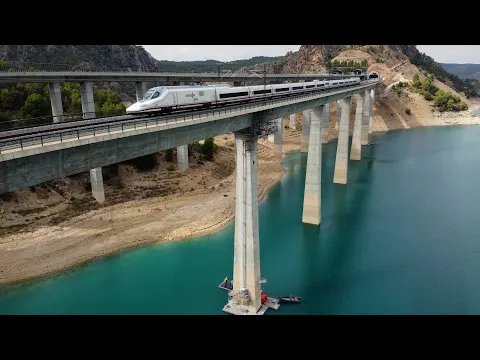
With 830 Meters in Length, Spain Modernizes a High-Speed Viaduct During the Night, Carries Out Heavy Works in a Few Hours, and Releases the Line Before Dawn.
According to technical statements from Adif and specialized regional reports, the modernization of the Viaducto del Istmo, located on the high-speed line Madrid–Valencia, shows how large railway works can be carried out without paralyzing the country. The viaduct, with 830 meters in length, crosses a deep valley in the Contreras reservoir region and is a critical part of a corridor through which trains travel at hundreds of kilometers per hour every day.
Unlike traditional works, which would require long closures, the strategy adopted was to concentrate interventions during the night, when there is no train traffic. Instead of closing the line for months, Spanish engineering chose to execute complex stages in short nightly windows, returning the infrastructure ready before dawn.
A Gigantic Viaduct That Cannot Stop
With nearly a kilometer in length, the Viaducto del Istmo is not a simple structure to replace or reinforce. It rests on 11 pillars, some with dozens of meters in height, and supports a deck designed for high-speed trains.
-
A 100 m² house can jump from R$ 220,000 to over R$ 750,000 just due to the standard of finish, while invisible choices in the plan turn the dream of construction into a difficult-to-predict expense.

-
While Brazil has been dragging its feet on the Rio-São Paulo bullet train for 30 years, California has turned its own into a zombie project: 18 years, $126 billion, 60 viaducts completed, and zero meters of track laid, with Trump cutting $4 billion in July.

-
While Brazil has been discussing the Maracanã renovation for 25 years and struggles to keep the Arena MorumBis open, Abu Dhabi signs a $1.7 billion deal to build the world’s second Sphere on an artificial island, with 20,000 seats, by 2029.

-
The Brazilian state will receive its own submarine cable and a billion-dollar supercomputer, and the state will no longer rely exclusively on Ceará, which currently handles 90% of all internet traffic circulating in Brazil.


Any intervention needs to maintain the stability of the structure and respect extremely tight tolerances, even when performed within a limited time.
For this reason, the work was not designed as a large open worksite, but as a sequence of surgical operations, repeated night after night.

Heavy Works Carried Out While the City Sleeps
During the nights, specialized teams spring into action as soon as the last train passes. The deck of the viaduct is lightly lifted with hydraulic cylinders, enough to allow the replacement and modernization of essential structural elements, such as the supports that absorb vibrations, thermal expansions, and movements of the structure.
These lifts are small in absolute value but critical from a technical standpoint. Millimeters make a difference in infrastructure designed to operate safely at high speed. Still, the entire process is planned to fit within a single night.
Engineering Designed to Save Time, Not to Be Seen
The most impressive aspect of the project is not just the size of the viaduct, but the execution time. Instead of dismantling large sections or reconstructing entire parts, Adif adopted a logic of progressive modernization, carried out over weeks, always during nighttime.

Each night represents a small advance. Together, these interventions replace old components, extend the life of the structure, and update the viaduct to more modern safety standards — all without interrupting the rail service during the day.
Why Returning the Line Before Dawn is So Important
The Madrid–Valencia line is strategic for passenger transport and for the regional economy. Halting this corridor would have immediate impacts on mobility, costs, and logistics. Therefore, the main criterion of the work was not only technical but operational: the train needed to return to circulation every morning.
At the end of each nightly window, the deck is repositioned, tested, and released. The line resumes normal operations, while the average user doesn’t even notice that heavy construction is underway.
A Maintenance Model for Modern Railways
The case of the Viaducto del Istmo exemplifies a growing trend in Europe: treating large infrastructures as systems that need smart maintenance, rather than long and visible interruptions.
Viaducts hundreds of meters long are now being modernized as if they were industrial equipment, with quick, planned, and repeatable interventions.
In this model, size ceases to be an obstacle. Even a structure of 830 meters, suspended over a valley, can be updated without becoming an urban or logistical problem.
When Scale and Short Time Go Hand in Hand
By combining a colossal viaduct with works carried out in a few hours, Spain shows that heavy engineering does not have to mean prolonged chaos.
The work on the Viaducto del Istmo proves that it is possible to intervene in gigantic infrastructures while respecting the rhythm of the city and the country.
As millions of tons of concrete and steel remain in place, the real advancement lies in the method: doing a lot, in a short time, and almost without being seen.




Brasil, deveria seguir esse exemplo.