





 Portuguese
  English
  Spanish
  4 min of reading
  0 comments


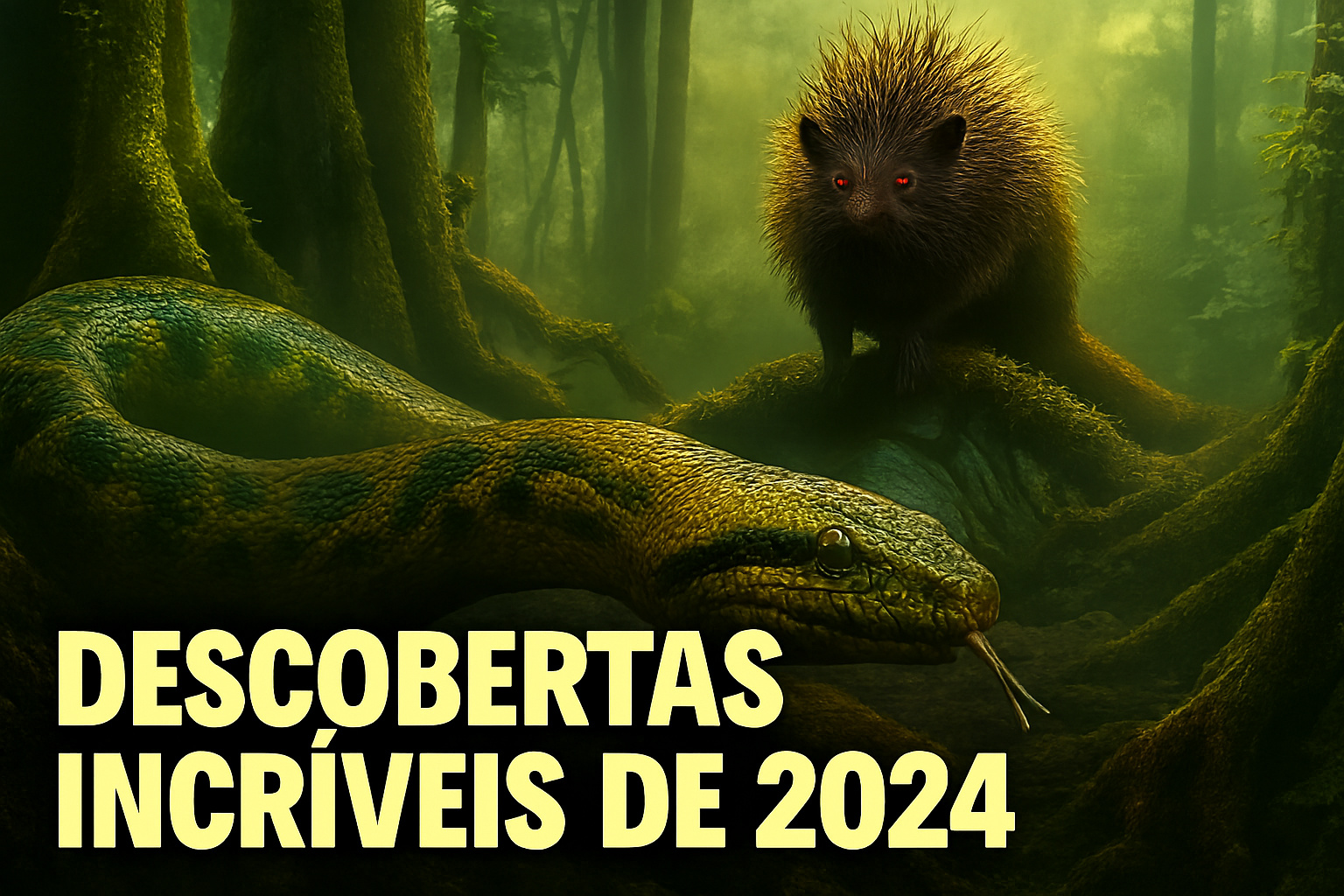
In 2024, Scientists Discovered Unknown Species Such as a 6-Meter Giant Anaconda and the Vampire Hedgehog, Proving That the Planet Still Hides Surprising Secrets.
Nature still holds mysteries that astonish even the most experienced scientists. The year 2024 went down in modern biology history as one of the most fruitful periods for the discovery of new species. From unexplored tropical forests to ocean depths, researchers identified dozens of animals and plants that had never been cataloged by science. The survey, published by magazines like Discover Wildlife and National Geographic, shows how vast and enigmatic the planet still is — and how human action may be threatening species even before they are known.
A Colossal Snake Hidden in the Amazon
Among the most impactful discoveries is the new species of giant anaconda, identified in an international expedition led by scientists from the University of São Paulo and the University of Groningen in the Netherlands.
Found in the flooded forests of Ecuador, the northern green anaconda (Eunectes akayima) measures up to 6.1 meters long and weighs over 200 kilograms, surpassing previous records of the known Eunectes murinus, which inhabits much of the Brazilian Amazon.
-
Family has lived for over 50 years without electricity and running water at home in the South of Minas, 10 minutes from the city, improvising light, bath, and water while facing a lack of basic resources and awaiting property regularization.

-
Children from the 1980s and 1990s who spent hours playing in the street until dark naturally developed spatial intelligence, which today has become the subject of expensive courses, cognitive training, and modern methods of child and adult learning.

-
Without bombs, without electricity, and without drilling the ground, villages in southwestern Morocco have discovered how to extract water directly from the air using only polymer nets, wind, and the humidity of the Atlantic amidst the advancing desert.

-
Son of a Brazilian, a 20-year-old young man defies extreme pressure, wins the world rodeo championship, and takes home a million-dollar prize of nearly R$ 5 million.





The finding was confirmed by genetic analyses that demonstrated a 5.5% difference in DNA compared to known species — a considerable variation in evolutionary terms.
According to Dutch biologist Freek Vonk, who participated in the discovery, “this new species represents a true giant of nature and reinforces the role of the Amazon as the last refuge of extreme biodiversity on the planet.”
The research was published in March 2024 in the journal Diversity, highlighting the importance of preserving the Amazon rivers and Ecuadorian floodplains.
The Vampire Hedgehog and the Unusual Fauna of Asia
Another noteworthy discovery was the so-called vampire hedgehog, a small mammal found in the jungles of Southeast Asia, whose dark quills and nocturnal habits gave rise to the curious nickname.

Scientists observed that the animal has a peculiar adaptation: salivary glands that secrete anticoagulant compounds, which help it feed on small insects and frogs.
Although the name sounds frightening, it is an innocuous species to humans and an example of how nature develops unique strategies for survival.
The discovery was published in the Journal of Mammalogy, which also highlighted the record of more than 60 new species of vertebrates in 2024 alone — an impressive number considering the pace of natural habitat destruction worldwide.
The Rediscovery of “Ghost” Species
In addition to new species, 2024 was also the year of the so-called “rediscoveries”, when animals considered extinct or missing were observed again after decades.
A notable example was the Mekong ghost fish, which had not been seen for over 20 years and reappeared in recent expeditions in Southeast Asia.

Another emblematic case was that of the Colombian crystal frog, rediscovered in 2024 by researchers from the National University of Colombia, showing that the conservation of tropical forests can still recover species on the brink of disappearance.
These rediscoveries serve as a reminder that many wild populations may be surviving in isolated refuges, invisible to modern science. However, they also reinforce the warning: without effective environmental policies, many of these species may disappear before being fully studied.
The Planet Is Still a Living Laboratory
According to the “Top New Species 2024” report prepared by the International Institute for Species Exploration, it is estimated that there are between 8.7 and 10 million species of living organisms on Earth, of which only about 20% have been identified. In other words, the planet remains a living laboratory with incalculable scientific potential.
With each new discovery, science gains more than just a name in taxonomy; it gains a fundamental piece to understand how ecosystems are structured and adapt.
The new Amazonian anaconda, for example, may help understand speciation processes in isolated environments, while the vampire hedgehog provides clues about the evolution of nocturnal mammals.
A Reminder That the Unknown Still Exists
The catalog of discoveries in 2024 is, in essence, a celebration of what we still do not know. It reminds the world that, even in the full era of technology and space exploration, Earth remains a territory of biological mysteries.
Each new described species is a testament to the complexity of life and also a silent plea for preservation.
Because, as the scientists involved in these studies assert, “you cannot protect what you do not yet know.” And the planet, with its forests, rivers, and oceans, still has much to reveal.









-

1 person reacted to this.