Portuguese
  Spanish





With the Quota Law, Federal Competitions Now Reserve 30% of Positions for Black, Indigenous, and Quilombola People. The Law Was Enacted on June 3, 2025, and Is Already in Effect.
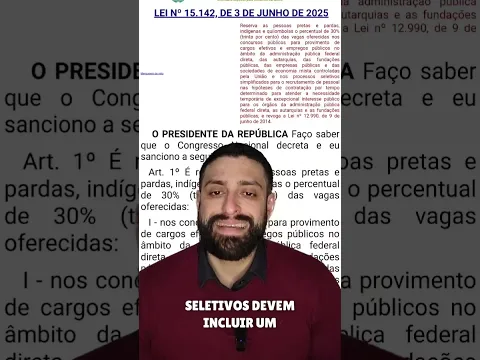
Law No. 15.142/2025 raised the quota for positions in federal public service exams and selections to 30% for black or brown individuals, indigenous people, and quilombola individuals. Enacted by President Luiz Inácio Lula da Silva on June 3, 2025, the law replaces the previous framework (Law 12.990/2014) and consolidates affirmative policy within the Union.
The text affects the direct federal public administration, autarchies, public foundations, public companies, and mixed-economy companies controlled by the Union, in addition to simplified selection processes for temporary hires. The rule applies from now on, meaning it pertains to new announcements.
On June 27, 2025, Decree No. 12.536 regulated the law. The decree detailed the implementation and internally divided the 30%: 25% for black or brown people, 3% for indigenous individuals, and 2% for quilombola individuals.
-
Brazilian Family’s Homeschooling Success Sparks International Debate: Daughters Read 30 Books Annually and Speak Multiple Languages

-
Piauí Governor Enacts Law Requiring State Contractors to Reserve Jobs for Former Inmates with Minimum Wage and Verification Before Payment

-
Providing Your Tax ID at Supermarkets: A Routine Step That Can Unlock Discounts and Rewards but Also Reveals Your Shopping Habits
-
Germany Changes Noise Regulations, Extending Quiet Hours Beyond 10 PM




The change responds to criticisms regarding the effectiveness of quotas and reinforces controls such as complementary confirmation to self-declaration, heteroidentification committees, and standardized procedures in announcements.
What Changes in Federal Public Competitions with the Quota Law 2025
The main novelty is the increase in the percentage: the limit of 20% has been replaced by 30% of reserved positions. The law also formally repeals Law 12.990/2014, consolidating the new framework for federal competitions and temporary selection processes. Federal agencies and entities must reflect the quota in the announcements.
The scope covers competitions for permanent positions and public jobs in the federal Executive and its entities, as well as temporary selections. The stated goal is to enhance racial inclusion and rectify historical inequalities in access to public service.
The rule applies to new competitions. According to the Chamber of Deputies, although the law is already in effect, it will only apply to future announcements, providing predictability for candidates and assessment boards. This avoids changes mid-process and reduces disputes.
Percentages, Distribution Among Groups, and Heteroidentification
Decree 12.536/2025 defined the internal distribution of the 30%: 25% to black or brown individuals, 3% to indigenous people, and 2% to quilombola individuals. The measure applies to all federal public administration and will be replicated in the announcements, with rules on how to calculate and fill reserved positions. Keywords: Quota Law 2025; quota distribution; federal public competition
The candidate’s self-declaration remains essential, but the decree provides for complementary confirmation (heteroidentification committees) for black and brown individuals, as well as verification of belonging for indigenous people and quilombola individuals, according to administrative criteria. Announcements must indicate the procedures and required documentation.
Official guidance and explanatory materials reinforce that heteroidentification does not replace self-declaration, but validates it as a mechanism for integrity in public policy. Agencies are responsible for training the committees and ensuring transparency.
When Does the 30% Quota Take Effect and How Will It Be Applied in the Announcements
The application is immediate for new announcements. The Chamber noted that the law is already in effect, but only applies to future competitions. Therefore, those preparing for federal competitions should closely monitor upcoming announcements for the new rules.
For positions with few vacancies, the regulation brought solutions to avoid “symbolic vacancies.” In the Unified National Public Competition (CPNU), for example, the government adopted a lottery to ensure the effectiveness of the quotas when the offer is insufficient to automatically apply the percentage.
The law also standardizes items that generated uncertainties: concurrent competition for open vacancies, dual classification in the results, and the rule that approved quota candidates within the open are not counted toward the quota, preserving the net increase in opportunities.
Calculation Criteria, Rounding, and Periodic Review
The Senate Agency highlights that the 30% quota applies when there are two or more vacancies in the position. In fractional calculations, there is rounding: up when the decimal is ≥ 0.5. This reduces loopholes for positions with low offers.
The government stated that the policy will undergo review every 10 years, maintaining monitoring and evaluation of results, with the possibility of adjustments. This review clause aims to ensure continuous improvement.
Do you think the 30% quota in federal competitions rectifies inequalities or violates the concept of merit? Does the lottery for positions with few vacancies ensure justice or create insecurity? Leave your comment and contribute to the qualified debate.