Portuguese
  Spanish


The Port of Itajaí, in Santa Catarina, is preparing a mega-operation to receive 11,700 electric and hybrid vehicles from BYD in two stages. On Tuesday (26), a ship from the Italian shipping company Grimaldi docks with 4,500 cars, and on June 23, the largest car carrier ship from BYD, the BYD Shenzhen of the Explorer class, brings the remaining 7,200 units. The operation mobilizes 150 port workers in a 24-hour uninterrupted regime, 90 car carrier trucks, and a special traffic plan to avoid congestion on the streets of Itajaí.
The largest car carrier ship from BYD is on its way to the Port of Itajaí with 7,200 electric and hybrid vehicles on board, but before its arrival on June 23, an Italian ship from the Grimaldi shipping company docks this Tuesday (26) with another 4,500 cars from the Chinese manufacturer. According to information from the portal Auto Papo, in total, there are 11,700 cars that will disembark at the Santa Catarina terminal in one of the largest movements of imported vehicles ever recorded in Brazil, requiring a task force that starts at 7 am on Tuesday and operates for 24 hours without interruption.
The operation is a test for the technical capacity of the Port of Itajaí and for the urban logistics of the city. The city hall has set up a strict traffic plan to channel the flow of 90 car carrier trucks that will continuously circulate between the port and the BR-101 highway. About 150 port workers were mobilized on standby to ensure that the transshipment of vehicles from the largest car carrier ship and the Italian ship happens without interruptions and with minimal impact on the city’s traffic.
The first stage: 4,500 cars on Tuesday

The first batch of vehicles arrives this Tuesday (26th) aboard a ship from the Italian shipping company Grimaldi, one of the largest ro-ro transport operators in the world. The unloading of 4,500 BYD automobiles will be carried out in a continuous 24-hour regime, with transshipment work starting at 7 a.m. and extending until Wednesday morning.
-
Brazil’s Port of Santos to Receive New $1.1 Billion Container Terminal, Tecon Santos 10, Set to Begin Operations in 2029

-
Ports without drivers and cabins already move containers like automated factories: robotic cranes, autonomous electric vehicles, and software transform giant terminals into 24-hour logistics machines.
-
About 300 American ports still breathe diesel from trucks, cranes, and locomotives, but they are now trying to electrify heavy machinery to clean the air for 31 million nearby residents.

-
A 220-meter giant powered in part by solar energy and lithium batteries has just unloaded nearly 5,000 Chinese cars at the Port of Itajaí. It is the first of ten Grimaldi super ships and the first in the world prepared to run on ammonia as fuel.


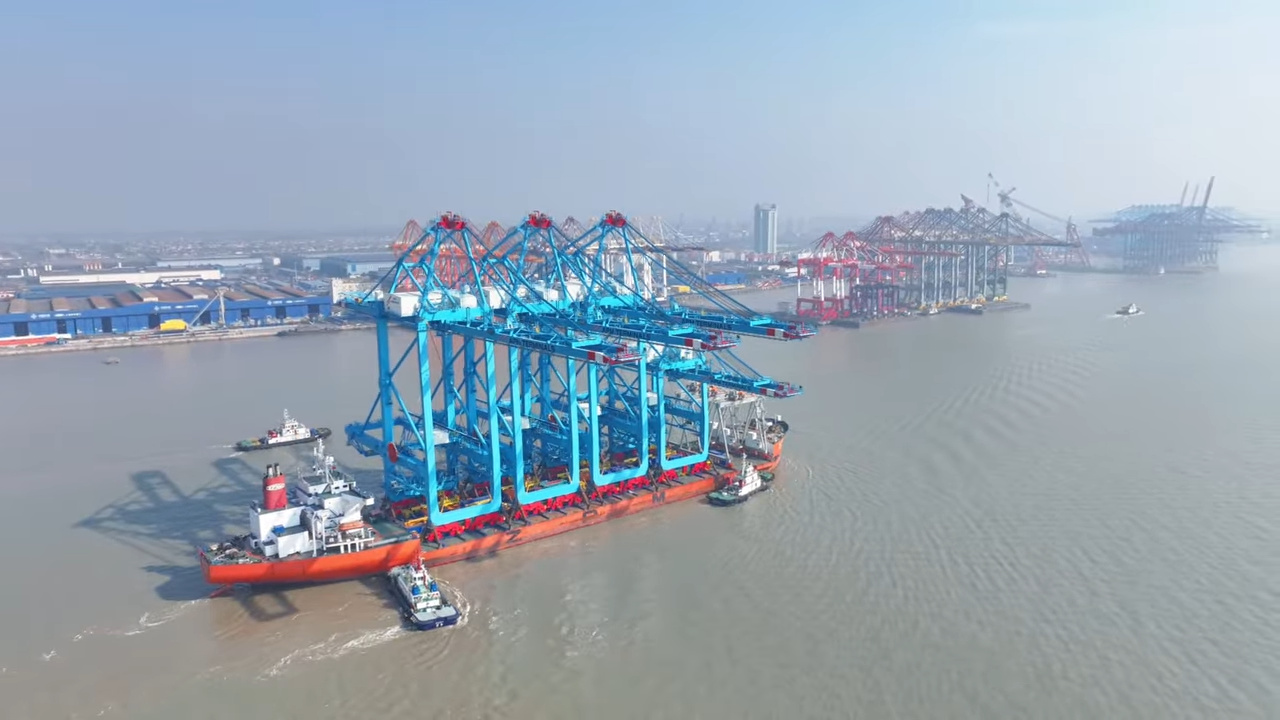


The initial fleet of 90 car carrier trucks will immediately transport the vehicles from the port to storage yards and distribution centers. Each car carrier truck transports between 8 and 11 cars per trip, which means hundreds of trips over the 24-hour operation. The logistics were planned so that empty trucks enter through the port and loaded ones exit through separate routes, avoiding crossings that could block the flow.
The second stage: the largest car carrier ship with 7,200 vehicles
On June 23, the Port of Itajaí will receive the BYD Shenzhen, an Explorer class vessel that is one of the largest car carrier ships designed exclusively for transoceanic vehicle transport. The largest car carrier ship from BYD will bring 7,200 units of electric and hybrid models, a volume that exceeds the first stage batch by 60% and will require an even more robust operation.
The largest car carrier ship of the Explorer class was specifically built by BYD to meet the growing demand for exporting electric vehicles from China to markets in South America, Europe, and Southeast Asia. The ro-ro vessel, an acronym for roll-on/roll-off, allows vehicles to board and disembark on their own wheels, speeding up the loading and unloading process compared to conventional ships that use cranes.
The traffic plan that Itajaí set up for the operation
With dozens of trucks continuously circulating between the port and the BR-101, the Itajaí city hall established pre-determined routes to minimize urban bottlenecks. The empty car carrier trucks access the port complex via exit 120 of the BR-101, traveling along Adolfo Konder and Carolina Vailatti avenues and Indaial and Felipe Reiser streets to the terminal.
After loading with vehicles from the largest car carrier ship and the Italian ship, the exit route channels the trucks through Felipe Reiser street towards Benjamin Franklin Pereira and Blumenau streets, to Reinaldo Schmithausen avenue for the return to BR-101. The separation between entry and exit routes is essential to prevent empty and loaded trucks from crossing on narrow roads, which could paralyze traffic during peak hours.
What the operation means for the Port of Itajaí and BYD
The choice of Itajaí as the disembarkation point for 11,700 vehicles confirms the position of the Santa Catarina port as a logistics hub for car imports in Southern Brazil. The largest car carrier ship from BYD had already used Brazilian ports in previous operations, but the combined volume of 11,700 units in two stages is historic for the terminal.
For BYD, the operation demonstrates the scale of the Chinese automaker’s expansion in the Brazilian market, where electric and hybrid models like the Dolphin, Song Plus, and Seal already compete with traditional brands. Assembling a task force with 150 workers and 90 trucks for a single import shows that the volume of Chinese vehicles arriving in Brazil is at a level that requires dedicated port infrastructure.
Did you know that 11,700 BYD cars will be unloaded at the Port of Itajaí in two operations? Do you think the Brazilian port infrastructure is ready for this volume of import? Tell us in the comments.