Portuguese
  Spanish


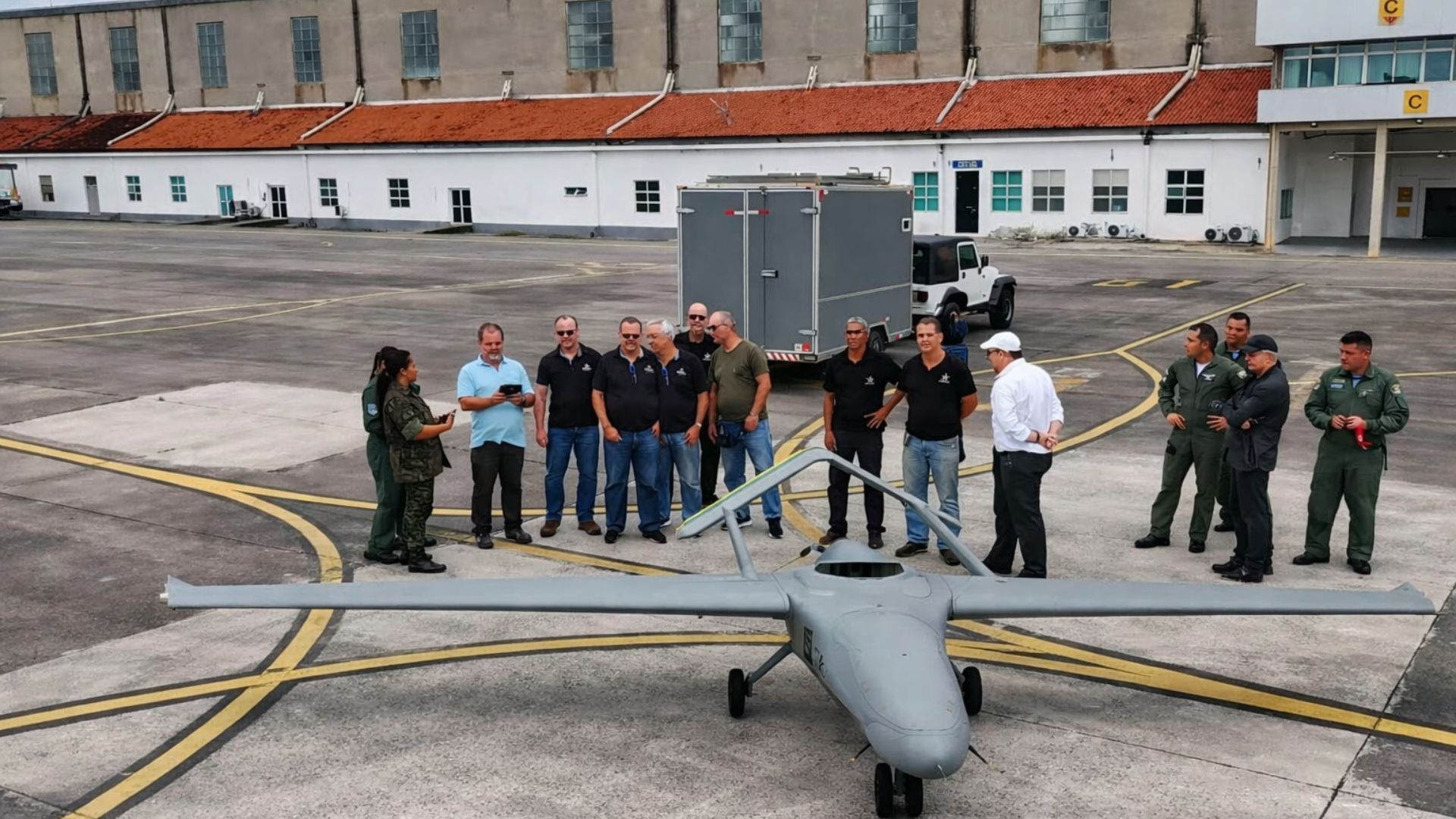


The First Flight of the Albatroz Vortex Equipped with National Jet Engine Consolidates an Unprecedented Capacity in the Country, Brings Together Brazilian Companies, Institutional Support from the Brazilian Air Force and the Ministry of Defense and Forecasts New Horizons for High-Performance Drones
Brazil has taken a significant and symbolic step in the development of advanced aeronautical technologies by conducting, for the first time, a test flight of the Albatroz Vortex Jet Drone, a high-performance unmanned aircraft designed and built entirely within national territory. The trial took place at the Santa Cruz Air Base (BASC), in Rio de Janeiro, and represents a historic milestone by bringing together, in a single operational platform, a Brazilian drone equipped with a jet propulsion system also developed in Brazil. This information was reported by the AEROIN website, specializing in aviation and defense, as per an article by Mateus Alves.
The First Flight That Consolidates an Unprecedented Capacity in the Country

First and foremost, the flight of the Albatroz Vortex was not just another experimental test. It represents a concrete advance in the technological autonomy of the Brazilian aerospace industry, especially in the segment of more complex unmanned aerial vehicles. The successful operation was a direct result of the integration between the airframe developed by Stella Tecnologia and the reaction turbine created by AERO Concepts, a combination that consolidates a capability that was previously non-existent in Brazil.
Furthermore, the test received institutional support from the Ministry of Defense and the Brazilian Air Force (FAB), under a cooperation agreement established in November 2025, which aims to develop strategic solutions for unmanned aerial systems. This institutional support reinforces the strategic nature of the project and demonstrates the interest of the Armed Forces in maturing the national industrial base.
-
She spent 73 years breathing inside an iron lung, survived the aftereffects of polio, and became the last woman in the United States dependent on the equipment before dying at 78 years old.

-
Brazilian students created a $1 filter using pine bark, cotton, and 3D-printed parts to clean cassava wastewater, reduce the toxicity of a hazardous waste, and transform contaminated water into biofertilizer.

-
Astronaut from Artemis II steps down after mission to the Moon and decision surprises after a record of 406,771 km, a historic 10-day journey, and an unprecedented achievement for Canada.

-
A fossil kept for years in a small museum in Montreal concealed 450-million-year-old soft tissue, a discovery that has only happened once before in history.


The flight took place on December 17, with the main objective of evaluating the turbine’s performance in a real operational environment, as well as validating the integration between the propulsion system and the aerial platform. This stage is considered critical in high-performance drone projects, as it involves aerodynamic, structural, and reliability aspects that cannot be fully simulated in a laboratory.
Albatroz Vortex: Performance, Weight, and New Operational Possibilities


In practice, the Albatroz Vortex derives from a line of unmanned aircraft already considered technologically mature, developed over the past few years by Stella Tecnologia. However, the adoption of jet propulsion represents an important qualitative leap compared to previous versions.
The drone has a maximum takeoff weight of around 150 kilograms, a feature that positions it in an intermediate category of UAVs, capable of addressing different mission profiles. With the new engine, the system now offers higher speeds, the capability to operate at higher altitudes, and greater flexibility for the development of new operational and technological applications.
Consequently, this advance opens up spaces for both civil uses and projects of strategic and defense interest. Platforms of this type can be employed in sensor testing, validation of embedded systems, reconnaissance missions, development of operational doctrines, and even as a basis for future more complex unmanned aircraft.
The ATJR 15-5 Turbine and the Leap in Brazilian Technological Autonomy
At the heart of this advancement is the ATJR 15-5 turbine, created entirely by AERO Concepts, a company based in São José dos Campos, in the state of São Paulo, one of the main aerospace hubs in the country. The engine was developed with own resources, from initial market studies to the design, prototype manufacturing, bench testing, and flight validation phases.
Technically, the ATJR 15-5 delivers thrust of 500 newtons, becoming the first small jet turbine designed in Brazil to effectively operate in flight integrated with a drone. This information is particularly relevant because propulsion systems are often one of the main technological bottlenecks in advanced aeronautical projects, frequently reliant on foreign suppliers.
Thus, the success of the flight represents a significant advancement in national autonomy in the development of propulsion systems, reducing external dependencies and expanding Brazil’s mastery over sensitive technologies. In addition to the direct impact on the industry, this achievement also strengthens the country’s ability to participate in global value chains in the aerospace sector, with products and solutions of higher added value.