






 Portuguese
  Spanish
  4 min of reading
  0 comments


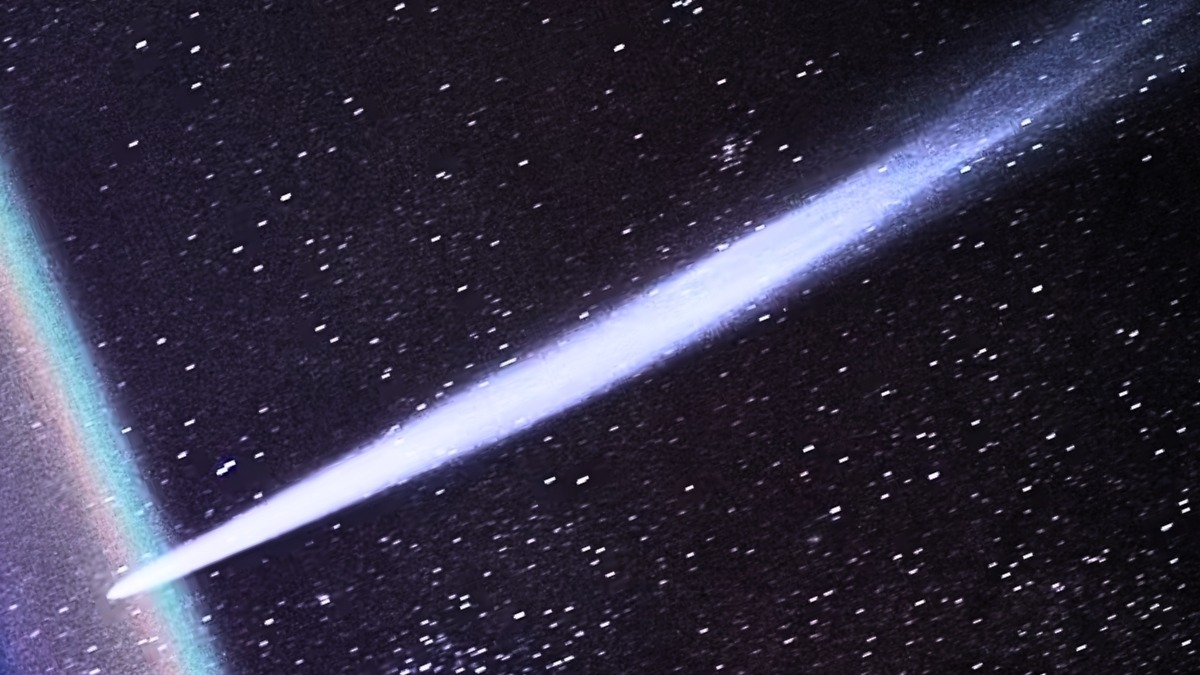
Discovered on January 13 in the Atacama Desert, Comet C/2026 A1 is part of the Kreutz sungrazers family, approaching within just 120,000 kilometers of the Sun’s surface in early April and may reach unusual brightness, with a chance of visibility to the naked eye
A newly discovered comet, C/2026 A1 (MAPS), identified on January 13 in the Atacama Desert, may become visible to the naked eye in early April as it passes 120,000 km from the Sun, repeating historical trajectories of Kreutz sungrazers.
Recent Discovery and Extreme Trajectory of the Comet
Comet C/2026 A1 (MAPS) was detected by a team of four amateur astronomers using a remotely operated telescope in the Atacama Desert. Shortly after its identification, it became evident that the object belongs to the family of Kreutz sungrazers.
This type of comet travels on an extremely elongated orbit around the Sun, dangerously approaching the star. In early April, the MAPS comet will reach an estimated minimum distance of 120,000 km from the solar surface.
-
Chinese robots trained for two weeks to row a dragon boat at the Sichuan Festival in China, took full control when humans stopped rowing, and even made rice dumplings in one of the most unusual tests ever conducted with humanoids.

-
Public school students in Sergipe create an early autism screening kit for vulnerable communities without a doctor, in the year Brazil won 8 awards at the world’s largest science fair.
-
Engineering students create a low-cost 3D-printed wheelchair for dogs and help the paralyzed dog Bili, who was born without legs, walk again for R$ 448.
-
Man creates ingenious hack with pipes buried 2.4 meters deep and transforms snow into a tropical fruit greenhouse; system created by a retired mailman uses ground heat, produces oranges and lemons in Nebraska’s winter and has already turned into more than 700 kits sold.


If the comet survives this passage, known as perihelion, it may exhibit a significant increase in brightness. There is a possibility that it could become visible even in full daylight, although there is a risk of disintegration before this critical point.
The Family of Kreutz Sungrazers
Over approximately 2,000 years, various extremely bright comets have appeared suddenly near the Sun. Many of them reached brightness sufficient to be observed during the day, historically classified as “Great Comets.”
Among these events is the Great Comet of 1965, C/1965 S1 (Ikeya-Seki), considered the brightest of the 20th century. Discovered just a month before perihelion, it reached brightness comparable to that of a full Moon and was easily visible to the naked eye during the day.
Another remarkable example was the Great Comet of 1882, C/1882 R1, which became a hundred times brighter than the full Moon. Its intense brightness dominated the sky for several months, making it one of the most impressive comets ever recorded.
Common Origin and Fragmentation of a Megacomet
Studies indicate that all these comets belong to the same lineage, the Kreutz family, originating from a single giant cometary nucleus. This megacomet, over 100 km in diameter, is believed to have dangerously approached the Sun possibly between the 3rd and 4th centuries BC.
After this approach, already far from the Sun, the nucleus fragmented into two large bodies and numerous smaller pieces. Centuries later, these fragments returned to perihelion, giving rise to multiple comets observed throughout history.
Reports from AD 363 suggest that several comets from this family were visible simultaneously in broad daylight. In the 11th century, the two largest remaining fragments produced the Great Comets of 1106 and 1138, which also fragmented again.
Since then, the products of these successive fragmentations have been observed as a series of comets over the last two centuries, keeping the lineage of Kreutz sungrazers active.
Modern Observations and the Role of Solar Probes
Currently, the Kreutz family includes numerous small fragments that disintegrate before reaching perihelion, in addition to some larger ones capable of generating significant displays. NASA’s Solar and Heliospheric Observatory, known as SOHO, has detected thousands of these fragments over the years.
Most of these objects are only a few meters or tens of meters in diameter. Larger fragments are observed much less frequently, making each new candidate for a Great Comet an eagerly awaited event for the astronomical community.
The last large Kreutz comet observed was recorded in 2011. Discovered by Queensland astronomer Terry Lovejoy, the comet narrowly survived perihelion and achieved brightness comparable to that of the planet Venus at the end of December that year.
Predictions and Expectations for the MAPS Comet
According to predictions by Czech-American astronomer Zdeněk Sekanina, two large sungrazers may appear in the coming decades, with one potentially appearing within the next two years. The MAPS comet fits into this expectation scenario.
The newly discovered comet has already set a record by being identified at a greater distance from the Sun than any other sungrazer at the time of discovery. This factor suggests that it may be a relatively large fragment of the Kreutz family.
The previous record was held by the comet Ikeya-Seki in 1965. However, technological advances in recent decades indicate that it is unlikely that the core of the MAPS comet is as large as that of that historical event.
Recent observations show a steady increase in the comet’s brightness, reinforcing the hypothesis that it is a larger fragment and not a body undergoing accelerated disintegration, as initially considered.
What May Happen After Perihelion
It is still early to accurately determine the final behavior of the MAPS comet. If the comet survives its passage through perihelion, it may provide a significant spectacle in early or mid-April, especially in the Southern Hemisphere.
Even if it does not achieve daytime visibility, the comet is expected to be widely recorded by the SOHO probe, providing detailed images of its solar approach. In the following days, the comet will enter the night sky.
Thanks to its orbit, typical of Kreutz comets, observation will be more favorable in the Southern Hemisphere. A late fragmentation during the passage near the Sun could result in a sudden and unexpected brightness, creating a particularly striking scenario.
For now, astronomers are closely monitoring the evolution of the comet, waiting to see if it will become another remarkable chapter in the long history of Kreutz sungrazers or if it will quietly disintegrate before the decisive moment.





-

-

3 people reacted to this.