






 Portuguese
  Spanish





The Partnership Between Brazil and China in Agriculture Has a Direct Impact on Brazilian Exports and Infrastructure. But the Growing Dependence on a Single Market Could Bring Unpredictable Risks to the National Economy. What Does the Future Hold for Us?
The Brazilian agribusiness is experiencing a phase of intense relationship with China, which has become Brazil’s largest trading partner.
In 2022, Chinese investments surpassed US$ 58 billion in agricultural sector products, a significant amount, but what does this represent for Brazil’s future?
China is not just a buyer; it is also transforming the dynamics of Brazilian agribusiness, with profound impacts on agricultural production.
-
It’s official: Petrobras takes 75% of block 3 in São Tomé and Príncipe and debuts as an offshore operator outside South America.

-
US$ 1.5 billion dam project on the Rio Indio promises water for the Panama Canal for 50 years, but it could flood rural areas and displace 2,000 residents from 38 farming communities.

-
At 14 years old, she worked in a factory in Hong Kong, studied economics abroad, and then entered the Chinese real estate market, which helped change the landscape of Beijing.

-
While NATO secured more than $10 billion in missiles and space surveillance at a single forum, Brazil still spends 1.1% of its GDP on defense and is stalling its own anti-aircraft system.




According to the channel Mastery in Business, the relationship between the two countries has grown exponentially in recent decades, especially with China becoming the main destination for Brazilian commodities, such as soybeans, meat, forest products, and others.
The Rise of China as the Main Consumer of Brazilian Commodities
This movement, however, is not recent.
Since the 2000s, China has stood out as a major consumer of Brazilian commodities, accounting for more than 30% of exports from Brazil’s agribusiness.
However, it is important to understand the implications of this growth.
The relationship represents opportunities for expansion, but also challenges that could bring economic dependency, as highlighted by the Mastery in Business channel.
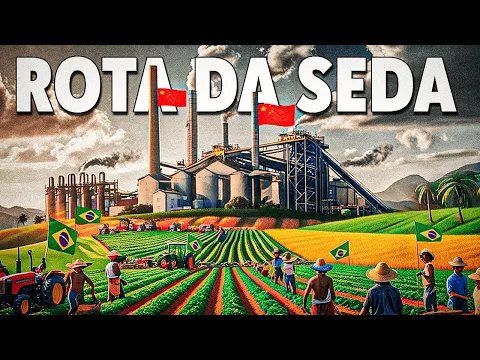
The key to understanding the impact of this partnership lies in China’s New Silk Road initiative.
The New Silk Road and Chinese Investments in Infrastructure
The New Silk Road, as explained by the channel, is an ambitious project by China to establish trade routes and global influence through investments in infrastructure.
Although Brazil is not officially part of the project, it is fully integrated into it, especially in the agricultural sector.
China is not limited to purchasing Brazilian products, but is also investing in crucial infrastructure to facilitate these exports, including ports, railways, and grain terminals.
According to the channel, these investments not only facilitate access to Brazilian products but also strengthen China’s position in the global food trade.
Improvement of Infrastructure in Brazil with a Focus on Energy and Logistics
Brazil is benefiting from this partnership, as according to Mastery in Business, infrastructure in Brazil is improving, with a special focus on energy and logistics, areas that have attracted significant Chinese investments.
In 2023, for example, electric energy led the reception of productive Chinese investments, with over 39% of the capital directed to wind, solar, and hydroelectric segments.
This type of investment aims to ensure that the infrastructure necessary for exporting commodities operates efficiently, allowing Brazilian products to reach China quickly, reducing risks and logistics costs.
Investments in Brazilian Ports and the Connection with China
A clear example of this interest is the Port of Santos in Brazil, which has received significant investments from Chinese companies such as COFCO, a giant in the food sector.
The company has been working on the expansion and modernization of the terminal, facilitating the export of grains and other commodities to China.
According to the channel, this investment is part of a larger plan by China to connect food-producing regions with consumer markets, especially in Asia.
This creates an efficient logistics network that ensures a constant flow of Brazilian products to China while maintaining that country’s food security.

Logistical Strategies: The Mega Port of Chancay in Peru
Moreover, China is not only investing in ports in Brazil but also in the construction of the mega port of Chancay in Peru, which is expected to shorten the travel time between South America and Asia by up to two weeks.
Although the project is located in Peru, as reported by Mastery in Business, it can benefit the export of Brazilian products, offering a new logistical alternative for exporters.
The construction of this mega port is part of China’s global strategy to ensure control over trade routes in South America.
Risks of Dependence on the Chinese Market
However, for Brazil, this partnership is not without risks. The dependence on a single market, in this case, China, can become a problem if there is economic or political instability between the countries.
Currently, more than 30% of Brazilian agricultural exports are destined for China, creating a market concentration.
This places Brazil in a vulnerable position, as any change in Chinese demand could severely impact the Brazilian economy, especially the agricultural sector.
Diversification of Exports and Sustainability in Agriculture
In addition to soybeans, Brazil also exports large quantities of beef, chicken, pork, pulp, sugar, and ethanol to China and has recently signed agreements to export corn, which is crucial for the Chinese animal feed industry.
This growing interest in Brazilian commodities reinforces the partnership, but it also highlights the need for diversification to reduce the risks associated with this dependency, as the channel points out.
Sustainability is another growing theme in the commercial relationships between the two countries.
China has shown interest in investing in sustainable agricultural practices in Brazil, such as the recovery of degraded pastures and the promotion of low-carbon agriculture.
Moreover, sustainability incentive programs have been implemented in Brazil, offering benefits such as interest rate discounts for producers who adopt socio-environmental practices.
Caution for the Future of the Brazil-China Partnership
According to Mastery in Business, the benefits of this partnership are clear, especially concerning the improvement of Brazilian infrastructure.
However, Brazil needs to pay attention to the necessity of diversifying its trade partnerships to avoid excessive dependence on China and ensure the country’s economic security.
In the long run, Brazil’s strategy should balance maintaining a strong relationship with China while also seeking to diversify markets and reduce risks.
In summary, China has become a crucial partner for Brazilian agribusiness, but this strategic relationship requires caution.
Brazil must watch the balance of this relationship while taking advantage of the benefits of Chinese investments, especially in areas such as infrastructure and sustainability.
The question now is how the country can navigate this partnership to ensure growth without becoming excessively dependent on a single market.
Is Brazil trading its economic independence for a risky relationship with China?






Parabéns governo Lules por vender o nosso país para a China. Você um dia vai ser extinto pela própria natureza e o seu legado será nós brasileiros colónia da China.