Portuguese
  Spanish




Did You Know That Smallpox Killed 300 Million People in the 20th Century? Understand How We Overcame This Invisible Enemy With the Power of Vaccination.
Imagine you have a large pile of rice in front of you. Each grain represents a person born between 1901 and the year 2000. That makes 10 billion people. Half of them are still alive. The other half, 5 billion, are gone. And a large portion of these deaths, astonishingly, could have been avoided with the medicine we have today.
Among heart diseases, cancer, accidents, and wars, there was one cause of death that profoundly marked the 20th century: infectious diseases. They alone killed around 1.5 billion people in the last century. And among these diseases, one stood out as the most cruel and lethal: smallpox. On its own, it took the lives of approximately 300 million people. More than any war or natural disaster in history.
And the most surprising part? Today we don’t have to worry about it anymore.
-
How to Prevent Brown Recluse Spider Bites: Common Hiding Spots and Free Tips to Reduce Risks

-
Natto: The Unusual Japanese Superfood Gaining Popularity on Social Media and Driving Record Exports
-
Brazilian Mayor Goes Undercover as Homeless for 24 Hours to Assess Public Services

-
15-Year-Old Entrepreneur Malu Lira Publishes 20 Children’s Books on Financial Education, Earns $500,000, and Expands Her Project to the Amazon Rainforest




Smallpox: A Threat That Lasted Millennia
Smallpox made no distinctions. It killed pharaohs, kings, and common people alike. Once infected, a person would show fever, headache, vomiting, and within a few days, the body would be covered in pus-filled blisters. One in three people died. And among those who survived, many were left blind or disfigured for life.
We have records of the disease since ancient Egypt; for example, Pharaoh Ramses V was found mummified with marks on his face consistent with the symptoms of smallpox.
When European colonizers arrived in the Americas in the 16th century, they brought the virus with them. For the indigenous peoples who had never had contact with such a disease, the impact was devastating. It is estimated that about 90% of the native population died from infections like smallpox. It was a true biological genocide.
The Turning Point: Science and Courage
For centuries, people noticed something curious: those who contracted smallpox once did not get it again. In China, around the year 1000, there was already a practice called variolation, where scabs from someone who had the disease were inhaled or inserted into the skin of another healthy person. It was a way to try to develop immunity, and while it worked in some cases, it was also quite risky, as it could cause the disease itself.
But it was in the 18th century that things began to change for real. The English physician Edward Jenner observed that women who dealt with cows, and contracted a milder version of smallpox, known as cowpox, seemed to become immune to the more severe version of the disease.
In 1796, he conducted an experiment that changed history. He took pus from a woman infected with cowpox and applied it to an 8-year-old boy named James Phipps. The boy experienced mild symptoms and soon recovered. Months later, Jenner exposed him to human smallpox, and nothing happened. He was immune.
This is how the first vaccine in history was born. In fact, this is where the name comes from: “vaccine” derives from the Latin vacca, because of the bovine origin of the immunization.
An Audacious Plan to End the Disease
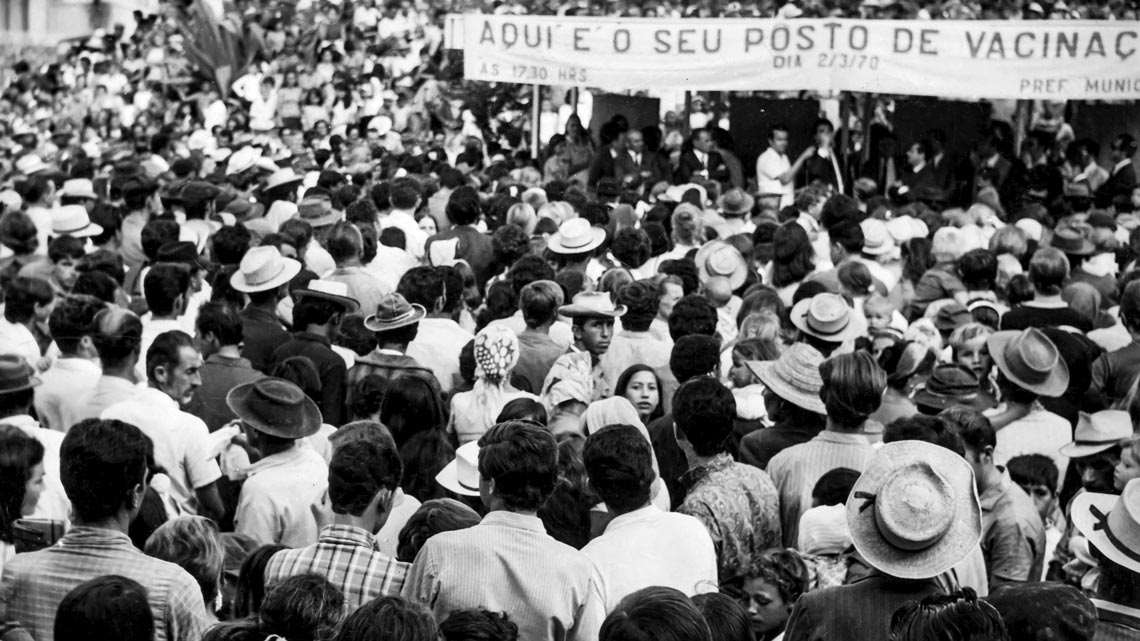
Over time, smallpox vaccination began to spread. By the early 20th century, many countries already had regular immunization campaigns. In 1950, the Pan American Health Organization managed to eliminate the disease in almost all of the Americas, except for countries like Brazil, Argentina, Colombia, and Ecuador, where there were more isolated communities that were harder to access.
Then, in 1958, a Soviet doctor named Viktor Zhdanov proposed something unthinkable to the World Health Organization: to eradicate smallpox from the entire planet. At the time, there were still 50 million cases per year.
The world accepted the challenge. The global vaccination campaign was one of the largest mobilizations in the history of health. Doctors and volunteers were sent to the most remote places on the planet. Villages were visited by boat, by plane, and on foot. Each outbreak was surrounded by mass vaccination, creating an ““immunological wall” around the disease.
And it worked.
In October 1977, the last natural case of fatal smallpox was recorded in Somalia. In December 1979, smallpox was officially eradicated from the world. It remains, to this day, the only human disease we have completely eliminated.
What Does This Mean?
It may seem normal to live in a world where you don’t have to worry about smallpox. But less than 100 years ago, it was almost certain that you would know someone who had the disease — and perhaps even lost a loved one because of it.
The victory over smallpox was only possible because of science, international collaboration, and the incredible invention of vaccines. Thanks to them, the healthcare system was able to direct its efforts towards other diseases, such as cancer and heart problems, which are now the leading causes of death.
Even Edward Jenner, who started it all, didn’t know exactly how immunity worked. It was only many years later that scientists understood that our body has a defense system that “remembers” invaders and prepares to attack them if they return. Vaccines function as training: they present a weakened or harmless version of the virus so our body learns to combat it without needing to become ill.


A Necessary Reminder
In times of fake news, misinformation, and unfounded fear about vaccines, it’s worth remembering: vaccines save lives. They are, perhaps, the greatest invention of modern medicine. And the eradication of smallpox is living proof of that.
The next time you get vaccinated or take someone to get vaccinated, remember: you are participating in one of the greatest achievements in human history. Thanks to vaccines, we live in a world where diseases that killed millions have become just chapters in a history book.
And how wonderful that it is.