






 Portuguese
  Spanish
  3 min of reading
  0 comments


Understand Where the Energy for Rotation and Translation Comes From and Why the Concept of “Infinite Energy” Does Not Apply to Our Planet
Have you ever wondered where the energy that makes the Earth spin comes from? Or why the planet keeps its movement of translation and rotation nonstop? These questions intrigue many, and the answer is more fascinating than one might think! Check below where the energy that makes the Earth perform the movements of rotation and translation comes from, according to the video from the Manual do Mundo channel.
The Formation and Initial Movement of the Earth
The movement of translation and rotation of the Earth has its roots in the formation of our solar system. Billions of years ago, a vast disk of gas and dust was slowly spinning in space. This disk collapsed, forming the Sun and, around it, the planets, including the Earth. This initial process gave rise to the spin we still observe today.
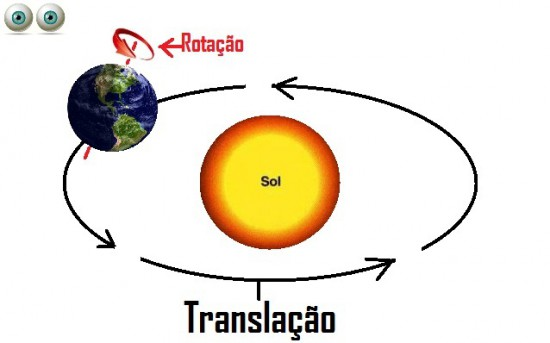
When an object in space starts to spin, it tends to maintain that movement due to the absence of friction. Just as a skater accelerates by bringing their arms together, the Earth, throughout its formation, increased its rotation as clouds of dust and gas came together to form the planets.
-
A Brazilian city decided to purchase a piece of the Atlantic Forest with more than 153,000 square meters, and owners of preserved areas will be able to submit proposals to transform the forest into a conservation unit.

-
Brazilian siblings aged 11 and 7 read 240 books in just one year and caught attention on social media: while many children spend hours on screens, they turned their family’s routine into an example of reading, discipline, and curiosity.
-
The legendary oak that, according to the story, hid Robin Hood from the Sheriff of Nottingham, died at the impressive age of 1,200 years in England, and the first chilling sign of its end was that no leaves sprouted on the tree this spring.

-
While the world looks at forests, the UN warns that the Earth is also threatened by the silent degradation of natural grasslands and savannas, ecosystems that cover half of the planet, support billions of people, and can exacerbate water, food, and climate crises.


The Concept of Infinite Energy
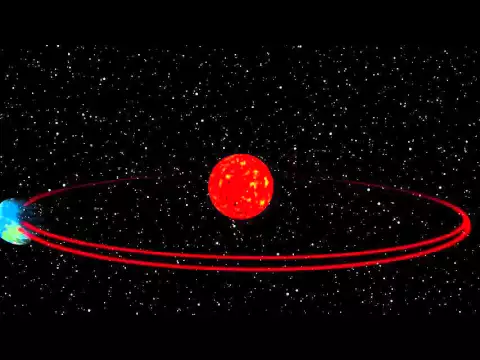
Despite the seemingly continuous movement, the concept of infinite energy does not apply to the Earth. The planet is not generating infinite energy; in fact, its rotation is gradually decreasing. This is due to several factors, including the gravitational interaction with the Moon, which causes a phenomenon called “tidal friction”, slowing down the Earth’s rotation.
If it were possible to couple a power generator to the Earth, the very movement of the Earth would begin to slow down. This happens because generating energy through a dynamo (or generator) implies energy conversion, which would eventually slow the planet’s rotational movement. Thus, it would not be possible to harness the Earth’s rotation to generate energy without impacting its spin speed.
The Earth in Motion: A Temporal Perspective
Although the concept of “infinite energy” does not apply, the movement of the Earth continues for immeasurable time in the human context. Rotation and translation are phenomena that, although gradually decreasing, occur on such an extensive timescale that they remain practically constant for us.
In summary, the energy that makes the Earth spin comes from its initial movement and the gravitational interactions that shaped our solar system. The concept of infinite energy does not fit the physics of the Earth, but the wonder of its continuous movement is a testament to the complexity and beauty of the cosmos.





Be the first to react!