






 Portuguese
  Spanish


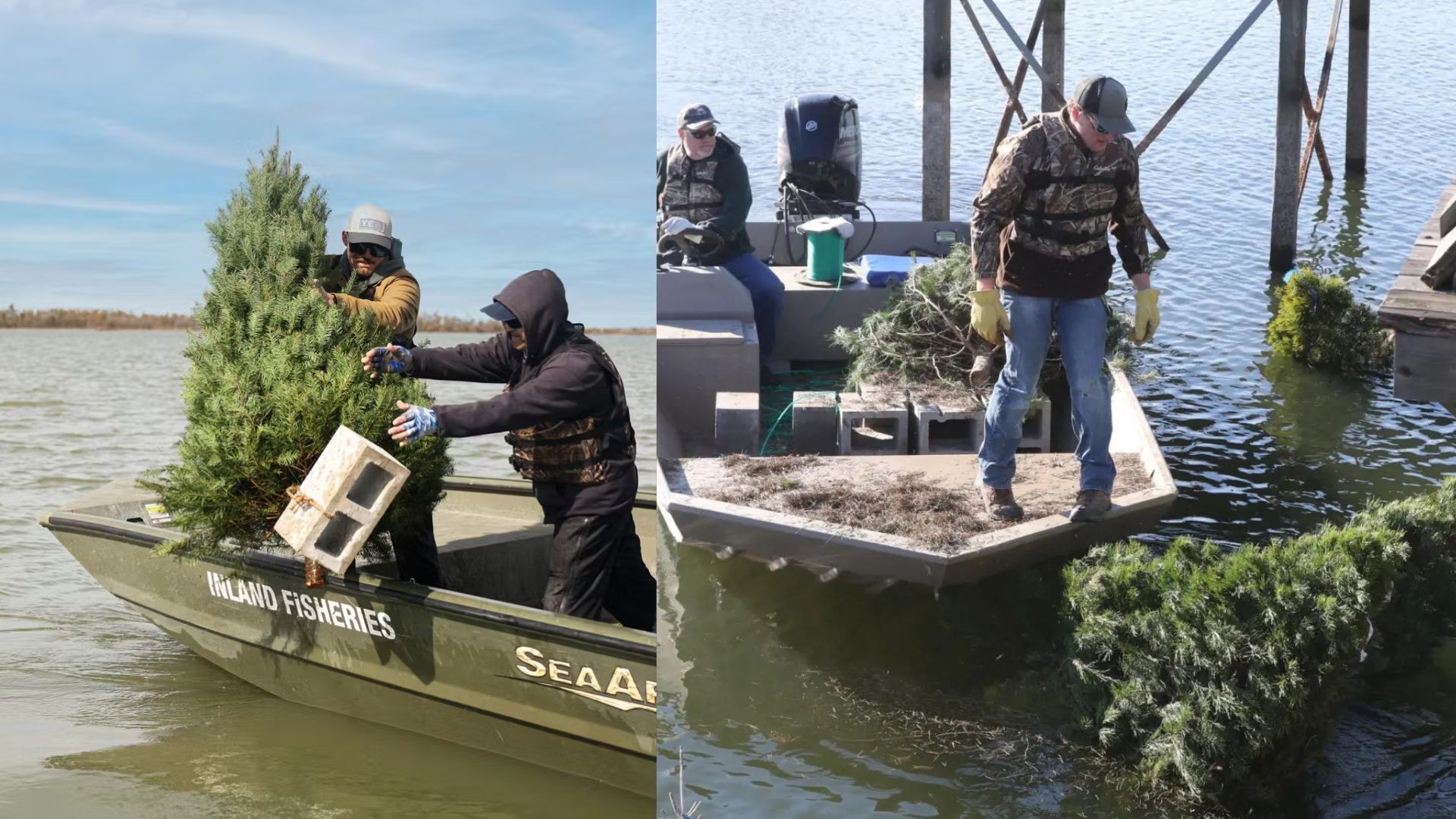


Reuse of Natural Trees After Christmas Is Being Used by Environmental Agencies to Create Submerged Habitats in Lakes and Reservoirs, Offering Shelter and Breeding Areas for Fish, Strengthening Recreational Fishing and Reducing the Disposal of Waste to Landfills Through Simple and Public Solutions.
After the lights go out and the ornaments go back into their boxes, the natural Christmas tree often has a predictable destination: the sidewalk, the collection truck, and often, the landfill.
In some regions of the United States, however, the path is different.
Environmental and forestry agencies reuse these trees to assemble submerged structures in lakes and reservoirs, creating shelter and breeding points for fish while also providing new fishing areas for the public.
-
YouTuber Discovers Surreal Collection in 400-Year-Old Italian Fortress Near Florence: 419 Anvils, Giant Walruses, Ancient Church, and WWII Tunnels

-
Creative Uses for Toilet Paper Rolls That Will Change Your Perspective
-
Crab Trapped in Plastic Bottle for 62 Days Near Okinawa Highlights Little-Known Impact of Marine Pollution on Small Animals
-
Esperanza’s Bamboo Barrier in Oaxaca Redirects River and Reduces Erosion by 85% in Five Years


Trees Transformed Into Aquatic Architecture
The logic is simple and has immediate appeal: an object associated with a few weeks of domestic use becomes “aquatic” architecture.
When installed on the bottoms of water bodies, the trees form a network of branches and empty spaces that serves as a refuge, especially for young fish.
The U.S. Forest Service describes these structures as locations that offer shade, protection from predators, and favorable conditions for spawning, as well as helping to concentrate organisms at the base of the food chain.
Public Forest Recycling Programs

This type of project appears within recycling routines linked to national forests and local partners.
In the material published by the U.S. Department of Agriculture (USDA), recycling trees after the holidays is treated as a community tradition in various areas managed by federal agencies.
The same publication notes that, in addition to becoming raw material for fish habitats, the discarded tree can also have other public uses, such as production of organic mulch and barriers against soil erosion, reducing the volume sent to landfills.
Submerged Structure and Food Chain
In the case of aquatic habitats, the goal is to insert physical structure in areas where the bottom is relatively uniform.
In such environments, the presence of a tangle of branches creates micro-areas with greater environmental complexity.
The USDA records that these habitats function as nurseries and shelter points, while the decomposition of the plant material contributes to the formation of indirect food sources.
Algae and plankton tend to develop in the surroundings, attracting smaller fish and, consequently, larger species of interest to anglers.
Scale and Annual Repetition of Projects


The examples cited by the USDA show how the practice is sustained through institutional partnerships and annual repetition.
In one of the described initiatives, the Allegheny National Forest in Pennsylvania worked with the Kinzua Fish and Wildlife Association and the U.S. Army Corps of Engineers on recycling projects.
According to the association, more than 19,500 trees were used to improve fish habitat in the Allegheny Reservoir.
The number illustrates the scale that this reuse can reach when there is logistics, collection points, and an established routine.
Local Programs and Planned Installation
The experience also appears in smaller programs, with more compact goals and a focus on specific lakes.
The USDA reports that a program from the Ironton District in the Wayne National Forest, in cooperation with the Ohio Department of Natural Resources – Division of Wildlife, collects 240 trees annually.
These trees are installed in bundles of three to four units in two locations:
- Lake Vesuvius
- Timbre Ridge Lake
The description suggests a recurring pattern in these projects: organizing the tree into sets and planning the positioning, instead of simply discarding the material into the water without criterion.
Multiple-Stage Reuse
There are also initiatives where the tree goes through more than one stage of reuse before becoming a habitat.
In Washburn, a city linked to activities in the Chequamegon-Nicolet National Forest, the USDA records a case of “double recycling”.
First, the trees are used to mark trails for a ski race over Chequamegon Bay, on Lake Superior.
Later, they proceed to the assembly of fish habitats, taking on forms known to managers and anglers, such as:
- Fish Cribs
- Structures in half-log
- Frameworks in pyramidal shape
These solutions turn a set of trees into a reference point at the bottom of the lake.
Experiences in National Forests

The strategy also appears in national forests of other states.
The USDA mentions that, in the Hoosier National Forest, teams from the Tell City Ranger District have been recycling trees to improve habitat in different lakes.
Among the cited locations are Tipsaw, Indian, Celina, and Saddle Lakes, as well as German Ridge Pond.
The common point among the reports is the use of the same input — the discarded tree — to fulfill a practical function: creating shelter and increasing the chance of finding fish in specific areas.
Direct Impact on Recreational Fishing
This type of intervention has a direct impact on the recreational fishing experience, which boosts local economies through licenses, equipment, tourism, and associated services.
The USDA considers the presence of habitats a factor capable of attracting fish to known spots, favoring activity in areas already frequented by communities.
Instead of relying only on natural characteristics of the lake bottom, management begins to include planned structures, installed with support from organizations, public agencies, and volunteers.
Seasonal Waste as a Practical Environmental Policy
In this context, the tree ceases to be merely a symbol of seasonal consumption and becomes part of a practical reuse policy.
The same USDA publication frames this solution as a community response to the question that arises every year-end: what to do with the tree after the holidays.
When the answer includes public logistics, institutional partnership, and a clear environmental goal, the waste gains a function that can last long enough to produce effects on the ecosystem and on the routine of those who depend on the lake for leisure.






Este site é uma verdadeira ****, você começa a ler a reportagem, aí entra uma infinidade de propaganda em cima do que você está lendo. Quando você tenta apagar, vai para outra página de anúncios…
Não entro mais, apesar que entrei só 2 X…
bringax turibringax bringuix
Eu reprovo pois os animais podem querer comer eles vão ver 🌿 folha vão falar comida obá!!! Quando abocanhar vão morrer podem se preparar pra ver vários animais mortos no mar por causa dessas malditas árvore de natal que deveriam ser usada pra reciclagem ♻️🚯 usem ela pra fazer outra coisa recicle ♻️ a árvore de natal pra outra coisa vai ser muito melhor pode ter certeza que vai dar certo reciclar plástico e objetos inúteis pra fazer outra coisa só parar e pensar
vai durmi entao ué
Mas são árvores de pinheiros naturais ,nao de plástico como vc disse,e elas em contato com a terra no fundo do lago podem brotar novamente..