Portuguese
  Spanish


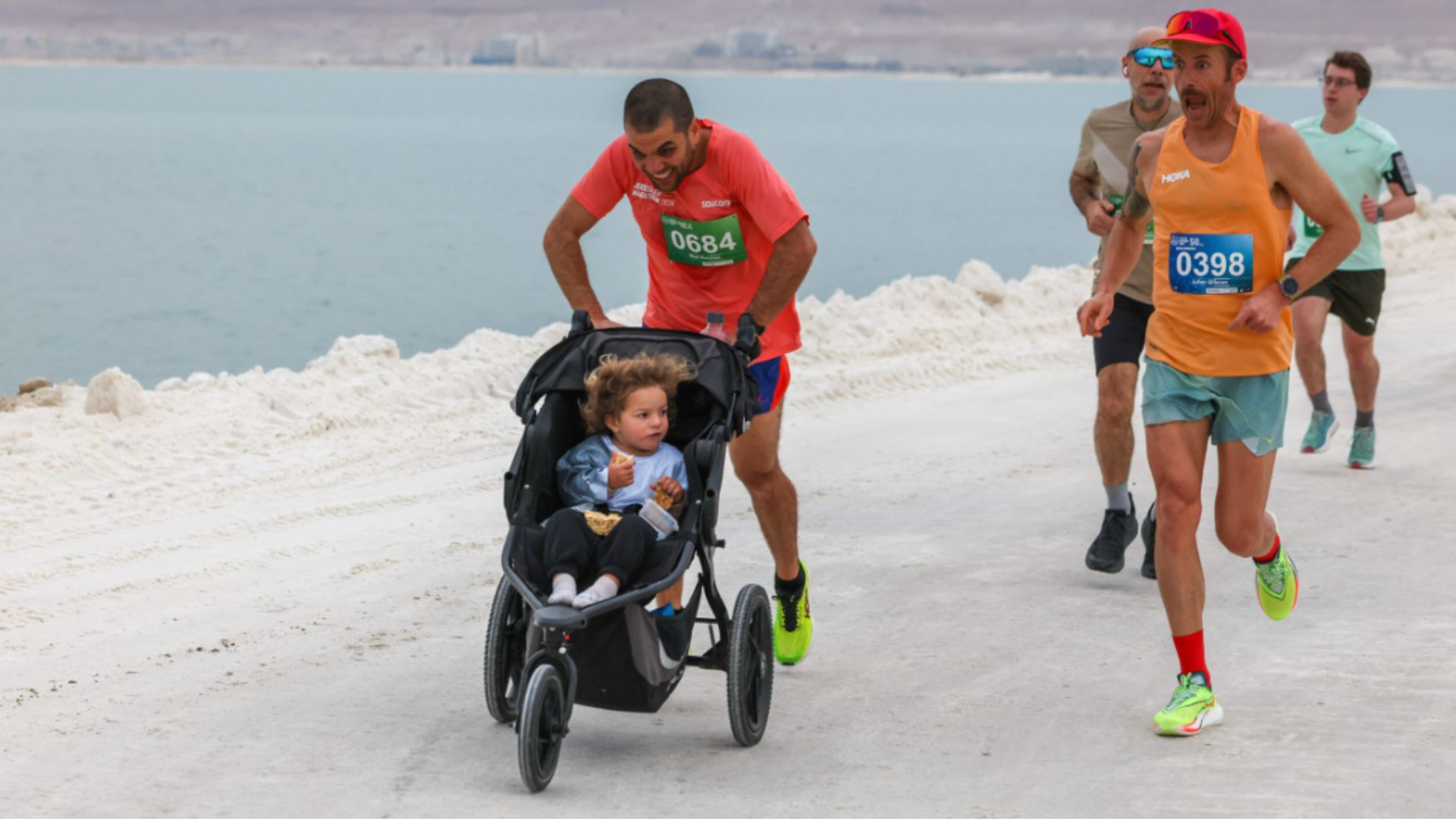


Amid Desert, Salt, and Millennial History, the Dead Sea Marathon Reveals Much More Than a Race — It Exposes Geographical, Physiological, and Cultural Layers at 430 Meters Below Sea Level
I started writing on the internet in the early 2000s, when blogs emerged and transformed how we share experiences. Back then, especially between 2009 and 2010, there was an intense debate: “bloggers are not journalists.” Even working at a major running magazine, I often heard this phrase while attending events. However, time passed. We reached 2026, and today, I don’t define myself as either a blogger or a journalist. I am a nutritionist, a runner, and I continue to write. It was precisely like this that I received, in mid-November, an invitation from the Ministry of Tourism of Israel to join a group of journalists and run the Dead Sea Marathon in February. Regardless of the label, it was an irresistible invitation.
Before the trip, however, protests erupted in Iran and reignited tensions in the Middle East. Naturally, questions about safety and ethics arose. Many people asked me if I felt comfortable traveling to Israel given the political complexities of the region. I confess that at first, I didn’t have a ready answer. So, I did what I know how to do: I studied. I studied more than I trained for the race. And this decision completely changed my experience.
The Descent to -430 Meters: When the Body Feels Before the Mind

It is not easy to reach the Middle East. It took 10 hours of flying from São Paulo to Madrid, followed by a 2-hour connection and another 5 hours to Tel Aviv. Still at the Spanish airport, I went through a thorough security inspection before boarding for Israel. As soon as I explained that I was a runner and would be participating in a race at the Dead Sea, I realized how sports create instant connections.
-
How to Prevent Brown Recluse Spider Bites: Common Hiding Spots and Free Tips to Reduce Risks

-
Natto: The Unusual Japanese Superfood Gaining Popularity on Social Media and Driving Record Exports
-
Brazilian Mayor Goes Undercover as Homeless for 24 Hours to Assess Public Services

-
15-Year-Old Entrepreneur Malu Lira Publishes 20 Children’s Books on Financial Education, Earns $500,000, and Expands Her Project to the Amazon Rainforest



From Tel Aviv to Ein Bokek, the main hotel area in Israel by the Dead Sea, the landscape changes drastically. First, the blue of the Mediterranean and Bauhaus architecture. Then, the ochre of the desert. After about 40 minutes on the road, the vegetation declines, camels appear, and the scenery takes on biblical traits. The signs indicate the descent: 0 meters, -100, -200, -300, -400. Until reaching approximately -430 meters below sea level, the lowest point on Earth.
The body perceives the change before consciousness. The atmospheric pressure is higher. The air is denser. There is more oxygen per volume. In the background, the intense blue of the Dead Sea contrasts with the wind-carved mountains. There, once a year, runners have access to the dyke that separates industrial waters from natural ones. The landscape looks lunar.
The information was disclosed by “Outside magazine,” according to the official invitation sent to the international sports press for coverage of the Dead Sea Marathon 2026, an event sponsored by Salomon and organized with the support of the Tamar Council, the agency responsible for the region.
The Salt, Science, and the Most Unusual Terrain of My Life

The terrain of the Dead Sea Marathon is pure salt. Unlike asphalt, dirt, or gravel, it is an irregular surface, sometimes compact, sometimes brittle. In some places, it resembles soft beach sand. The technical director of the race explained that falls can cause intense stinging because the salt penetrates the skin immediately.
For me, a nutritionist and student of physiology, running there had an additional symbolism. Salt is vital. It regulates blood volume, conducts nerve impulses, and allows muscle contraction. Without enough sodium, we die. For millennia, it was a medium of exchange. The word “salary” comes from this history. Books like The Salt Fix, by James DiNicolantonio, and The Art and Science of Low Carbohydrate, by Volek and Phinney, reinforce the importance of the mineral in human performance.
There, in the saltiest place on Earth — where the water is 10 times saltier than regular sea water — I was not just experiencing sports tourism. I was experiencing a meeting between science, history, and body.
Why I Chose 21 km Instead of 50 km

The Dead Sea Marathon offers distances from 5 to 50 km. I am 42 years old and have been running for 20. I have completed about 20 marathons, with a personal record of 3h04 in Chicago 2019. I have participated in the Cruce de los Andes and in 50 km races. However, perimenopause has changed my relationship with the sport. Today, I seek balance.
That’s why I chose the half marathon. At the start, at 6:45 AM, I felt something different. The pre-race anxiety didn’t appear. Instead, I experienced presence. I adjusted my pace to 4:50 per km, a cruising speed close to the anaerobic/aerobic threshold. Physiologically, it is a sustainable point. Psychologically, it is almost meditative.
Between the Judean Desert and the Moab Mountains, between Israel and Jordan — countries that signed a Peace Treaty in 1994 — between waters where there are no fish or algae, I felt more alive than ever. I completed the 21 km in 1h42. Upon crossing the finish line, I sat in the salt and cried.
Is It Safe to Run in Israel?
This was the question I received the most. Israel is part of a complex geopolitical region. However, throughout my stay, I did not witness instability. Security is strict. The airport conducts detailed inspections. Security forces are visibly well-trained.
The Dead Sea Marathon takes place annually and brings together thousands of local and foreign runners. Besides it, the country offers races such as the Tel Aviv Marathon, which attracts tens of thousands of participants; the Hermon Challenge in the Golan Heights; the Volcano Race; the Eilat Desert Marathon; and events in Arad and Masada.
Israel maintains a robust sports calendar, even amid regional tensions. This does not eliminate the complexity of the context but demonstrates that daily life, including sports, goes on.
By Paula Narvaez Teixeira
Would you run 21 km at the lowest point on Earth to experience a transformative experience like this?