Portuguese
  Spanish


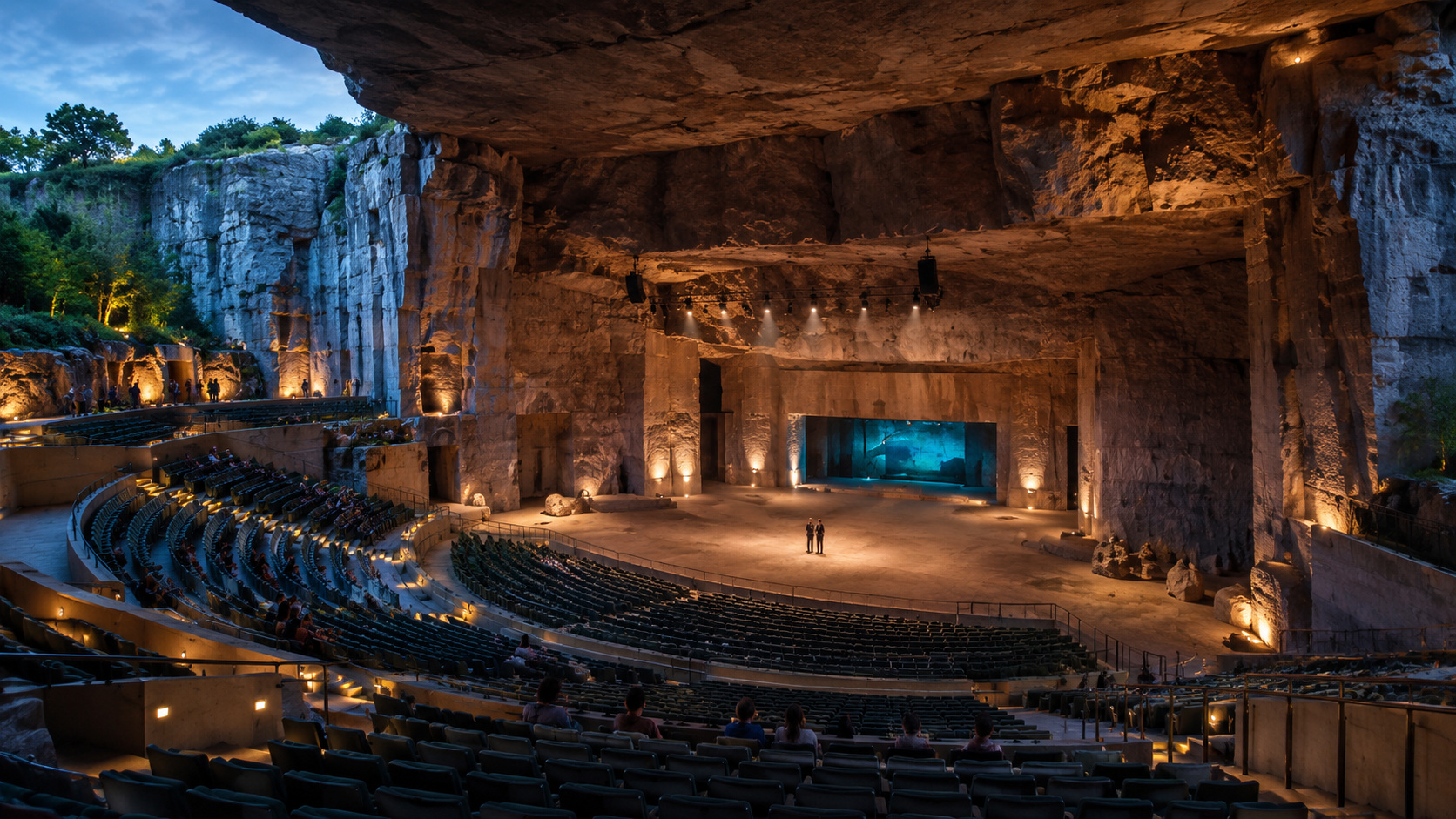

The limestone quarry of Fertőrákos shows how a space excavated for mining can become a cultural attraction, with cave theater, stage inside the rock, tourist visitation, and 760 seats in an area of 4,600 m² in Hungary
While many modern works still try to hide concrete and steel, an old limestone quarry in Hungary took the opposite path. In Fertőrákos, the space opened by stone removal turned into a cave theater with 760 seats.
The information was released by Visit Sopron, the tourist portal of the Sopron region. The old quarry occupies an area of 4,600 m² and now functions with a stage, auditorium, visitor center, and theme park.
What draws attention is the change of function. The place that once served to extract limestone now hosts the public, shows, and visitors inside the rock itself, without erasing the memory of mining.
-
U.S. City Builds Tiny Home Village on Water Company Land to House 136 Homeless People: Inside the Social Housing Units

-
Woman Turns Shipping Container into Home, Embraces Rural Life to Cut Monthly Expenses to Just Over $330
-
France Revamps 530 Social Housing Units with Large Balconies and Glass Facades Without Demolishing Existing Buildings

-
Facing high rent, couple transforms parents’ garage into a fully functional apartment, creating a complete home at a fraction of the market cost.




How an old limestone quarry became a cave theater in Hungary
Where workers once removed limestone blocks, there are now chairs, a stage, and visitor circulation. The Fertőrákos quarry was adapted to host cultural events within large spaces formed by the stone extraction itself.


The cave is not just a backdrop. It is part of the experience. The rock walls help create an environment different from a common theater, with a sense of depth, historical weight, and direct contact with the old mining area.
The project transformed a raw space into a public-use structure. The site now combines cave theater, exhibition, visitation, and theme park, keeping the rock as the main element of the architecture.
This is why the work draws so much attention. The public does not enter a traditional building. They enter an old extraction space, adapted to watch performances within the stone itself.
Why the limestone of Fertőrákos was important for Sopron and Vienna
The extraction in Fertőrákos began in the Roman period. The limestone removed from the region was used in important constructions in Sopron and Vienna, cities that help explain the historical value of the quarry.
The limestone was valuable because it could be worked more easily. Simply put, it was a good stone for cutting, shaping, and applying in works, especially in constructions that required detailed facades.
Visit Sopron, the tourist portal of the Sopron region, detailed the use of Lajta limestone in the region’s constructions. This material appears as a central part of the history of the ancient quarry and its connection with local architecture.
Over time, mining left large cavities in the rock. These cavities, born from the extraction work, formed the basis of the space that today houses the theater, exhibitions, and tourist visits.
The challenge of placing 760 seats inside an area carved into the rock
Adapting an old quarry to accommodate 760 seats requires planning. The space needs to allow entrance, exit, stage view, audience comfort, and safe operation during events.
In a regular theater, walls, ceiling, and seats are planned from the start. In Fertőrákos, the path was different. The structure had to make use of an area that already existed, formed by the removal of limestone over time.
The area of 4,600 m² shows the scale of this adaptation. It is not just an improvised stage in a cave. The space combines theater, visitation, visitor center, and theme park.
This change also alters how the public perceives mining. The old quarry is no longer seen only as a stone extraction area and starts functioning as a place of culture and memory.
Why the stage inside the rock changes the audience’s experience
A stage inside the rock creates a sensation not found in regular theaters. The audience watches the performance surrounded by the quarry’s own marks, in an environment that carries the history of working with limestone.
The rock functions as a visual part of the presentation. It does not need to be hidden, covered, or disguised. On the contrary, the strength of the place lies precisely in showing the mineral origin of the space.
This choice makes the Fertőrákos theater intriguing for those who like architecture, construction, and the reuse of old areas. What was once seen as an extraction space has gained a new function without losing its identity.

The result is a work that combines historical mining, tourism, and culture. The stage within the rock becomes the meeting point between the industrial past and current public use.
Why sound and temperature are essential points in a cave theater
In a cave theater, sound needs to be well controlled. The audience must hear the performances clearly, and the shape of the rock influences how voice, music, and noises spread throughout the environment.
Temperature also matters. Enclosed stone places can have a thermal sensation different from common environments. Therefore, the comfort of the public needs to be considered during visits and performances.
These details show that adapting a quarry does not depend solely on appearance. A beautiful space can attract attention, but it only works well when it receives structure for the public, stage, circulation, and continuous use.
In the case of Fertőrákos, the old quarry gained a function that requires technical care and organization. The cave theater needs to be safe, comfortable, and capable of hosting events without losing the visual impact of the rock.
The mining hole that became a cultural and tourist attraction
The transformation of the Fertőrákos quarry shows how an area marked by mining can gain new meaning. What was once a limestone extraction site now attracts visitors for its history, architecture, and the experience of watching performances inside the rock.
The visitor center and theme park increase interest in the location. The visit is not just about the theater. It also presents the formation of limestone, the use of the stone, and the memory of mining in the region.
This type of reuse draws attention because it avoids erasing the past. The rock remains visible. The cavities continue to be part of the landscape. The difference is that now the space welcomes people for culture, tourism, and knowledge.
The old limestone quarry of Fertőrákos proves that impressive constructions don’t always need to be built from scratch. Sometimes, the most curious work arises when an old place finds a new function.
If a quarry can become a theater without hiding its history, how many other forgotten spaces could gain new life in cities? Leave your opinion and share.