






 Portuguese
  Spanish


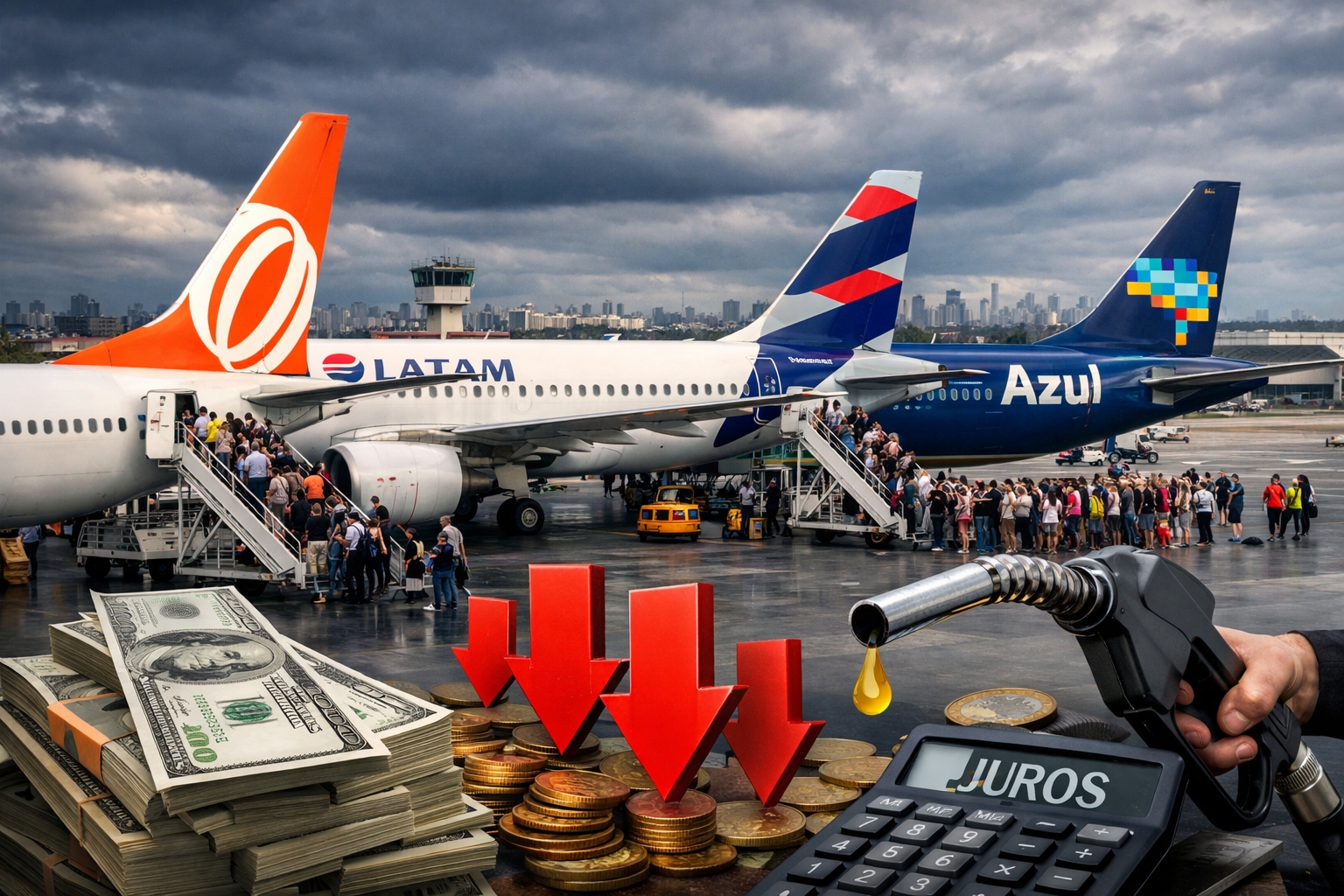


Planes from Gol, Latam and Azul Remain Full as Demand Grows, but the Sector Closes the Books in the Red and Faces a Structural Crisis that Threatens the Survival of Companies
The commercial aviation industry in Brazil faces a paradox that draws attention in the market. Despite more passengers flying and aircraft becoming increasingly occupied, airlines accumulate R$ 54.7 billion in losses between 2015 and the first half of 2025.
The increase in demand has not translated into sustainable margins. The sector operates under constant pressure from dollarized costs, expensive fuel, high interest rates, and frequently changing regulations.
In this environment, any shock—economic, regulatory, or demand—becomes a real risk of collapse and pushes companies toward restructuring, bankruptcy proceedings, and exit from the market.
-
Brazil to Issue “Panda Bonds” in China, Aiming to Raise Up to 5 Billion Yuan at Lower Interest Rates Than Dollar Debt
-
NATO Faces Internal Tensions as U.S. Pushes for Increased Defense Spending, Targeting 5% of GDP by 2035, with Warnings for Countries Near 2% Level

-
Brazil to Introduce B16 Diesel with Increased Soybean Oil Content for Trucks by 2026
-
Brazil’s July Bolsa Família Payments May Include Extra $150 and $50 for Families with Children, Pregnant Women, and Updated CadÚnico Registration


Demand for Air Transport Grew but Financial Results Remained Negative
Demand for air transport, measured in passenger kilometers transported, grew 6.7% between 2015 and 2024. In the first half of 2025, the increase was 11.1% compared to the first six months of 2024.
The occupancy rate also rose, reaching 85% in October, the highest for that month since 2000. In simple terms, planes flew fuller and for longer periods.
Even so, the financial results remained negative. The explanation lies in a combination of macroeconomic, regulatory, and internal factors that continue to drive the crisis.
Bankruptcies and Restructurings Have Become Part of the Sector’s History
The market has seen several brands cease operations since the beginning of the century. Among them are Varig, Vasp, Transbrasil, Avianca Brasil, formerly OceanAir, and Itapemirim, which lasted just months.
Other companies continued flying but needed deep changes. TAM merged with the Chilean LAN in 2012, forming Latam Airlines, and Gol partnered with the Colombian Avianca in 2022, creating Abra.
Even with these reorganizations, there were bankruptcy proceedings in the United States. Latam Airlines‘ process lasted from May 2020 to November 2022, while Gol‘s stretched from January 2024 to June 2025.
Azul filed for Chapter 11 in May 2025, with a plan approved in December to restructure over R$ 34.6 billion in debt.
Dollar Costs and High Interest Rates Tighten Margins
One of the central issues lies in the exchange rate. The sector has expenses heavily dollarized, while a significant portion of revenue enters in reais, creating a mismatch that becomes pronounced during periods of volatility.
The estimate is that 57% of expenses are in US dollars, including fuel, lubricants, insurance, leases, and aircraft maintenance. This profile reduces predictability and makes cash more vulnerable.
To this, high interest rates increase the cost of leasing aircraft, financing, debt, and working capital. The effect is evident on the financial accounts and further reduces the ability to form consistent margins.
Jet Fuel Impacts the Budget and Follows International Price Logic
Aviation kerosene, or Jet Fuel, accounts for about one-third of costs and can represent 30% to 38% of an airline’s total cost. In practice, it is one of the items that most influences the price and sustainability of operations.
Despite 90% of Jet Fuel being produced in Brazil, the pricing policy follows international parity. This keeps the reference as if it were an imported fuel, increasing pressure during times of external price hikes.
In October, Jet Fuel cost R$ 3.48 per liter, almost half the price recorded in July 2022, when there was a peak in the historical series that began in 2000. Besides the price, taxation through ICMS, with different rates between states, creates distortions between airports and routes and influences operational decisions.
Full Planes Don’t Guarantee Profit and Demand Is Volatile
Even with high occupancy, the sector relies on fares that sustain the cost of operations. Demand is sensitive to income and price, which limits the room for adjustments at many times.
This scenario makes the business model more fragile. To survive, companies need to maintain aircraft with high occupancy rates, but this is not always enough to compensate for exchange rates, fuel, interest, and other expenses.
In October, the occupancy rate was at 85%, with an increase of 1.1 percentage points compared to the same month the previous year. Still, pressure on margins remained.
Farewell Varig, TAM and Vasp! Latam, Gol and Azul, the Three Companies Concentrate 99.9% of the Domestic Market
The concentration of the domestic market has increased over time. In October 2000, the three largest in participation, Varig, TAM, and Vasp, held 64.2% of the total.
In October 2025, the concentration deepened. Latam, Gol, and Azul came to hold more than 99.9% of the domestic market, practically the entirety.
In that same month, 9 million passengers traveled, and 10.9 million seats were offered. In October 2000, there were 2.4 million passengers and 5.4 million seats.
Why New Competitors Have Difficulty Entering the Air Market
The entry cost is high and involves an expensive fleet, costly maintenance, high insurance, and operational requirements that demand scale. Additionally, access to slots, the landing and takeoff times, is restricted at profitable airports like Congonhas, Santos Dumont, and Brasília.
The market has a large volume but low profitability, and the population has less purchasing power to sustain higher fares. This restricts margins and increases the risk for those trying to start from scratch.
In recent history, smaller companies tend to be incorporated. Gol acquired Webjet in 2012, TAM incorporated Pantanal in 2009, and Azul absorbed Trip in 2012.
There has also been interest from foreign groups. In 2019, the Spanish Globalia, then owner of Air Europa, expressed interest in operating domestic flights in Brazil. More recently, the Chilean group Sky Airline also showed interest in flying in the country.
Future of the Air Market: What Could Happen from Now On
The pandemic of COVID-19 exposed vulnerabilities and accelerated problems such as indebtedness and low liquidity. In April 2020, passenger movement in Brazil fell by 94.5%, with losses exceeding R$ 15 billion for the main airlines.
The shock also hit the stock market. Over the past five years, shares of Gol fell by 77.2% on B3, shares of Azul dropped by 97.8%, and shares of Latam Airlines lost 64.7% on the New York Stock Exchange, the NYSE.
Another point pressuring the sector is litigation. In the first half of 2025, judicial condemnations related to air service provision totaled R$ 710 million, almost triple the amount in the same months of 2024.
In terms of financing, lines from BNDES discussed throughout 2024 have yet to be implemented, with disbursements expected for 2026.
There is also an indication of the permanent use of Fnac, the National Civil Aviation Fund, as a funding source for airlines, with annual disbursements operationalized by BNDES.








Nao sei preocupem o Governo Brasileiro , vai ajudar a todas.
Assim como ajudou a Varig…..
Contém ironia né?
Verdade Kkkkkkkk