






 Portuguese
  Spanish
  3 min of reading
  0 comments


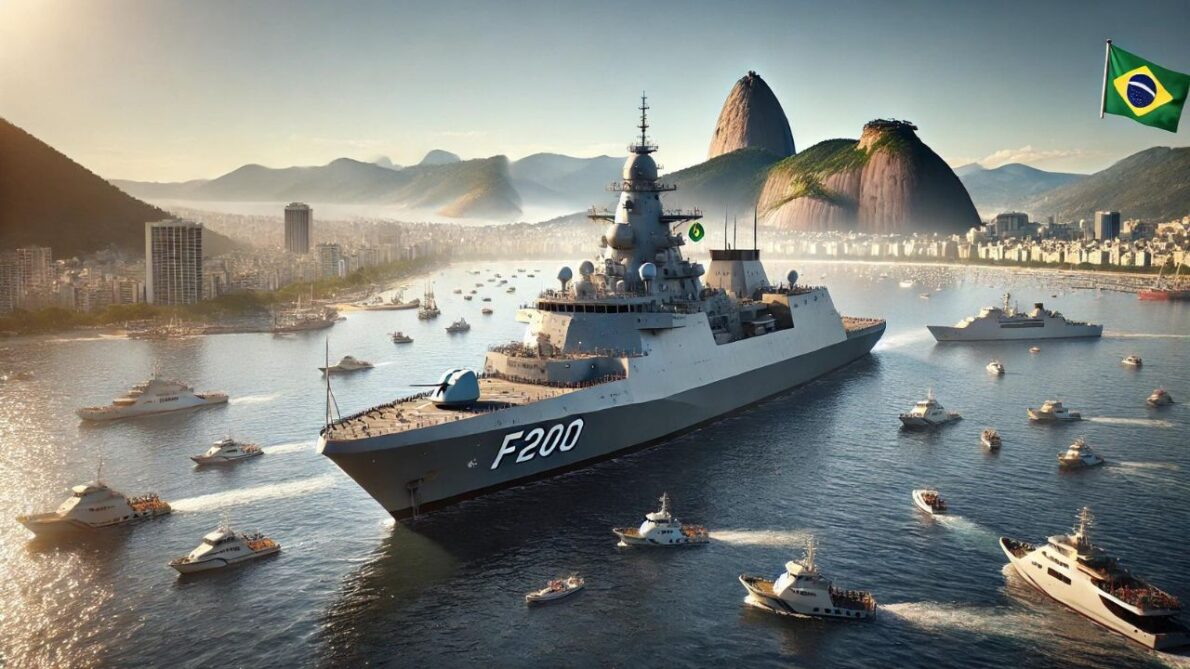
The F200 Tamandaré Is Launched! Find Out Everything About the Most Powerful Frigate of the Brazilian Navy!
The long-awaited F200 Tamandaré has finally been launched, and expectations couldn’t be higher. With cutting-edge armaments and state-of-the-art technology, this Frigate of the Brazilian Navy arrives to reinforce the national fleet, which has long needed modernization. But is all this pomp and circumstance justifiable?
The launch of the F200 Tamandaré, the newest Frigate of the Brazilian Navy, took place in grand style on August 9, 2024. The ceremony was attended by several important figures, including the President of the Republic and the Minister of Defense. The vessel was named by the Minister of Defense’s wife, Vera Brenan, following Brazilian naval tradition.
Built at the Brasil-Suíno Shipyard in Itajaí
Built at the Brasil-Suíno shipyard in Itajaí, the F200 Tamandaré is the first of a series of four frigates that make up the new Tamandaré class. In addition to the F200 Tamandaré, three more frigates are planned: the F201 Jerônimo de Albuquerque, the F202 Cunha Moreira, and the F203 Maris Barros. Commissioned by 2026, the F200 is the result of a plan devised in 2017 to replace the old Niterói class frigates, which had already accumulated over 40 years of service.
-
North Korean Fiasco: Launch of the Largest Warship Ends in Sinking

-
While giant ships still burn heavy fuel and the maritime sector races against climate targets, Maersk and Vale are starting to bet on ethanol as a new route to reduce emissions at sea.

-
China begins construction of the world’s largest LNG ship, a 344-meter giant capable of supplying 4.7 million homes for a month, carrying 271,000 m³ of gas, and placing QatarEnergy in the largest naval order ever recorded in world history.
-
China is designing a container ship with a thorium nuclear reactor that will operate for 40 years without refueling, and the 25,000-container giant from Jiangnan Shipyard will cross oceans without emitting carbon in an industry that burns 300 million tons of fuel per year.



F200 Tamandaré
What really catches attention in the F200 Tamandaré? Of course, its firepower. Equipped with MBDA CAM surface-to-air missiles, domestically manufactured anti-ship missiles Mansup, as well as triple torpedo launchers and a Leonardo OT Melara 76mm gun, this frigate means business. In addition, it can also carry a helicopter, further enhancing its operational capabilities.
Frigate of the Brazilian Navy of the Tamandaré Class Represents a Significant Advance
Despite all this power, we cannot overlook some issues. It is undeniable that Brazil needs to modernize its naval fleet, but are four frigates enough? The Frigate of the Brazilian Navy of the Tamandaré class represents a significant advance, but if all units of the Niterói class are decommissioned, the number of operational frigates may be insufficient to ensure the defense of Brazilian waters if needed.
Another point is the construction time. Although the F200 Tamandaré was built in record time by Brazilian standards, the comparison with the Niterói class frigates, which took up to eight years to be completed, leads us to question: was quality sacrificed for the sake of speed?
Brazilian Naval Industry
The Brazilian naval industry has certainly made a step forward, but we must keep our eyes open for the future. Brazil cannot afford to stop here. With only four planned units, the Tamandaré class may not be sufficient to guarantee the country’s naval superiority in the long term. Continuous modernization and fleet expansion should be priorities, especially in a scenario where neighboring countries are already moving to acquire their new frigates.
In the end, the F200 Tamandaré is indeed an important milestone, but we cannot let excitement blind us to the challenges that lie ahead. Brazil needs to continue investing in its navy, not only to maintain its prominent position in Latin America but to ensure that its waters are always well protected.
What do you think? Will the Frigate of the Brazilian Navy of the Tamandaré class be enough to guarantee the country’s defense? Leave your opinion in the comments!







Be the first to react!