






 Portuguese
  Spanish


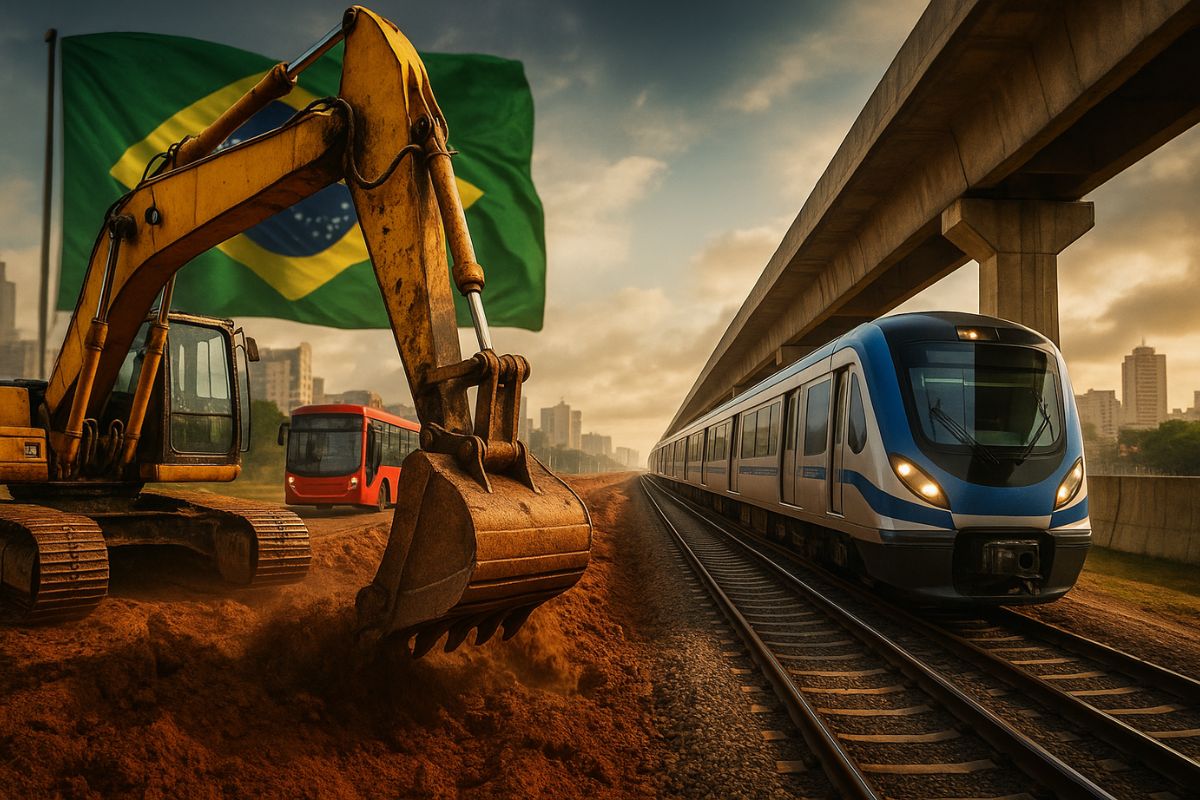

Study Reveals Brazil Will Need to Invest R$ 500 Billion in Public Transport to Avoid Collapse in Cities
The government’s vision for the future of urban mobility involves a profound transformation in high and medium capacity public transportation. A study by BNDES, in partnership with the Ministry of Cities, indicates that Brazil needs to double its metro network and quadruple the BRT and VLT networks by 2054. The plan outlines 194 priority projects and requires public and private investments of around R$ 500 billion.
The proposal is considered the most ambitious of the decade and responds to a 43% decline in the number of passengers between 2014 and 2023. The federal government’s plan aims to recover the attractiveness of public transport amid the growing migration to cars and motorcycles, especially via apps, in addition to tackling historical investment and urban planning bottlenecks.
BNDES Maps 192 Projects and Sets Goals for the Next 30 Years
According to the National Study on Urban Mobility, Brazil’s metro network, currently at 376 km, will need to gain an additional 323 km over the next 30 years. For BRT, VLT, and monorail systems, the planned expansion is even more drastic: from 631 km to 2,500 km. The survey considered only cities with more than 1 million inhabitants and critically assessed the feasibility of each project.
-
U.S. City Builds Tiny Home Village on Water Company Land to House 136 Homeless People: Inside the Social Housing Units

-
Woman Turns Shipping Container into Home, Embraces Rural Life to Cut Monthly Expenses to Just Over $330
-
France Revamps 530 Social Housing Units with Large Balconies and Glass Facades Without Demolishing Existing Buildings

-
Facing high rent, couple transforms parents’ garage into a fully functional apartment, creating a complete home at a fraction of the market cost.




Felipe Borim, superintendent of infrastructure at BNDES, explained that the cost of one kilometer of metro can reach R$ 1 billion, while BRT costs, on average, R$ 50 million. Therefore, the government’s construction strategy also involves cheaper but integrated solutions: “All major cities will need metros and BRTs complementing each other, each with its advantages.”
Government Forecasts R$ 42 Billion by 2028
The Minister of Cities, Jader Barbalho Filho, stated that the plan already anticipates an investment of R$ 42 billion by 2028. He criticized the lack of funding in previous years and argued that the government’s construction needs to be continuous and stable: “Before this, there was no funding at all. This cannot happen again.”
In São Paulo, the study considered projects like the expansion of the Green Line and the new Onyx Line. In Rio, the analysis included the expansion of Line 4 and Line 3 from Niterói to São Gonçalo. The complete list of projects is expected to be released in the coming months, depending on the maturity of each proposal.
VLT Advances Within Cities; Trains Continue to Decline
The study also evaluated urban train services, which will practically see no expansion, except for São Paulo, which is expected to add 96 km to its current network. Meanwhile, VLTs have been gaining traction as an efficient alternative for central areas. “At this moment, VLT is more effective than trains for urban environments,” Borim said.
Clarisse Cunha Linke, director of ITDP, emphasizes that the complementarity between railways and bus corridors will be essential for the success of the government’s plan for urban mobility. Fare integration, priority in traffic, and disincentives for individual transportation are central points of the proposal.
Number of Passengers Plummets; Pandemic Accelerated the Crisis
Between 2014 and 2023, the number of passengers using public transport fell by 43%, according to BNDES. The pandemic worsened the issue: at its peak, demand fell by 80%. Even in 2023, the use of public transport was still 15% below pre-pandemic levels. In parallel, the use of app-based motorcycles and cars increased, especially among informal workers.
For the government, this loss reflects the low quality of services and the abandonment of public policies in the area. The creation of a new national public transport policy seeks to reverse this situation with long-term planning, integration between modes, and affordable fares.
Expansion Could Increase the Number of Users by Five Times
If the planned network is implemented, cities like Fortaleza could serve up to 501% more people in high and medium capacity systems — increasing from 213,000 to 1.2 million users. In Rio, the population served could jump from 1.6 million to 5.9 million. In São Paulo, the increase would be 68%, reaching 15 million people.
To achieve this, it will be necessary to maintain the government’s plan consistently, with guaranteed budgets, quick licensing, and political prioritization. The optimistic scenario depends on four pillars: limiting user spending to no more than 6% of income, fare integration, policies against excessive car usage, and traffic signal preference for public transport.
Do you think Brazil will be able to fulfill this plan by 2054? Do you believe that public transport can become a priority again? Share your opinion in the comments — we want to hear from those who experience this firsthand.








