Portuguese
  Spanish


Headset That Captures Brain Signals Transforms Thoughts into Digital Commands. Launched by NeuroSky, Device Already Starts to Be Used in Experiences in Brazil.
Have you ever imagined starting a game, moving an object, or even learning to meditate just with your mind? This reality is getting closer. The company NeuroSky launched the MindWave in Brazil, a headset that captures brainwaves and translates them into digital commands, enabling so-called mental control of objects. This novelty, which seemed like science fiction, is beginning to gain ground in the country in academic experiments, educational projects, and even in meditation practices.
How MindWave Works
The MindWave is a lightweight headset, similar to headphones, equipped with a electroencephalography (EEG) sensor on the forehead and a clip on the ear. These sensors detect electrical signals emitted by the brain, which vary according to the person’s mental state—more active when concentrated, more stable during moments of relaxation.
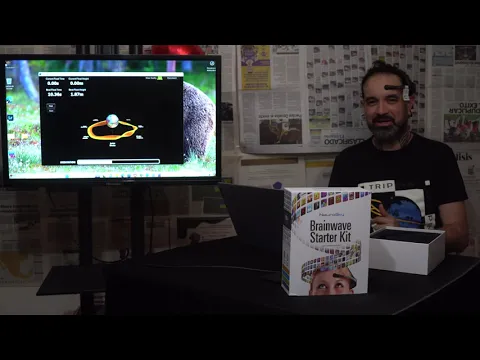

These signals are transmitted via Bluetooth to a computer or mobile device. Software interprets the brainwaves and transforms patterns of attention or relaxation into digital commands, which can be used in games, study applications, or even in controlling integrated objects.
-
How Much Does Starlink Satellite Internet Cost for Cars, Trucks, and RVs? Prices for Antenna, Accessories, and Plans

-
Scientists Convert Food Waste into Aviation Fuel, Successfully Test 50% Blend with Conventional Kerosene to Cut Emissions and Promote Sustainable Flights
-
OnePlus N6 Smartphone to Launch in India with 8,000mAh Battery and 45W SuperVOOC Charging, Lasting Up to Three Days
-
Scientists Plan to Release Air Bubbles Underwater to Protect Antarctica’s “Doomsday Glacier” from Melting



Applications in Brazil
In Brazil, institutions like FIAP are already testing the technology in activities aimed at children’s learning. The goal is to use MindWave to stimulate focus and concentration in the classroom, providing real-time metrics that help educators and students track performance.
Another promising field is guided meditation. The headset can indicate, in wellness applications, the user’s level of tranquility, assisting in the practice of breathing and relaxation techniques.
In health, there are expectations of use in neurological rehabilitation processes and in therapies for children with attention deficit disorder (ADHD), as the device measures the variation between states of focus and distraction.
Entertainment and Mind-Controlled Games
One of the most interesting areas is entertainment. The MindWave is already compatible with dozens of applications and games where the user can move elements on the screen, activate functions, or earn points based on their level of concentration.
This type of interaction creates an innovative experience: it is not the click of a mouse or a touch on the screen that determines the action, but rather brain activity. The promise is that soon this will also extend to toys, drones, and robots controlled by the mind.
The Impact of Technology
The launch of MindWave in Brazil opens doors for a market of brain-computer interfaces (BCI), technology that connects brain signals to machines. Although the devices are still simple and have limited range, they already show potential to change areas such as:
- Education: real-time monitoring of students’ attention;
- Health: support for focus, relaxation, and rehabilitation therapies;
- Well-being: monitoring of meditation and stress states;
- Games and Entertainment: mind-controlled immersive experiences.
Current Limitations
Despite the impact, experts remind us that the technology is still in its early stages. The headset is not a medical device and does not replace diagnoses. Moreover, the control of more complex physical objects—such as opening doors or moving machines—depends on additional integrations with robotic systems and specific software.
Even so, progress is notable: each year, new compatible applications emerge, making the use more accessible and varied.
A Future Connected to the Mind
What once seemed like a scene from a movie is becoming commonplace: using the mind to interact with computers, games, and even real objects. The MindWave represents just the first step of a global trend that is expected to grow exponentially in the coming years.
With research advancing in countries like the United States, Japan, and now Brazil, it is likely that, in no time, controlling simple tasks with the mind will be as common as using voice commands to speak with Alexa or Google Assistant.
The arrival of MindWave in Brazil marks an important moment in the history of interaction between humans and machines. From classrooms to meditation centers, passing through games and robotics experiments, the technology promises to unite innovation, well-being, and learning.
There are still technical limits, but the message is clear: the future of digital interfaces no longer relies solely on fingers or voice—it now also relies on the power of the mind.