Portuguese
  Spanish


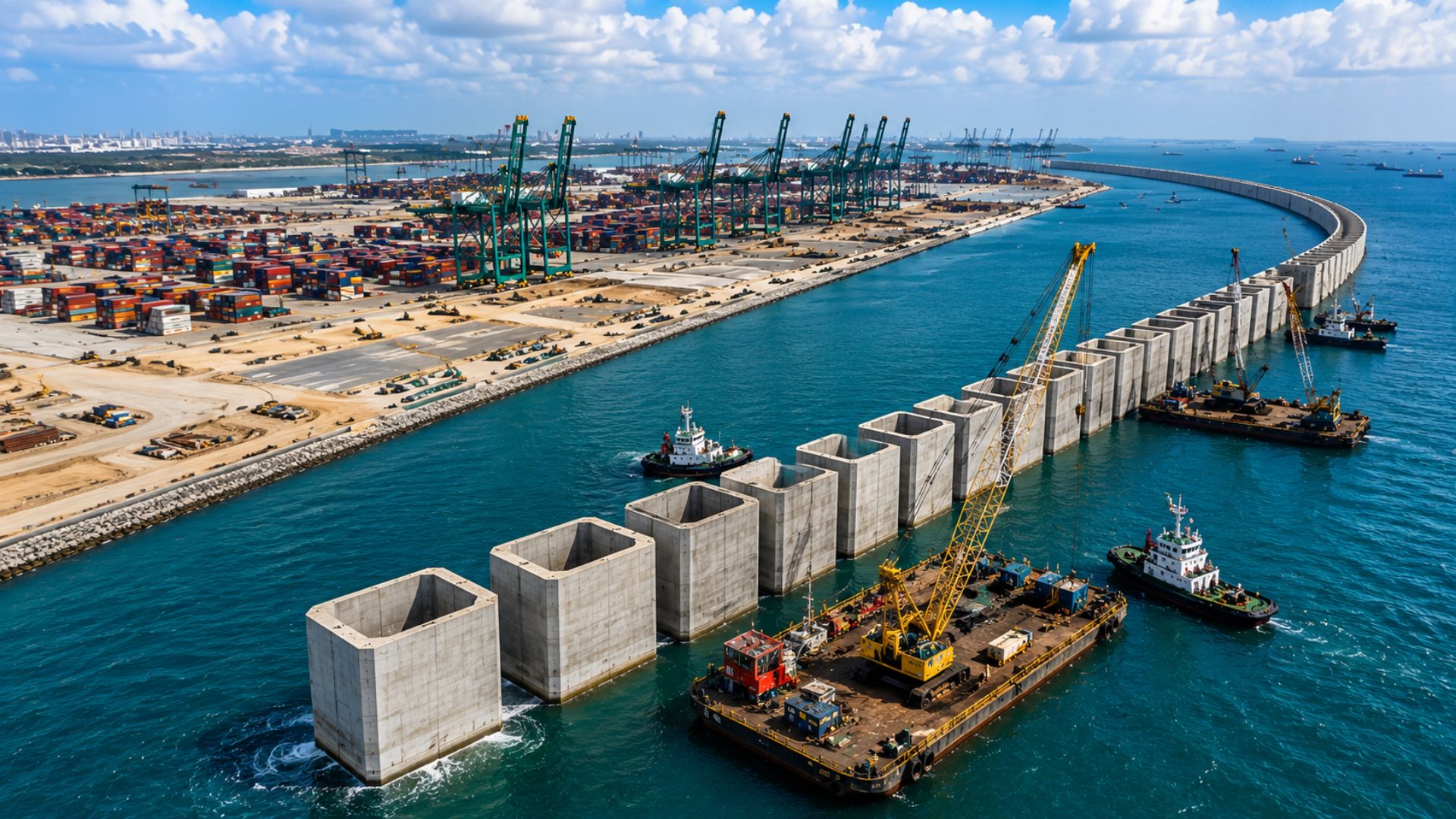

Billion-dollar project transforms Singapore’s coast with giant submerged structures, port automation, and territorial expansion to create the largest automated port on the planet, capable of handling up to 65 million containers per year and consolidating the Asian country as one of the main global logistics centers.
Singapore advances in the construction of the Tuas Port, a project planned to concentrate its container operations in a single automated complex, with a projected capacity of 65 million TEUs per year when completed in the 2040s.
Despite being one of the smallest countries on the planet in terms of land area, Singapore has maintained a strategic position in international maritime trade for decades, mainly due to its location on one of the busiest routes between the Indian and Pacific Oceans.
The new megaport was conceived to further enhance this logistical relevance, gradually replacing old terminals scattered across the island and centralizing operations in a single highly technological and integrated structure.
-
Brazilian Mayor Goes Undercover as Homeless for 24 Hours to Assess Public Services

-
15-Year-Old Entrepreneur Malu Lira Publishes 20 Children’s Books on Financial Education, Earns $500,000, and Expands Her Project to the Amazon Rainforest
-
Entrepreneur Turns Rio Cemetery Canteen into a Successful Snack Chain Generating $4.9 Million Annually and Expanding to Metro Stations

-
Rare fox feared “extinct” found alive on Caribbean island after over two decades without official sightings





With limited territory and a strategic position on the routes between Asia, Europe, and the Middle East, the country bets on land reclamation, automation, and logistical integration to expand its port capacity without relying on large natural coastal extensions.

Tuas Port will have 66 berths and automated operation
The Tuas Port is designed to have 66 berths distributed along 26 kilometers, in a final area of about 13.37 km², equivalent to 1,337 hectares.
The goal is to gather in the west of Singapore the operations currently spread across other terminals, reducing internal movements, increasing operational efficiency, and creating a structure prepared for large container ships.
The concentration of port activities in Tuas will also allow areas occupied by old terminals to be freed for future urban and industrial projects, something considered strategic for a country facing severe geographical limitations to expand its cities and infrastructure.
According to the Maritime and Port Authority of Singapore, the complex is expected to almost double the movement recorded in 2021, when the country operated 37.5 million TEUs.
In 2025, the Singaporean port reached a new record, with 44.66 million TEUs handled.
Concrete caissons support expansion over the sea
One of the most complex stages is in the second phase of the project, which involves 387 hectares of land reclamation and the installation of large concrete caissons manufactured on-site.

Official data indicates 227 concrete caissons to form a quay structure of 8.6 kilometers.
Technical reports from the responsible consortium also mention 9.1 kilometers of underwater walls in the maritime containment area.
These pieces function as submerged structural blocks, creating barriers capable of containing the sea and allowing the formation of new operational areas.
The use of this type of structure is common in large maritime works, but the scale adopted in Tuas has placed the project among the most complex ever executed in Asia in coastal engineering and territorial expansion over the sea.
In works of this type, the caissons serve as the base for quays, yards, and port infrastructure.
The size of the structures helps explain the scale of the enterprise.
Specialized publications indicate that each caisson is about 28 to 30 meters high, approximately equivalent to a ten-story building.
Singapore bets on a unique and digitized port
The Port of Tuas will be developed in four phases and is expected to operate as an integrated system, with greater use of automation, digitization, and coordinated management of cargo, ships, and equipment.
The proposal is to reduce bottlenecks in a country that heavily depends on maritime trade but faces physical limits to expand its traditional terminals.
Therefore, the project combines coastal engineering, port technology, and territorial reorganization.


In addition to automation, the complex is expected to operate with intelligent maritime traffic management systems, digital monitoring of cargo, and automated equipment for internal container transport, reducing operation time at the terminals.
The plan also envisions a more efficient integration with industrial zones, logistics centers, and land transport networks, strengthening Singapore’s position as a cargo redistribution point for different regions of Asia.
The PSA, the port operator involved in the project, states that integration will be a central point of the operation.
“Everything will function as a single integrated system,” said Liang Hui Tan, Vice President of Tuas Development, Strategic Port Technology, Solutions and Services at PSA.
When complete, the complex is expected to strengthen Singapore’s role as a global transshipment hub, an activity where containers arrive on large ships, are redistributed, and proceed to other regional or intercontinental destinations.
Project expected to progress until the 2040s
The Tuas Port was officially inaugurated on September 1, 2022, but its full implementation will proceed in stages until the 2040s, according to Singapore’s official maritime transport authorities.
The final estimated capacity of 65 million TEUs places the project among the largest port ventures ever planned, especially by combining physical scale, operational automation, and national consolidation of container operations.