Portuguese
  Spanish


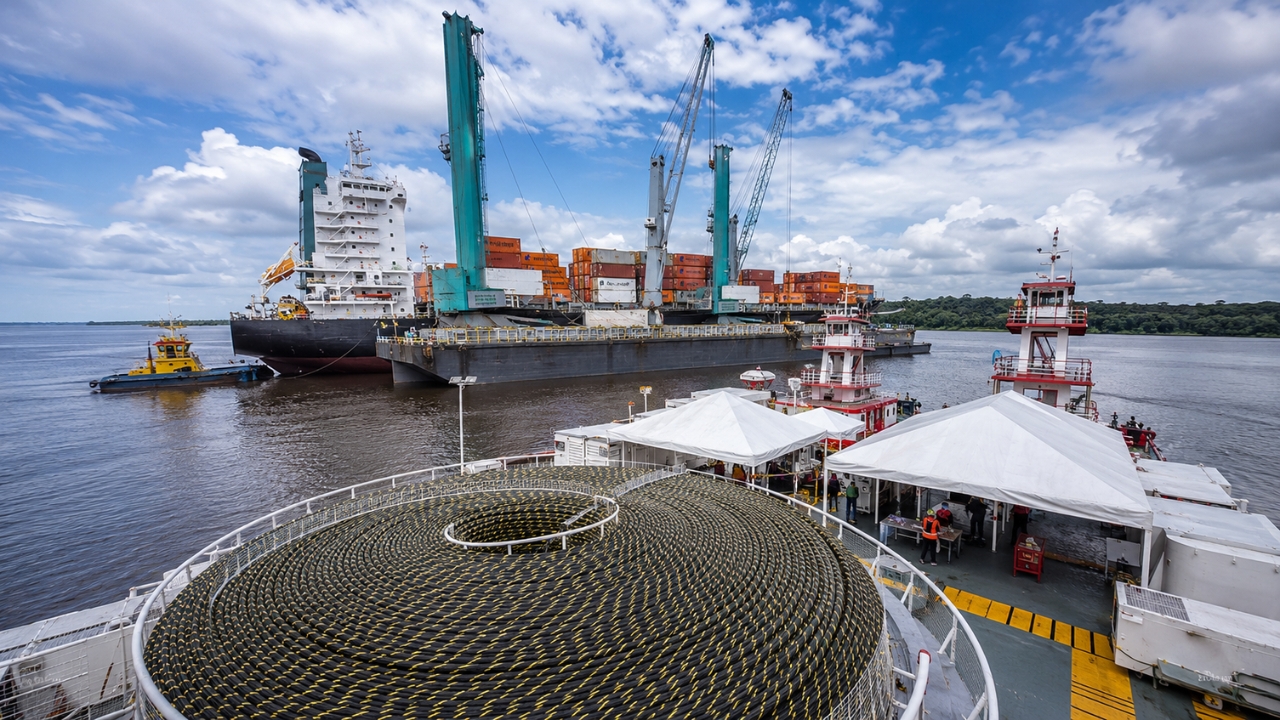

Brazil received 3,170 km of optical fiber to expand the Connected North, a project that aims to bring high-speed internet to remote areas of the Amazon through cables installed on riverbeds.
A gigantic shipment from China arrived in Brazil with an unusual mission: to help bring high-speed internet to isolated regions of the Amazon through cables installed on riverbeds.
In total, the country received 3,170 kilometers of optical fiber cables, material that will be used in three new infoways of the Connected North program, an initiative by the Ministry of Communications aimed at expanding connectivity in the Northern region. The operation was coordinated in partnership with the Band Administrator Entity, the EAF, and is considered by the government as the largest logistics transfer of optical fiber ever carried out within the program.
The size of the operation is impressive: about 5 thousand tons of cables, prepared to form Infoways 05, 06, and 08. Before going to the bottom of the Amazon rivers, the cables underwent a transshipment stage at the Super Terminals port in Manaus, in a process that lasted about 30 days.
-
Scientists Develop Innovative Material That Converts Visible Light to Ultraviolet, Unlocking New Possibilities for Optical Equipment and Advanced Communications

-
2011 Japan Earthquake Sent Seismic Waves to Earth’s Core, Returning in 15 Minutes and Shifting Entire Country Simultaneously, Scientists Reveal

-
NASA captures heart-shaped pink lagoon in Argentina’s salt flats
-
To Aid Mars Missions, 12 Volunteers to Spend 60 Days in Bed Without Getting Up, Earning €18,000 in Study Starting 2026


Cables came from China to connect remote areas of the Amazon

The received material will be used to expand the structure of the Connected North, a program created to bring telecommunications infrastructure to municipalities that have historically faced difficulties in accessing stable internet.
The idea is to transform the Amazon rivers themselves into a path for connectivity. Instead of relying solely on land works in hard-to-reach areas, the project bets on the installation of subfluvial cables, placed on riverbeds.
This strategy allows reaching communities, cities, and public services in one of the most complex regions of the country. The Amazon has long distances, low population density in various areas, and stretches where road access is limited or non-existent.
Therefore, the arrival of the shipment from China gained symbolic weight. It is not just another batch of equipment. It is an important stage of a project that promises to change the way part of the Northern region connects to the rest of Brazil.
Mega operation in Manaus prepared 5 thousand tons of optical fiber
After arriving in Brazil, the cables underwent a logistical operation at the Super Terminais port in Manaus. According to information released by official agencies and specialized media, the work involved final tests and the transfer of the material to vessels prepared for the next phase of the project.
The structure will be destined for Infovias 05, 06, and 08, sections that are part of the new phase of Norte Conectado. These routes are expected to expand the presence of fiber optics in strategic areas of the Amazon, reinforcing the network that is already being implemented in other parts of the region.
The volume is impressive because it surpasses previous stages of the program. According to the Ministry of Communications, the new shipment is larger in scale than already completed phases, which used thousands of kilometers of fiber optics in other infovias.
In practice, the cargo that crossed the ocean is now expected to be transformed into a network capable of supporting essential services such as education, health, security, research, and public administration.

Internet via riverbed can reach schools and hospitals
One of the most important aspects of the project is the direct impact on public services. Norte Conectado aims to bring quality internet to regions where the connection is still unstable, expensive, or limited.
With the new structure, schools, health units, public agencies, and riverside communities can gain more regular access to digital services. This includes everything from online classes and electronic medical records to judicial systems, remote assistance, and administrative communication.
The government states that the program’s infrastructure, when completed, should total 13.2 thousand kilometers of optical cables, connecting 70 locations in six states of the Legal Amazon and benefiting about 7.5 million people.
The states involved include Amazonas, Pará, Acre, Roraima, Rondônia, and Amapá. These are areas where connectivity can represent not just comfort but real access to opportunities and basic services.
Subfluvial fiber optics avoid major land works
Another detail that makes the project different is the installation method. The cables are designed to operate on the riverbeds, reducing the need for major land interventions.
According to information released about the program, using the rivers as a route helps avoid opening sensitive areas of the forest, making the strategy more suitable for the Amazonian scenario.
Each cable gathers pairs of optical fiber and was developed to withstand subfluvial installation conditions. The goal is to create a high-capacity network without relying on long terrestrial stretches in hard-to-reach regions.
This model positions rivers, which have always been natural transportation and integration routes in the Amazon, also as corridors of digital connectivity.
New phase may change connectivity in the North
The arrival of cables from China marks a new stage of a project that is still expected to progress in phases. After transshipment and testing, the structure moves to the phase of deployment in the Amazonian rivers, planned to supply the new infoways of the program.
If the promise materializes, the load of 5,000 tons that arrived in Manaus could transform into internet for millions of Brazilians living far from major centers.
More than a technology project, it exposes a historical challenge: connecting a vast region, crossed by rivers, forests, and long distances. And this time, Brazil’s bet is precisely to use these rivers as a path to deliver high-speed internet where it still does not reach stably.
In the end, the cables that came from China should not remain merely as a symbol of a mega logistical operation. They could become the foundation of a new phase of connectivity in the Amazon, with a direct impact on schools, hospitals, city halls, riverside communities, and municipalities that still live on the margins of quality internet.