






 Portuguese
  Spanish


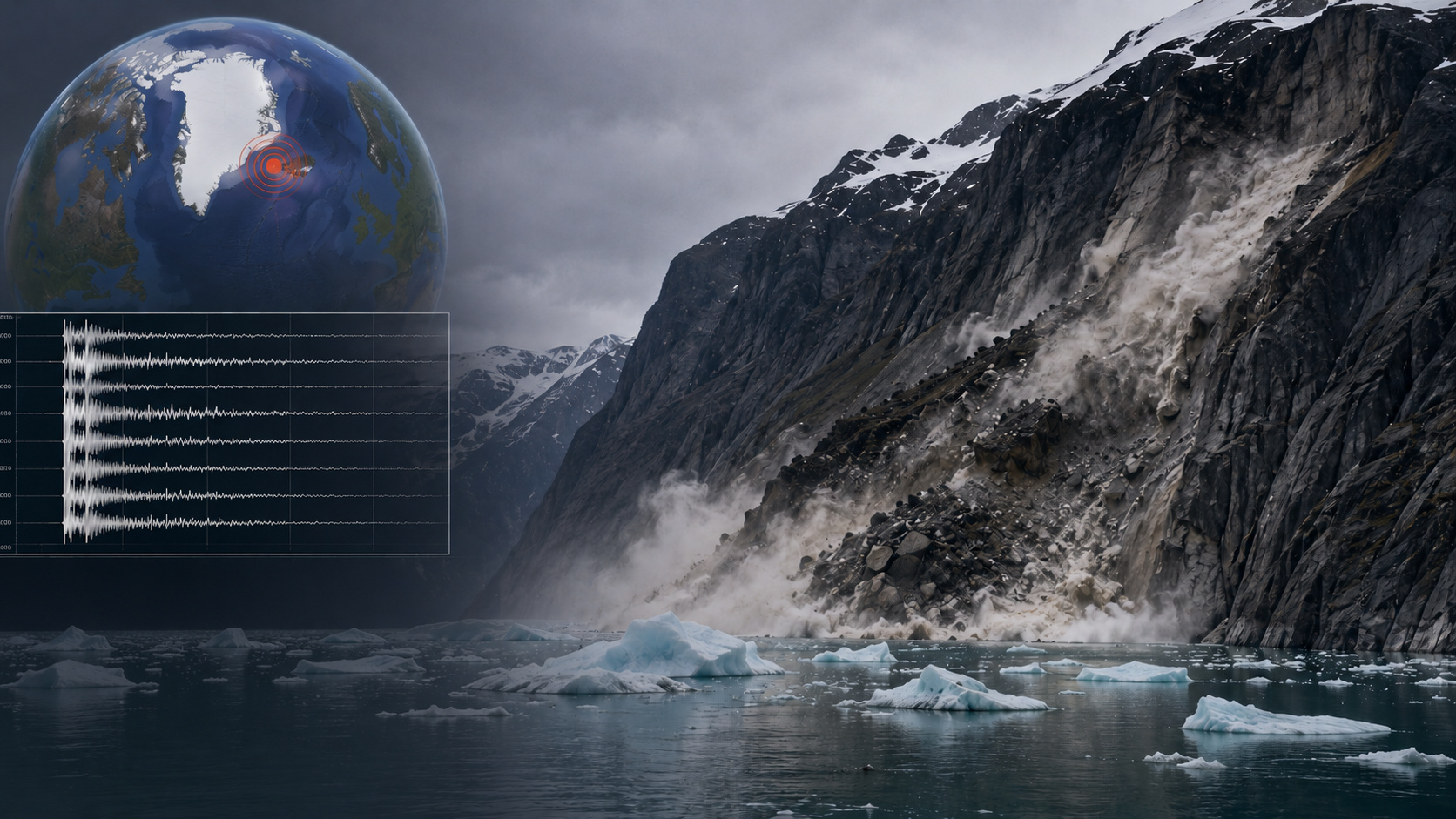

The unusual seismic phenomenon intrigued global researchers for days until it revealed a gigantic mountain landslide in Greenland, capable of generating continuous vibrations never before observed by modern science.
On September 16, 2023, at 12:35 universal time, something happened in a remote corner of eastern Greenland that no one saw. There were no witnesses. There were no cameras. There was no village nearby. What there was, was a mountain peak called Hvide Støvhorn that rose 1,200 meters above a narrow, icy fjord — the Dickson Fjord, nestled between rock walls 200 kilometers from the open ocean.
And that morning, the top of this mountain simply fell. According to Science magazine, Smithsonian Magazine, Live Science, and UCL News, 25 million cubic meters of rock and ice — equivalent to the volume of 25 Empire State buildings — plummeted onto a glacier, slid like a mixed avalanche of stone and ice, and plunged into the fjord. What happened over the next 9 days is unprecedented in the history of seismology.
The signal that no one recognized
Less than an hour after the impact, seismological stations in Antarctica — on the other side of the planet — recorded a strange signal. It was not the pattern of an earthquake. Earthquakes produce complex waves, with multiple frequencies that rise and fall in a few minutes. This signal was different: a single frequency, 10.88 millihertz, repeating every 92 seconds. Monotonous. Constant. Like a bell that someone struck once and let vibrate.
-
Brazilian Innovator Develops Concrete Blocks from Recycled Plastic, Eliminating Mortar and Reducing Construction Costs

-
World’s Most Powerful MRI Machine in France, Weighing 132 Tons and Generating 11.7 Tesla Magnetic Field, Offers Unprecedented Clarity of the Human Brain
-
Brazilian Woman Builds House with Recycled Plastic Bottles, Halving Construction Costs in the Process
-
The U.S. is Repurposing Giant Retired Wind Turbine Blades in an Ambitious Project to Tackle Energy Transition Waste


Seismologist Stephen Hicks, one of the authors of the study published in Science, described the scientific community’s reaction to New Scientist: “We were like, ‘wow, this signal is still coming. This is completely different from an earthquake.'” The signal did not stop in minutes. It did not stop in hours. It continued for 9 consecutive days, recorded at seismological stations around the entire world. And no one had any idea what it was.
The mountain that lost its ground
The Dickson Fjord is in such a remote region that almost no one goes there — except, occasionally, tourist cruise ships that navigate the eastern Greenland fjords. The Hvide Støvhorn peak was supported at the base by a glacier that filled a side channel of the fjord. For decades, global warming had been thinning this glacier. The ice that acted as a buttress — holding the mountain in place — became too thin.
On September 16, the support gave way. A block of metamorphic rock 150 meters thick, 480 meters wide, and 600 meters long detached from the top of the mountain. The mass hit the glacier below, incorporated ice into the avalanche, and plunged into the fjord at a peak speed of 42 meters per second — over 150 km/h. The total volume of the landslide was 25 million cubic meters. The impact with the water generated a splash column that rose 200 meters into the air.
A 200-meter wave with no way out
The initial tsunami reached 200 meters in height near the impact point — one of the highest waves recorded in recent history. Along a 10-kilometer stretch of the fjord, the average run-up height was 60 meters. Marks on the rock and vegetation confirmed the devastation: everything up to 60 meters above the water level was swept away.
But the fjord is narrow. The walls are of solid rock. And the channel extends for dozens of kilometers before opening into the broader fjord system. The wave had nowhere to go. It hit one wall, bounced back, hit the other, and bounced again. The rounded shape of the fjord’s bottom — revealed by bathymetric data from the Danish Navy — reduced friction, preventing the wave from losing energy normally. The water kept oscillating from side to side like water in a bucket that someone shook — a phenomenon called seiche.
9 days vibrating like a bell
The seiche in Dickson Fjord lasted 9 days. Every 92 seconds, the mass of water completed a round trip cycle between the fjord walls. Each oscillation transferred energy to the Earth’s crust. Each transfer generated a seismic wave that propagated across the planet. The result was a continuous, monotonous signal of a single frequency — detectable 5,000 kilometers away.
It is the first time in history that the movement of oscillating water in a fjord was recorded as seismic vibration around the world. “This is the first time that moving water has been recorded as vibrations through the Earth’s crust, traveling around the world and lasting several days,” said the UCL researcher involved in the study. The Earth was literally vibrating because a pool of water — relative to the size of the planet — kept rocking back and forth.
The team that pieced together the puzzle
The signal was so strange that no isolated research group could explain it. An interdisciplinary team of 68 scientists from 40 institutions in 15 countries came together to investigate. Seismologists, glaciologists, oceanographers, geologists, tsunami specialists, and numerical modelers worked together — a rare scientific effort due to its scale and urgency.
“When we embarked on this scientific adventure, everyone was confused and no one had the slightest idea what caused this signal,” said Kristian Svennevig, a geologist at the Geological Survey of Denmark and Greenland and lead author of the study. “All we knew was that it was somehow associated with the landslide.” The investigation used satellite images, drone videos, regional and global seismic data, high-resolution bathymetry, and numerical tsunami simulations. The study was published in Science in September 2024.
What the wave destroyed
70 kilometers from the impact point, 4-meter waves hit the Ella Ø research station — a small island used by scientists studying the Arctic. The base was damaged. Cultural and archaeological sites along the fjord system were destroyed. Splash marks up to 100 meters high were found kilometers away from the original landslide.
The fjord is a route for tourist cruise ships. If a ship had been in the Dickson Fjord at the time of the collapse, it would have been hit by a wall of water dozens of meters high. The researchers explicitly noted this risk in the study. Greenland has already had a tragic precedent: in 2017, an avalanche in the Karrat Fjord generated a tsunami that flooded the village of Nuugaatsiaq and killed four people. The Dickson event was larger — but it happened in a place where there was no one.
The glacier that held the mountain
The landslide was not random. The collapse was caused by what geologists call “glacial debuttressing” — when a glacier that supports the base of a slope melts and removes the structural support. It’s like pulling the foundation of a building: the wall above, with nothing to hold it, collapses.
Satellite images show that the glacier in the side channel of the Dickson Fjord had been retreating for years. Arctic warming — which is advancing two to four times faster than the global average — accelerated the process. The study concluded that climate change was the ultimate trigger of the landslide. Without the glacier melting, the mountain would probably still be intact. The Dickson mega-tsunami is, at its root, a climate event.
Greenland is becoming unstable
The Dickson event is not isolated. Greenland is losing ice at a rate that accelerates each decade. Glaciers retreat, permafrost thaws, rocky slopes lose support. Scientists warn that massive landslides — and the tsunamis they generate — will become more frequent as warming continues.
In western Greenland, tsunamis caused by landslides have already killed people and destroyed communities. On the east coast, mega-tsunamis with waves over 100 meters have already hit Europe in prehistoric events. The Dickson study showed that these events can generate seismic signals detectable globally — which means that seismology can function as an early warning system for tsunamis in remote fjords where there are no witnesses.
The connection between atmosphere, ice, water, and rock
The study published in Science highlighted something that rarely appears in scientific articles: the interconnection between four Earth systems in a single event. Climate change in the atmosphere melted ice in the cryosphere. The melting destabilized rock in the lithosphere. The rock fell into the water of the hydrosphere. The oscillating water generated vibrations in the crust that traveled the entire planet.
“Our study incredibly highlights the intricate interconnections between climate change in the atmosphere, glacial ice destabilization in the cryosphere, water body movements in the hydrosphere, and the Earth’s solid crust in the lithosphere,” said the UCL researcher. A single event connected four spheres of the Earth system in a way that had never been documented before. And it all started because a glacier became too thin to hold a mountain.
The fjord that acted as a resonance box
The Dickson Fjord is about 20 kilometers long, with a width varying between 1 and 3 kilometers and an average depth of 540 meters. These dimensions are crucial to understanding why the wave lasted 9 days instead of dissipating in hours.
Numerical simulations conducted by the GFZ team — German Research Centre for Geosciences — showed that the shape of the fjord created almost perfect conditions for a standing wave: the parallel rock walls reflected the wave with minimal energy loss, and the rounded bottom reduced the friction that normally slows down the oscillation.
The fjord acted as a natural resonance box — an involuntary geological instrument that amplified and sustained the vibration for more than a week. Researcher Angela Carrillo-Ponce, from GFZ, noted that without the seismic analysis, the existence of the seiche in the fjord would never have been known.
“If we hadn’t found another explanation, we would have gone with sea monster”
Stephen Hicks, the seismologist who helped decipher the signal, summed up the experience with British humor to Quanta Magazine: “If we hadn’t found another explanation, we would have gone with sea monster or dragon babies.” The joke hides the truth: for months, the signal was genuinely inexplicable. A unique frequency, lasting 9 days, unparalleled in the history of seismology. The answer — a mountain falling into a fjord and generating a trapped wave — was so unlikely that it needed 68 scientists from 15 countries to be confirmed.
The Dickson Fjord event is both a scientific detective story and a warning. The detective: how a mysterious signal led dozens of researchers to track down a mountain that fell in a corner of Greenland where no one was watching. The warning: as the Arctic warms, more mountains will lose their supporting glaciers, more slopes will collapse, more fjords will generate giant waves. And next time, there might be a cruise ship in the way.
The planet that responds when something falls
The Earth vibrated for 9 days because 25 million cubic meters of rock fell into a narrow fjord and the water couldn’t stop swaying. The signal traveled from Greenland to Antarctica in less than an hour. It was recorded on all continents. And for more than a week, seismologists looked at their monitors without understanding what they were seeing.
The lesson of the Dickson Fjord is not about a landslide. It is about what happens when a connected planet — where atmosphere, ice, water, and rock influence each other — begins to feel the effects of unrelenting warming. A glacier melts, a mountain falls, a wave ricochets, and the entire planet vibrates. No one heard. But the sensors did. And what they recorded was the sound of a world changing faster than science can keep up with.


