Portuguese
  Spanish


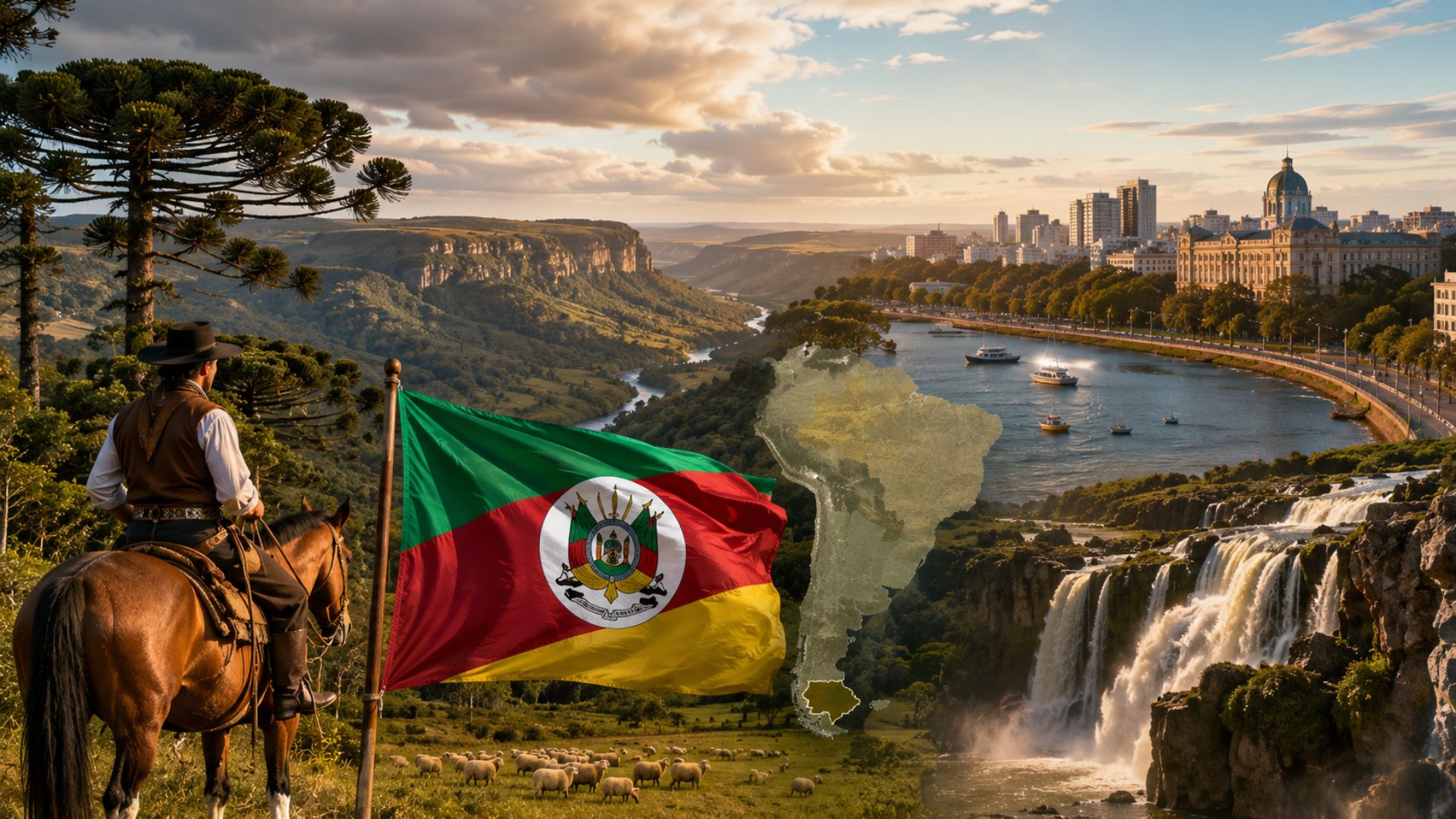

Rio Grande do Sul is the only Brazilian state with an exclusive biome, the Pampa, and the only one that lived a decade as an independent republic, between 1835 and 1845. The local culture is strongly influenced by Argentina and Uruguay, as well as German and Italian immigrants who arrived from the 19th century onwards.
Rio Grande do Sul is the southernmost state of Brazil and the only one that combines characteristics that no other has: an exclusive biome, two countries as direct neighbors, a history of almost a decade as an independent republic, and a culture that is often closer to Argentina and Uruguay than to the center of Brazil. With about 281 thousand square kilometers in area, the state is larger than many European countries and hosts one of the most striking regional identities in the national territory.
The reason for this difference lies in a rare combination of historical and geographical factors. Rio Grande do Sul borders only one Brazilian state, Santa Catarina, but has two entire countries as direct neighbors: Uruguay and Argentina. The distant location from the traditional centers of the country and the proximity to the Rio de la Plata region made the cultural influence of Buenos Aires and Montevideo as strong there as the Portuguese influence that shaped the rest of Brazil.
The Pampa, exclusive biome of Rio Grande do Sul

Rio Grande do Sul is the only Brazilian state to host a biome that does not exist anywhere else in the country. The Pampa occupies the southern half of the gaucho territory and extends to Uruguay and northeastern Argentina, forming a landscape distinct from the Atlantic Forest, Cerrado, Caatinga, Pantanal, and Amazon.
-
Chevrolet Offers Chance to Win a 2026 Sonic RS for Free via WhatsApp

-
Earthquake vs. Tsunami: Which Causes More Destruction and Why One Can Be Even More Dangerous
-
Hospital Cook Discovers 1,700-Year-Old Pot of 52,503 Roman Coins Using Metal Detector in Field

-
Salvador’s Acarajé Vendors Turn Used Frying Oil into Income by Selling it for Biodiesel Production



The Pampa is a plain of native fields, with low vegetation and few trees, ideal for extensive cattle raising. It was precisely this biome that determined who would live there: when the Spanish introduced cattle and horses to the region in the 17th century, the Pampa offered ready pastures, the cattle multiplied, and a new social figure was born, the gaucho, a free, mixed-race, and skilled horseman.
The republic that lasted ten years

In 1835, a revolt broke out in Rio Grande do Sul and forever changed the state’s relationship with the rest of Brazil. The Farroupilha Revolution lasted ten years and is considered the longest civil war in Brazilian history. It ended in 1845 not as a military defeat, but as a political negotiation.
During this decade, Rio Grande do Sul was not part of Brazil. It existed as the Republic of Rio Grande, an independent state with its own government, army, and flag, in an experience that no other Brazilian state replicated for so long. This past of autonomy helped shape a distinct political and cultural identity, marked by a strong sense of regional pride that persists to this day in the collective imagination of the Gaúcho people.
The border that shapes the culture


The geography of Rio Grande do Sul creates a rare situation among Brazilian states: most of its borders are with other countries, not with other states. This configuration pushes the state more outward than inward into the national territory.
The result is a hybrid culture, with elements coming from both Brazil and the Platine region. The chimarrão, the barbecue, the traditional clothes worn at cultural festivals, and even the way of cattle raising have shared roots with Uruguay, Argentina, and Paraguay, a heritage of the Guarani people who occupied this entire region before the arrival of Europeans. The word chimarrão, in fact, comes from the Spanish “cimarrón,” meaning wild or ownerless, initially used to describe the mate drunk pure as the indigenous people did.
The German and Italian immigrants who changed the state
Another decisive factor in the formation of Rio Grande do Sul was the arrival of European immigrants starting in the 19th century. The first Germans landed in São Leopoldo in 1824, and the Italians arrived in the Serra Gaúcha from 1875, forming colonies that completely transformed the northern half of the state.
The way these immigrants were integrated into Rio Grande do Sul was also different from the Paulista experience, for example. Instead of serving as substitutes for slave labor on large farms, they received their own lands for their families, granted by the emperor himself, who feared the region would become sparsely populated in the south. The model generated small properties, family labor, a rural middle class with access to education, and higher population density, which accelerated urbanization and early industrialization in the northern part of the state.
An unpopulated coastline and a surprising economy
Unlike most Brazilian states, Rio Grande do Sul does not have millions of people living on the coast. The coast is sandy, without warm beaches all year round or clear waters like the Northeast, and has historically been sparsely populated. Despite the state’s 11 million inhabitants, just over 500,000 live in the coastal zone.
The economy of Rio Grande do Sul also surprises those who only associate the state with agribusiness. Rio Grande do Sul has the fifth largest GDP in the country, with around R$ 570 billion in 2025, and is the second largest exporter of agricultural machinery and road implements in Brazil. The machinery and equipment sector represents 12% of the state’s industrial GDP, and the state led the national competitiveness ranking in 2025 in terms of innovation and efficiency.
Rio Grande do Sul brings together in one state a unique biome, a history of an independent republic, a double border with other countries, and a diversified economy that goes far beyond agribusiness. This rare combination of factors explains why the state has a cultural identity that no other Brazilian can replicate.
And you, what do you think about these peculiarities? Do you know other characteristics of Rio Grande do Sul that make the state so different from the rest of Brazil? Have you visited the state and felt this Platine influence in the local culture? Leave your comment, share your opinion, and tag someone who loves the South of the country.