Portuguese
  Spanish


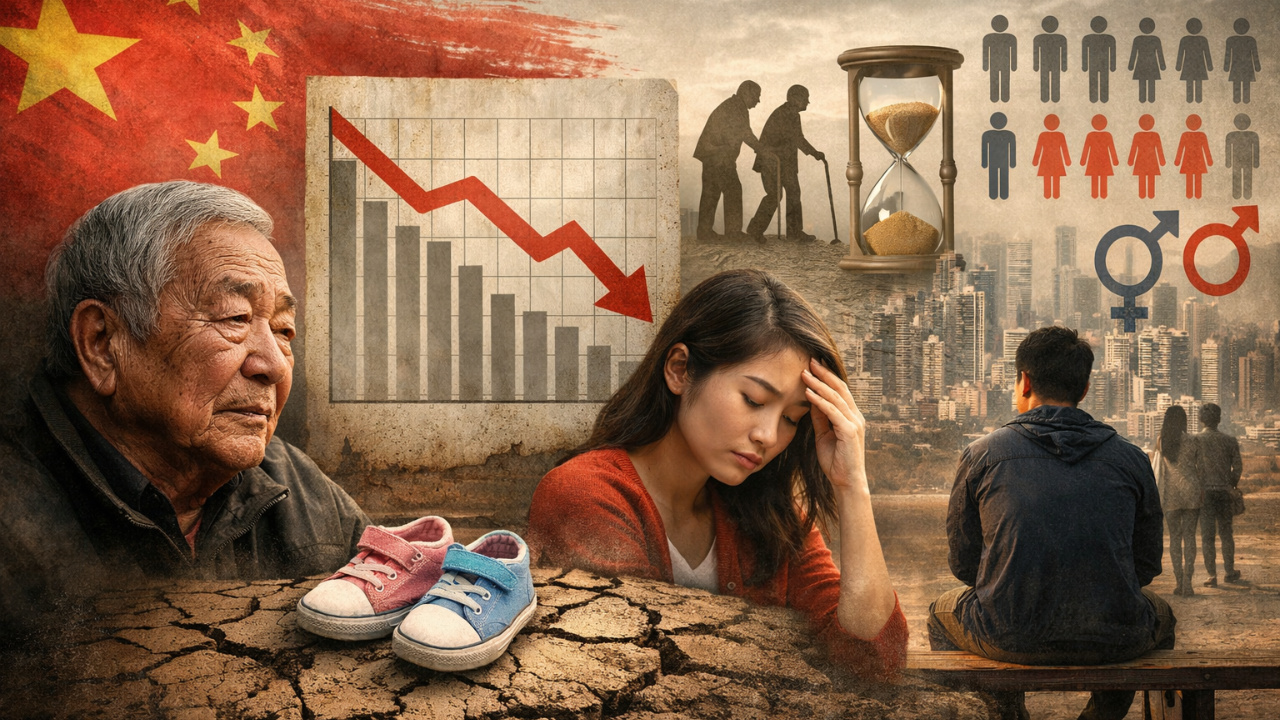


With Record Low Birth Rate, China Faces Demographic Crisis, Aging Population, and Impacts of the One-Child Policy.
China is facing an unprecedented demographic crisis, marked by a historic decline in the birth rate, an increase in the aging population, and long-lasting impacts of the one-child policy.
The data was released in January by the National Bureau of Statistics and raised alarm bells in Beijing.
The phenomenon occurs throughout Chinese territory and reflects social, economic, and cultural changes accumulated over the last few decades.
-
Ayatollah Ali Khamenei’s Funeral Draws 15 to 20 Million in Tehran, Calls for Revenge Against Trump After Joint Israel-U.S. Attack

-
U.S. Establishes Permanent Embassy in Jerusalem, Reigniting International Debate Over Israel’s Capital
-
The world has nearly 12,000 nuclear warheads, with the majority held by the United States and Russia; see the figures for China, France, and the United Kingdom.

-
Venezuela Faces UN Alert for Hunger, Disease, and Service Collapse After Earthquakes Cause Nearly 2,000 Deaths and $6.7 Billion in Damages


In 2025, the country recorded only 7.92 million births.
The rate fell to 5.63 births per thousand inhabitants, the lowest level since 1949.
Moreover, deaths exceeded births for the fourth consecutive year, reducing the population by about 3.4 million people in the last year.
United Nations experts project that the Chinese population could shrink by half by the end of the century.
This scenario contrasts sharply with forecasts made two decades ago when continuous growth was expected until 2033.
Declining Birth Rate and Errors in Projections
For years, Chinese planners believed that the low birth rate would be temporary.
The expectation was that, after easing restrictions, families would start having more children again.
A strategic report published in 2007 argued that fertility had strong “recovery potential.”
Therefore, it recommended caution in relaxing the rules, even in the face of declining births.
However, reality turned out to be different.
The allowance for two children in 2016 and then three in 2021 did not trigger the expected “baby boom.” On the contrary, the demographic crisis deepened.
One-Child Policy and Its Lasting Effects
Established in 1979 during Deng Xiaoping’s administration, the one-child policy aimed to curb population growth and boost economic development.
The measure offered incentives for those who complied with the rules and punishments for those who did not.
According to official estimates, around 400 million births are believed to have been avoided.
Although this number is contested, it is undeniable that the policy profoundly altered the country’s age structure.
Over time, another challenge emerged: the aging population.
Fewer young people are available to support a growing elderly population, putting pressure on the social security system and the labor market.
“Constant Decline”: Social Change Beyond the One-Child Policy
According to Professor Kerry Brown, director of the Lau China Institute at King’s College London, the decline began even before the restrictive policy.
“China’s fertility rate had been declining for natural reasons since the early 1970s,” he told the BBC. “The peak of population growth, in terms of children per family, occurred in the 1950s and 1960s.”
Brown noted that economic factors weighed more heavily than government rules.
“I think the party may not have truly understood the economic difficulties faced by families in raising their children and how critical it is for them to decide whether they can do this well or if they will not have children.”
He adds: “We have observed these changes around the world, but in China, it happened very quickly.”
Gender Imbalance and the “Singles Crisis”
Another significant legacy of the one-child policy was the gender imbalance.
For decades, many families prioritized male children, distorting the ratio between men and women.
The result was a so-called “singles crisis,” with millions of men facing difficulties in finding partners. Brown describes the phenomenon: “This generated a phenomenon called ’empty branch men,’ a metaphor to denote men unable to find partners.”
He explains that the expression refers to the idea of branches that bear no fruit — in other words, do not produce children.
At the same time, educated women began to delay or avoid marriage.
The state media even used the derogatory term shèngnǚ, meaning “leftover women.” “It is a very pejorative expression, a reference to women discriminated against due to their age, who did not marry because they prioritized their careers over marriage and settling down,” the professor states.
In 2023, 43% of Chinese women aged 25 to 29 were single, which also contributes to the decline in the birth rate.
Financial Incentives Do Not Halt the Demographic Crisis
In the face of the demographic crisis, the government launched financial incentives.
One of them offers 3,600 yuan per year for each child under three years old.
Still, many young people claim that the cost of living is too high.
Expensive childcare, high housing costs, and professional pressures make the decision to have more children difficult.
Millie, an air traffic controller in Beijing, told the BBC: “I definitely will not have another child. It’s not good for my body, it will be difficult to find daycare, and no one will help me.”
Meanwhile, Li Hongfei, a businessman in Chongqing, summarizes the financial dilemma: “My work is diminishing, but the cost of maintaining the business remains the same. My daughter’s tuition is rising, and my savings are running out.”
Aging Population and Global Impacts
With about one child per woman, China is far below the population replacement rate of 2.1.
This accelerates the aging population and reduces the workforce.
The consequence goes beyond Chinese borders.
The decrease in population may affect global supply chains and put pressure on international prices.
“In almost the entire region, the population is declining and aging,” Brown explains.
“The phenomenon is more critical in places like Japan and Taiwan, but the scale of change in China is undoubtedly the largest.”
He further warns: “In terms of social support and other ways to address the aging population and provide assistance to the elderly, China has not yet reached the levels of wealth necessary.”
Despite the challenging scenario, Brown remains cautious. “They will likely try to use technology and hold all sorts of political levers to tackle these issues,” he says.
“I think people often have pessimistic ideas about China’s ability to get things done. But in the end, they tend to find a solution.”
Thus, the demographic crisis in China is not just a statistical problem.
It is a structural transformation that redefines the country’s future — and may reshape the global economic balance in the coming decades.
Read more at: China: The ‘Baby Boom’ That Never Came and the Continued Decline of Birth Rates in the Country – BBC News Brazil