






 Portuguese
  Spanish


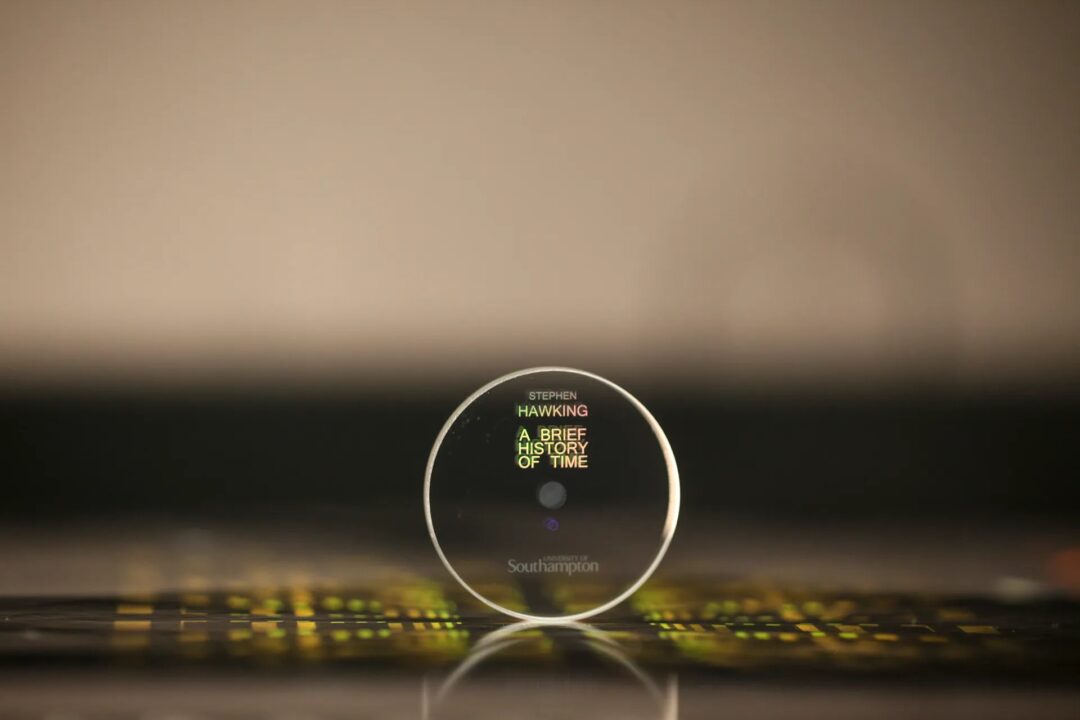

Researchers Develop Indestructible Quartz Crystal HD. In Addition to Lasting Billions of Years and Being Resistant to High Temperatures, It Is an HD Capable of Storing 360 TB.
Scientists from the University of Southampton in the UK have made an impressive discovery: they managed to store the entire sequence of the human genome in a quartz crystal using 5D optical memory technology. This indestructible crystal, smaller than a coin, has a remarkable storage capacity of up to 360 terabytes (TB). This innovation could revolutionize the future of data storage, providing a durable and resilient solution capable of preserving information for billions of years in an HD.
Quartz Crystal HD Can Withstand Temperatures Up to 1,000ºC
The claims of indestructibility of the HD capable of storing 360 TB are no joke, considering that the disks can withstand temperatures up to 1,000 ºC, cosmic radiation, and even direct impact forces of 10 tons per cm³.
Developed at the Southampton Optoelectronics Research Center, the 5D memory crystals use ultrafast lasers to inscribe data in “oriented nano-structured voids within silica.”
-
She spent 73 years breathing inside an iron lung, survived the aftereffects of polio, and became the last woman in the United States dependent on the equipment before dying at 78 years old.

-
Brazilian students created a $1 filter using pine bark, cotton, and 3D-printed parts to clean cassava wastewater, reduce the toxicity of a hazardous waste, and transform contaminated water into biofertilizer.

-
Astronaut from Artemis II steps down after mission to the Moon and decision surprises after a record of 406,771 km, a historic 10-day journey, and an unprecedented achievement for Canada.

-
A fossil kept for years in a small museum in Montreal concealed 450-million-year-old soft tissue, a discovery that has only happened once before in history.



The 5D in the name comes from the fact that, unlike 2D markings on a piece of paper or tape, this quartz crystal HD uses two optical dimensions and three spatial coordinates to write throughout the material. The team claims that this technique allows for an unprecedented data density of up to 360 terabytes at the largest size, without degradation over billions of years.
The goal of this effort is simple, and the researchers envision that in a distant future, where science allows for the reconstruction of organisms from DNA alone, the genome map stored in this eternal crystal could provide a safety blueprint.
In addition to reviving humans, the crystals could also preserve the genomes of endangered plant and animal species today due to climate change, habitat loss, and other environmental crises.
Understand How the HD Capable of Storing 360 TB Can Save Humanity
Moreover, if humans cannot figure out how to recreate organisms or disappear before doing so, scientists designed the quartz crystal HD so that other intelligent beings can retrieve it. According to the lead researcher, Professor Peter Kazansky, the visual key inscribed in the crystal provides the knowledge of what data is stored within and how it can be used.
The key represents the basic molecular structure of the nucleic acid base pairs of DNA, how they form the iconic double helix structure, and even a reference to the famous diagrams of the “Pioneer Plaque” once carried by interstellar probes from NASA to represent life on Earth.
The researchers have already deposited the first of these genome crystal backups in a repository in a salt mine in Hallstatt, Austria, aimed at preserving records of human civilization.
New HD Will Help Companies with Backups
The quartz crystal HD was created using a laser that emits powerful and short light pulses, recording the data in 3 layers, with spaces of only 5 micrometers. The nanostructure changes how light passes through the crystal, modifying its polarization, which can then be read by a combination of optical microscope and a polarizer.
The research is led by Jingyu Zhang from the Optoelectronics Research Center, in partnership with Eindhoven University of Technology, which states that a very secure and stable form of portable memory using glass is being developed, which can be very useful for organizations with large files. At present, companies have to back up their files every 5 to 10 years due to the short lifespan of hard drives.








Eo campo de batalha,sò interessa a vitória é vençer,vençer e vençer sergioguedes,a tecnologia do perdoar,amizade,amor,vida sò o sem pecdo do DEUSVIVOVIDAETERNAPAIJESUS CRISTO o ALIMENTOSANTO se alimente leia A bliblia,ore e jejue