





 Portuguese
  English
  Spanish
  5 min of reading
  0 comments


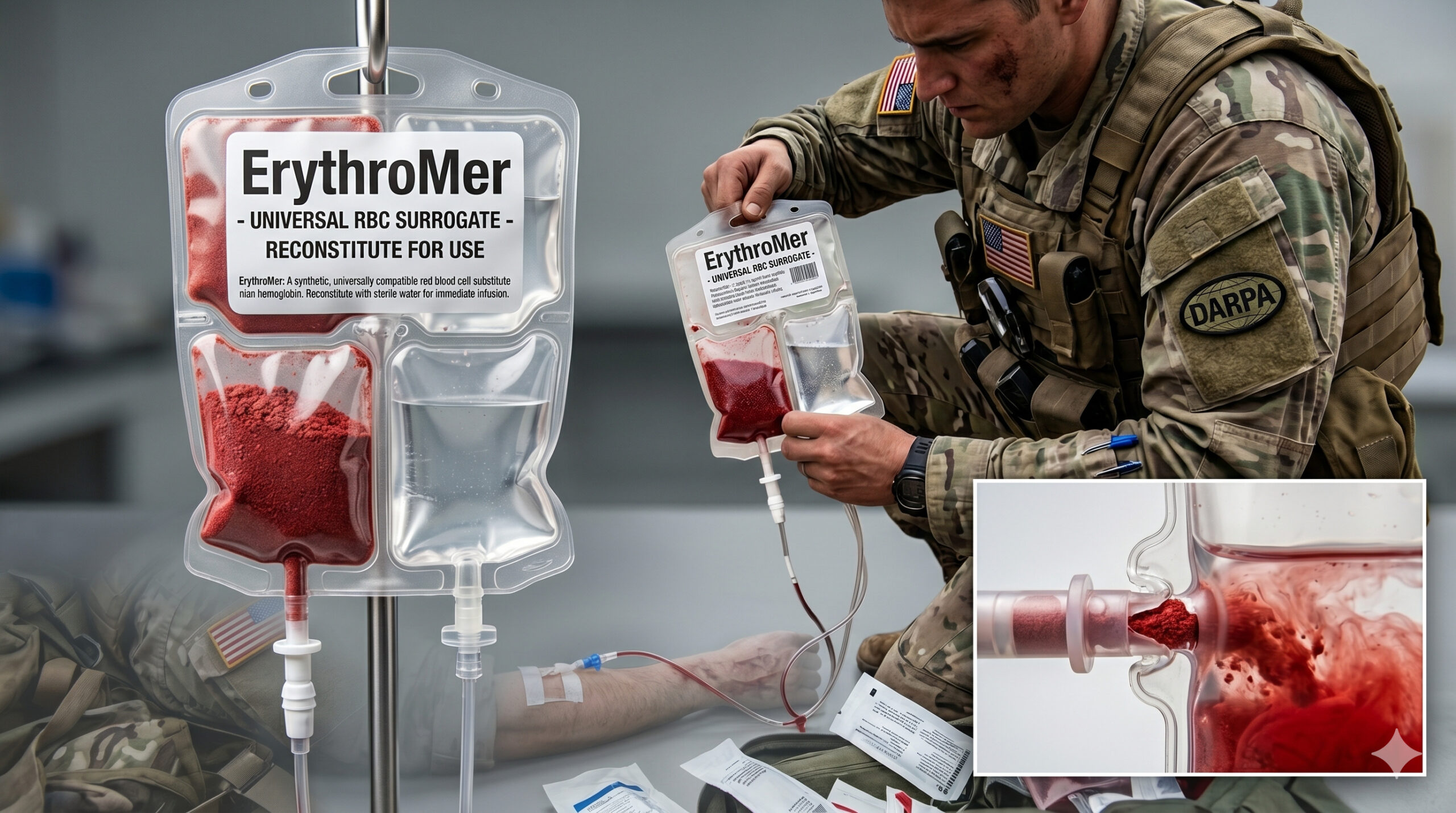
DARPA funds artificial blood powder that eliminates blood type and refrigeration requirements, potentially changing medical care in combat.
In 2023, DARPA began funding an effort to address one of the biggest bottlenecks in treating wounded soldiers in combat: the difficulty of performing transfusions in locations without refrigeration and without quick access to compatible blood. Within this project, KaloCyte is developing the ErythroMer, described by the company as a lyophilized artificial red blood cell, designed for use when conventional blood is not available.
The proposal is to create a portable, room temperature stable, and quickly usable solution that can circumvent well-known logistical limitations of human blood, such as short shelf life, the need for a cold chain, and compatibility requirements. In combat scenarios, where minutes can determine a patient’s survival, these barriers often make transfusion impossible.
Hemorrhage remains the leading cause of preventable death in combat
Data from military studies indicate that hemorrhage is the leading cause of preventable death on the battlefield, especially in the first hours after injury. The difficulty of immediate access to compatible blood further exacerbates this situation.
-
Country begins releasing crocodiles into protected area to try to save critically endangered species and restore degraded freshwater ecosystem in Cambodia

-
Physics has been challenged: researchers have discovered something that moves faster than the speed of light, but the phenomenon does not break relativity because it involves dark patterns within optical vortices.
-
Europe is “frying” with records: United Kingdom records 35°C, France reaches 35°C, and Spain and Portugal face heat close to 40°C in May as a heatwave advances across the continent.
-
On the other side of the planet, a Brazilian doctor operates on a patient in Porto Alegre while being in China, almost 19,000 km away, using a surgical robot that responds in 200 milliseconds in a procedure that seems like science fiction.



It is in this context that the ErythroMer was conceived: not as a complete substitute for blood, but as an emergency solution capable of quickly restoring the body’s oxygen transport capacity.
By directly addressing this critical point, the technology aims to increase survival chances until the patient can receive complete treatment in a hospital environment.
ErythroMer mimics the function of red blood cells and eliminates blood compatibility requirements
The ErythroMer is a product based on artificial particles that replicate the main function of red blood cells: transporting oxygen throughout the body. Unlike conventional blood, it does not contain the surface proteins responsible for incompatibility reactions between different blood types.
This means that, in theory, the product can be administered without the need for blood typing, eliminating a critical step in emergency care.
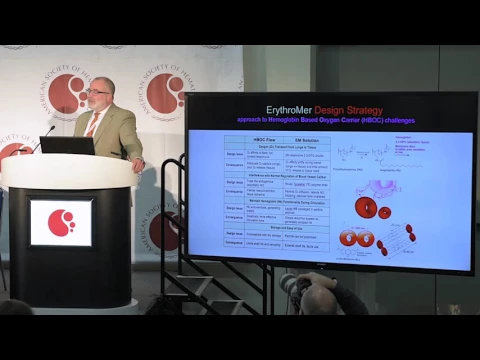

Additionally, because it does not rely on human donors, the system reduces the complexity of the supply chain, one of the biggest logistical challenges in military operations.
Powder format allows storage for long periods without refrigeration
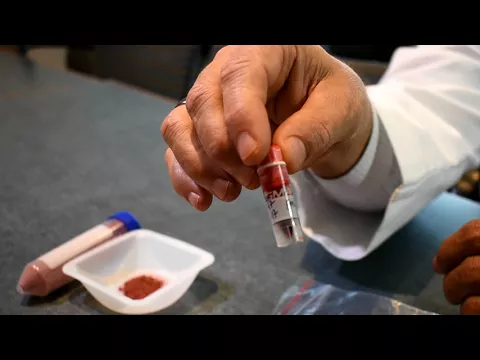
One of the most relevant advancements is in the product format. ErythroMer is lyophilized, meaning it is transformed into powder through a controlled dehydration process. This allows it to be stored for long periods at room temperature, without the need for refrigeration.
In practice, this means that the material can be transported in individual medical kits, significantly enhancing field response capacity.
At the time of use, the product is reconstituted with a liquid solution, such as saline, and administered similarly to a traditional transfusion.
Preclinical tests show performance similar to blood under controlled conditions
The data released so far indicates that ErythroMer has shown promising results in animal tests. In experiments with significant blood volume loss, the product was able to restore oxygenation comparably to real blood.
These tests are considered an important step in the development of the technology, but they do not yet represent complete validation for large-scale use in humans.
The transition from preclinical results to practical application involves a series of regulatory steps and additional testing, especially when it comes to products intended for medical use.
Difference between artificial blood and whole blood still limits application
Despite the potential, DARPA ErythroMer does not replace all components of human blood. It specifically acts on the function of red blood cells but does not include elements such as:
- platelets, responsible for clotting
- plasma, which transports proteins and nutrients

Therefore, the product is viewed as a temporary and emergency solution, not as a complete substitute for conventional transfusions. This point is crucial to understanding the real role of the technology in the medical context.
Lyophilized plasma is already a reality and reinforces the trend of portable solutions
While the ErythroMer is still in development, other solutions are already in use. One example is OctaplasLG, a treated and lyophilized plasma that has received emergency use authorization in the armed forces of the United States and Canada.
This type of product demonstrates that the idea of portable blood components is already being applied in practice, albeit partially.
The combination of different solutions of this kind could, in the future, form a more complete field medical support system.
Technology can transform each soldier into an advanced medical support point
One of the central concepts behind the development of the DARPA ErythroMer is to decentralize access to critical medical resources. With stable and easily transportable products, each military unit can have immediate capacity for response to severe emergencies.
This reduces dependence on complex medical structures and expands the time window for treatment, a decisive factor in severe trauma situations.
The idea that each soldier could carry a potential transfusion solution represents a significant change in military logistics.
Development reflects integration between biotechnology and military strategy
The advancement of ErythroMer highlights a broader trend: the incorporation of advanced biotechnology into defense strategies. Projects like this show that military superiority depends not only on weaponry but also on medical and logistical solutions.
The ability to save lives on the battlefield directly impacts operational efficiency and troop survival, making this type of technology a strategic element.
With the progress of technologies like the ErythroMer, a central question arises for medicine and defense: to what extent will it be possible to replace complex biological components with artificial solutions?
Although the advancements are significant, there are still scientific, regulatory, and operational challenges to be overcome before these technologies are widely used.
In this context, the development of artificial blood powder not only represents a technical advancement but also paves the way for a new phase of medicine, where portable and independent solutions can redefine care in extreme situations.


-

1 person reacted to this.