Portuguese
  Spanish


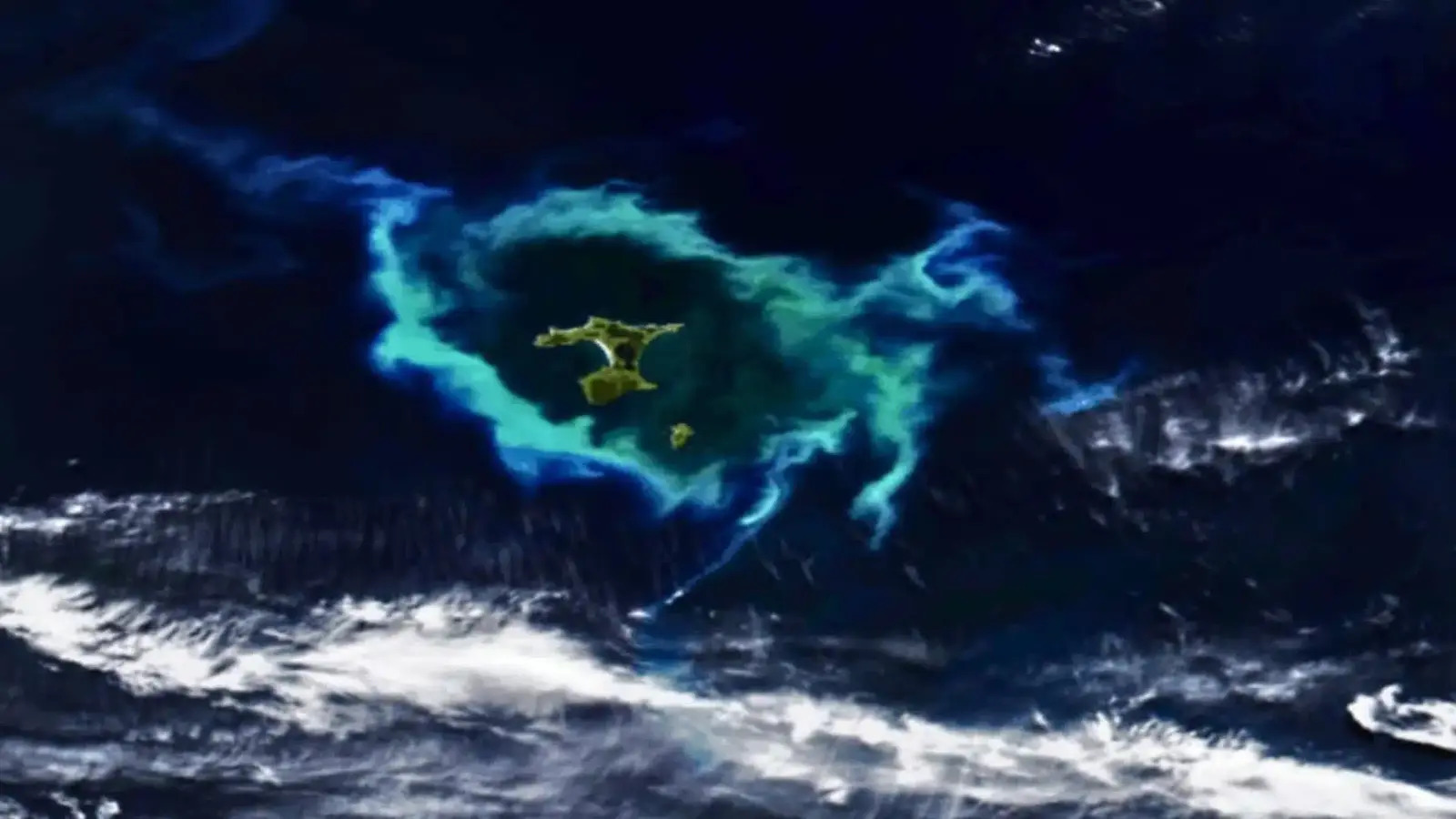

Image captured by NOAA-20 satellite shows a large phytoplankton bloom around the Chatham Islands, New Zealand, shaped by the Chatham Rise and visible from Earth’s orbit
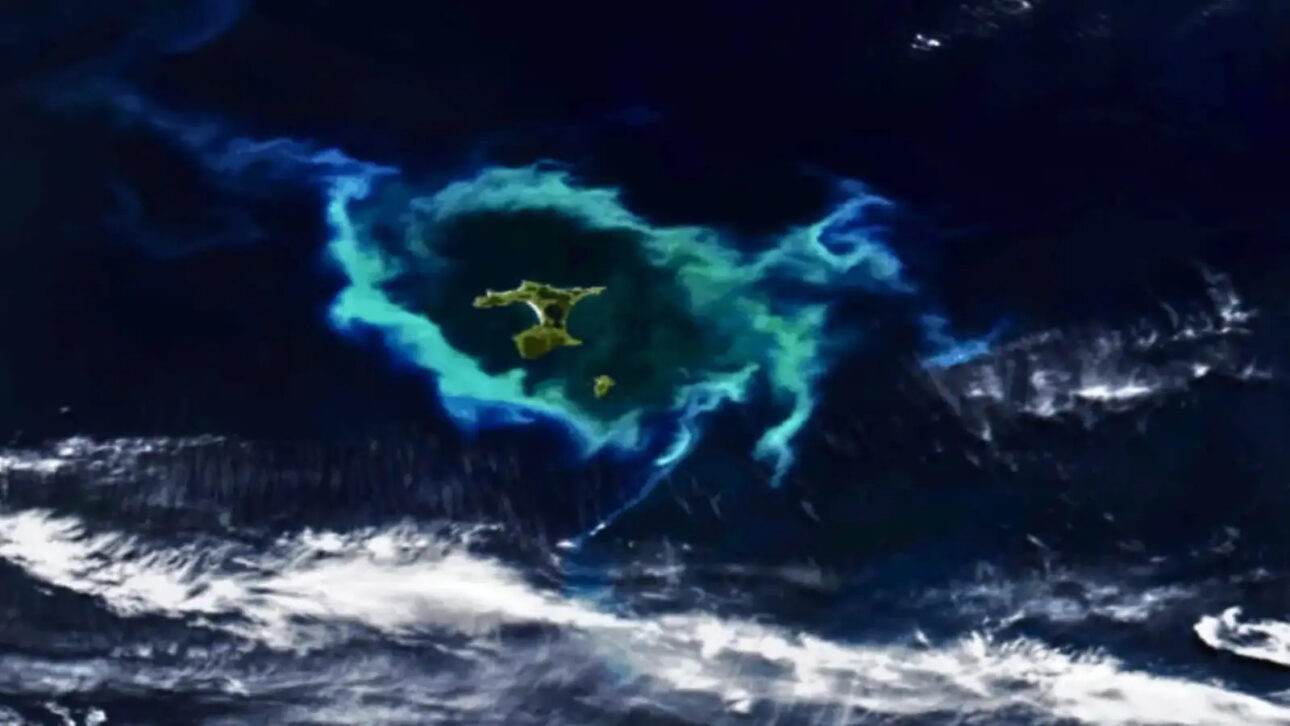
A large phytoplankton bloom formed a turquoise and green ring around the Chatham Islands, about 800 kilometers from New Zealand’s South Island. The image was captured on January 10, 2026, by the NOAA-20 satellite and released by NASA on January 16, showing a phenomenon visible from orbit.


NASA satellite recorded bright ring in remote area of the South Pacific
The record was made by the VIIRS instrument, installed on the NOAA-20 satellite. The image drew attention because the bloom outlined the Chatham Rise, a shallow underwater plateau extending east from New Zealand’s South Island.
The Chatham Islands are located in an isolated region of the ocean. The largest, Chatham Island, is about 58 kilometers in diameter. The neighboring Pitt Island is approximately 15 kilometers.
-
Scientists Develop Method to Store Wind and Solar Energy by Liquefying Air for On-Demand Power Generation

-
Brazilian Engineer Who Grew Up Without Electricity Develops Software, Expands AltoQi to 67,000 Clients, Aiming for $21 Million by Digitizing Brazil’s Construction Industry

-
Spain Launches World’s Largest Floating Dry Dock: 56-Meter Giant Produces Massive Concrete Structures in A Coruña Using Technology Proven in Brazil

-
AI-powered toys that talk, recognize faces, and collect data face scrutiny from Brazilian government over children’s privacy concerns





Due to this remote location, satellite images are one of the main ways to observe large-scale oceanic events in this part of the South Pacific.
According to NASA’s Earth Observatory, the proliferation was large enough to be seen with the naked eye from orbit.
Chatham Rise helped shape the phytoplankton bloom
The Chatham Rise acts as an underwater structure capable of influencing water movement. The plateau lies between deeper waters to the north and south, creating a sort of ramp on the seafloor.
Cold, nutrient-rich currents from Antarctica encounter this rise and are pushed to the surface.
Upon reaching the upper layers, this water mixes with warmer, nutrient-poor water from the subtropics.
In the austral summer, the long daylight hours complete the conditions necessary for the rapid growth of phytoplankton. The combination of nutrients, light, and ocean circulation favors large blooms in the region.
After forming, the bloom was pulled by surface currents and eddies. This movement spread the organisms into filaments, spirals, and the ring shape seen in the image.
NASA notes that blooms are common along the Chatham Rise. The Earth Observatory had previously documented similar phenomena in the region, including an event recorded in December 2009.
The difference in the January 2026 record was the scale and the well-defined shape of the ring around the islands.

Turquoise color indicates possible presence of coccolithophores
The milky blue-green hue suggests the presence of coccolithophores, a group of phytoplankton that form microscopic calcium carbonate shells around their cells.
These small structures reflect sunlight and produce the chalky turquoise appearance observed by satellites. This color is different from the darker green normally associated with other types of algae.
The image was processed using a near-infrared filter. This feature helped highlight the contrast between the bloom and the darker waters of the open ocean.
Despite the visual signature, there was no direct sample collection by research ships during the proliferation.
The identification of coccolithophores was based on the optical signature captured by satellite instruments.
This type of observation is already supported by previous studies. A study published in 2001 in the New Zealand Journal of Marine and Freshwater Research mapped the distribution of phytoplankton around New Zealand using ocean color data obtained by satellite.
This work found the same turquoise signature associated with coccolithophore blooms, which repeatedly appear in the waters of the Chatham Rise over time.
Bloom supports food chain and local fisheries
The phytoplankton is at the base of the oceanic food chain. When a bloom of this size occurs, there is a pulse of energy available for organisms that depend on it, such as small fish and crustaceans.
This food base also supports larger animals and helps explain the productivity of the waters around the Chatham Islands. The region is home to abalone, lobster, and blue cod fisheries.
The ocean surrounding the islands is also habitat to five species of seals and about 25 species of whales and dolphins. The region also hosts penguins, albatrosses, and sea lions.
The same underwater structure that favors the bloom also maintains the regular supply of nutrients.
By pushing deep water to the surface, the Chatham Rise sustains a biologically active environment in the South Pacific.
Shallow waters are also linked to whale strandings
The waters around the Chatham Islands are also known for a history of whale and dolphin strandings. The pattern has been repeating for over a century in the region.
Pilot whales are among the most vulnerable because they move in very tight groups. When one animal becomes disoriented or injured in shallow waters, others may follow it towards the shore.
In October 2022, nearly 500 pilot whales stranded on Chatham Island over about four days.
According to New Zealand’s Department of Conservation, the animals were euthanized because rescue was not possible given the number of whales and the remote location.
The case was not the largest ever recorded at the site. In 1918, more than 1,000 pilot whales died after stranding on the same island, in the deadliest whale stranding ever documented.
This article was prepared based on information from NASA’s Earth Observatory, New Zealand’s Department of Conservation, and a study published in the New Zealand Journal of Marine and Freshwater Research, with data, numbers, and statements preserved as per the consulted material.