Portuguese
  Spanish


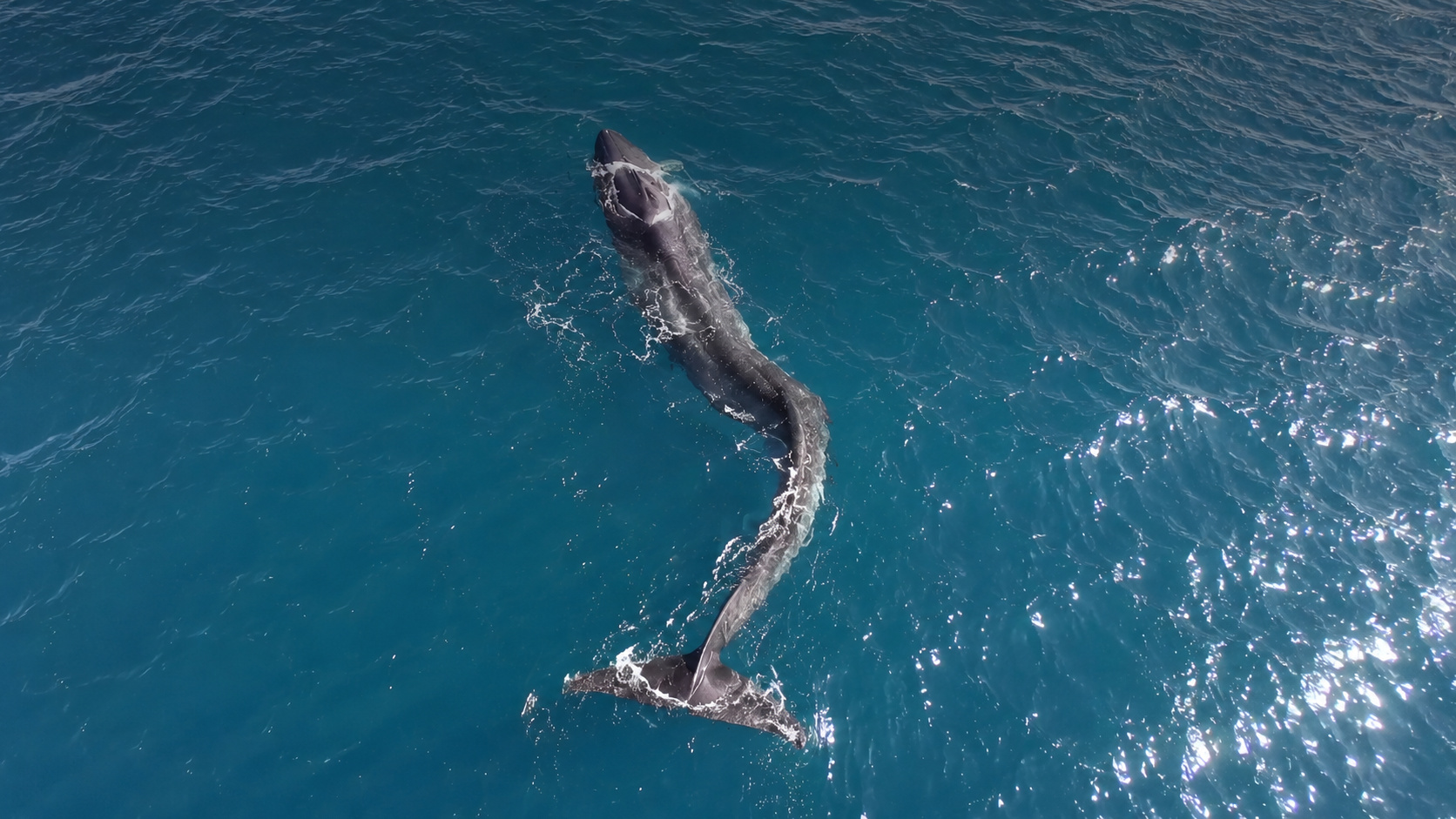

Fin whale was recorded in Valencia with a severe curvature in the spine, difficulty swimming, and suspected injury caused by collision
On March 11, a fin whale was spotted off the coast of Valencia, Spain, in a scene that quickly caught attention on social media. The animal, about 17 meters long and approximately 40 tons, had a pronounced spinal deformity, identified as scoliosis.
The first alert came from local sailors. Initially, they thought the whale was trapped in fishing nets and trying to escape. However, after the arrival of biologists and veterinarians, the situation was reassessed. The problem was not a net, but a severe curvature in the marine mammal’s body.
Fin whale with scoliosis was recorded by rescue team in Valencia
The team from Fundación Oceanogràfic de València monitored the case with aerial images. The footage showed that the animal had a severe deviation in the middle of the spine, which compromised its movements in the water.
-
Son of Poor Farmers Fled Home Four Times Seeking Work, Founded Hyundai, and Transformed It into a Global Industrial Giant in Over 190 Countries

-
13-Year-Old Raises Funds to Build Well, Transforming Lives in Cambodian Community Lacking Clean Water

-
Man with Metal Detector Finds Medieval Silver Seal in England, Uncovers 2,000-Year-Old Roman Gem with ‘Richard’s Secret’

-
Thailand Converts 8 Tons of PET Bottles into 3,500 School Backpacks, Showcasing Circular Economy with Over 40 Factories Involved





Experts tried to place a tracker on the whale to monitor its movement. However, the deformity prevented the equipment from being installed safely.
After a few hours near the coast, the whale left the region. Still, the images showed that it was swimming with difficulty, which reinforced the severity of the observed condition.
Species is the second largest animal on the planet and can reach almost 26 meters
The whale seen in Spain belongs to the species known as fin whale or finback whale. These animals can reach almost 26 meters in length and weigh up to 48 tons.
Furthermore, fin whales are considered the second largest animal on the planet. They are only surpassed by the blue whale.
In the case of Valencia, the specimen was smaller than the maximum limit of the species, but still impressive in size. At 17 meters and about 40 tons, the animal had dimensions equivalent to those of a large vessel.


Scoliosis in whales is rare and usually linked to accidents
In humans, scoliosis can arise spontaneously. This occurs because human anatomy distributes weight in a way adapted to bipedal posture, which can favor deviations in the spine.
In whales, the scenario is different. The anatomy of these marine mammals makes the spine less prone to curvatures caused by posture or body pressure.
Therefore, cases of whales with scoliosis are usually associated with accidents. Among the main suspects are collisions with vessels, a hypothesis considered to explain the case of the common whale in Valencia.
Collisions with boats are among the greatest risks for common whales
About 2,000 whales die every year due to collisions with boats. These accidents are especially concerning for common whales, as the species spends a lot of time near the surface.
This behavior increases the risk of contact with vessels. Consequently, the common whale appears among the species most involved in this type of occurrence.
Shortly after, another species frequently recorded in similar episodes is the humpback whale, also known for making long migrations across the oceans.
2022 case showed suffering of humpback whale with broken spine
In 2022, a humpback whale with a broken spine was tracked during a long journey between British Columbia, on the west coast of Canada, and Hawaii.
The images of the animal with a twisted body caused strong emotion. Even probably feeling intense pain, the whale traveled thousands of kilometers without being able to propel itself normally with its tail.
The journey left the animal extremely debilitated. Along the way, it became emaciated and covered by whale lice, signs of a severely compromised physical condition.

Valencia whale exposes silent impact of vessels on marine life
The case recorded in Spain revealed more than a rare scene. It showed how a spinal injury can compromise the survival of a gigantic animal, even when it can still swim.
The common whale spotted in Valencia continued on its way after a few hours. However, the difficulty of movement indicated that its condition was severe.
The story also highlights the necessary attention to the impacts of vessels on large marine mammals. After all, even when a collision does not cause immediate death, it can leave prolonged and painful sequelae.