Portuguese
  Spanish


Detectorist finds in Essex a medieval silver seal with a 2,000-year-old Roman gem and rare inscription “SECRETUM.RICARDI”, a piece that mixes two historical periods
A detectorist found in Gosfield, in the county of Essex, England, a medieval silver seal that draws attention for mixing two periods separated by more than a thousand years. The object, analyzed by experts, features a Roman gem about 2,000 years old at its center and, around it, a rare medieval inscription that refers to “Richard’s secret”.
According to Live Science, the find was made in the fall of 2024 and is already considered an unusual piece even by British archaeology standards. Besides the mix of eras, the seal raises questions about status, symbolism, and even how its owner wanted to be perceived.
Weighing only 6.44 grams and measuring 27.5 millimeters, the object is small but carries a big history. The most impressive detail is the central stone, a carnelian engraved with a scene of a chariot drawn by two horses, much earlier than the medieval silver setting.
-
Thailand Converts 8 Tons of PET Bottles into 3,500 School Backpacks, Showcasing Circular Economy with Over 40 Factories Involved

-
Mysterious Bats Spotted in Paris’s Père Lachaise Cemetery, Drawing Tourists to the “Vampire Cemetery”

-
From Selling Street Food to Leading a $300 Million Construction Firm: The Journey of a Brazilian Entrepreneur

-
Abandoned Penthouse in Houston Reveals Million-Dollar Suite with 24-Karat Gold, Tiffany Crystals, and Opulence Even Elvis Might Have Snubbed




A small piece, but with more than 1,200 years of difference between the parts
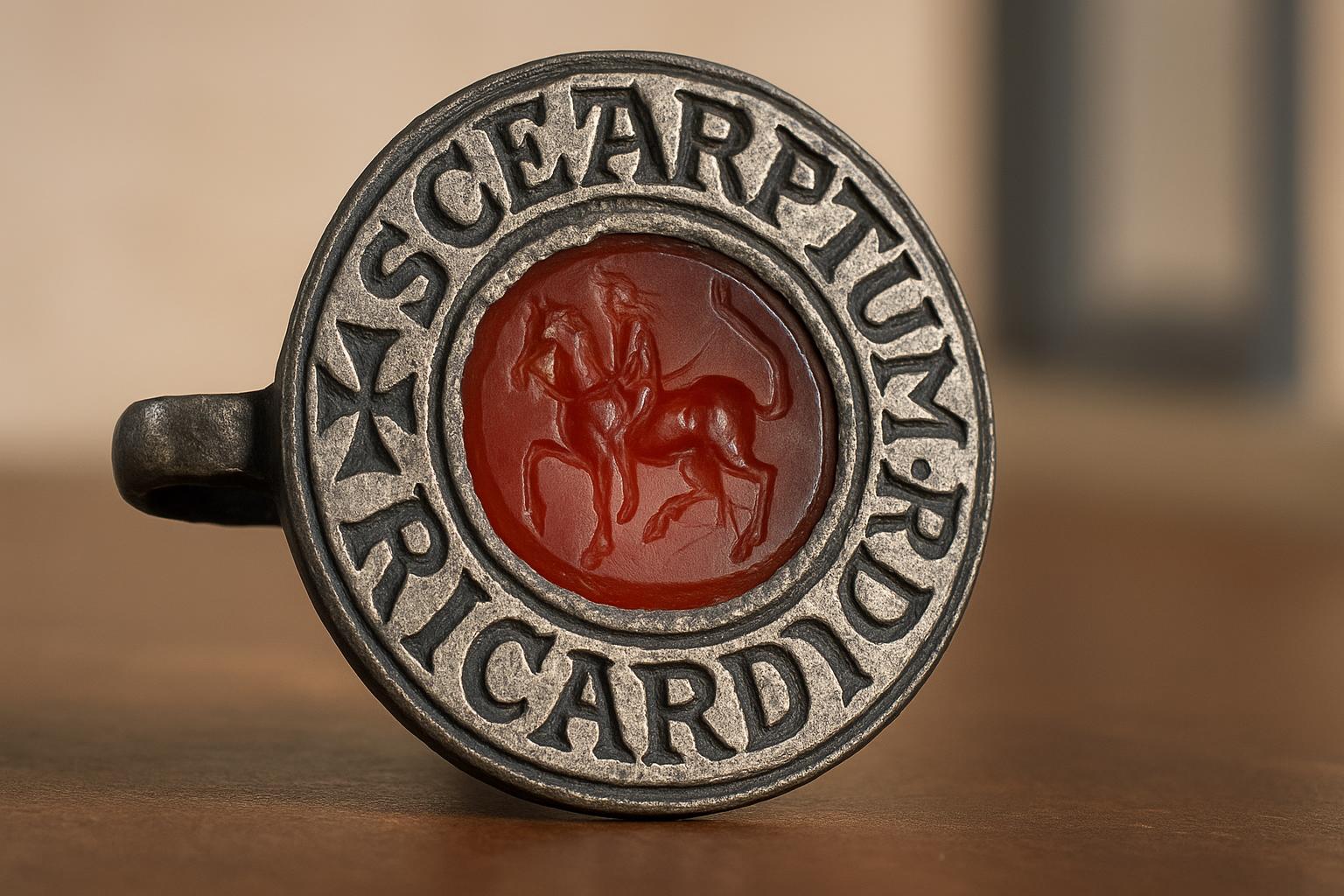
The seal is about 800 years old, but the Roman gem used in the center was dated to the end of the 1st century BC or the beginning of the 1st century AD. This means the stone is at least 1,200 years older than the metal frame surrounding it.
This type of combination is not common. Lori Rogerson, responsible for finds in Essex, told the BBC that it is not frequent to find an object formed by two such distinct eras. For her, the find is special precisely because it brings together materials and references from different worlds in the same item.
The inscription “SECRETUM.RICARDI” and the social weight of the owner
On the edge of the seal, the mirrored inscription reads “SECRETUM.RICARDI”, an expression that can be translated as “Richard’s secret” or “Richard’s secret seal”. There is also a cross pattée, a Christian symbol widely used in the Middle Ages, including by groups linked to the Templars.
The reading of the piece suggests that it was not just an ornament. The tip with a small handle indicates that the object might have been hung, possibly on a necklace, rather than used as a signet ring. When pressed on wax, the design would appear correctly, confirming its function of authentication and personal mark.
For Rogerson, the choice of the Roman gem may have been intentional. She stated that Richard might have wanted to demonstrate knowledge of the classical world and the ability to obtain something from a distant place and time. In practice, the piece would also function as a sign of prestige.
Roman gem shows chariot race and reinforces the rarity of the find
At the center of the seal is a reddish-colored stone engraved with a moving chariot. In the scene, the driver appears standing in the cart, holding the reins and a whip, in a typical image of ancient circus races.
This detail not only beautifies the object but also helps explain why it attracts so much attention among experts. The gem is much older than the medieval seal and was repurposed into a new piece, which gives the set a double historical value.
What should happen with the seal now
The Gosfield seal was submitted for evaluation as a treasure, under the British legislation known as the Treasure Act of 1996, as it is made of silver and is over 300 years old. The Braintree Museum in Essex hopes to keep the piece after the official investigation.
For now, the find remains a rare encounter between two eras of European history: a 2,000-year-old Roman stone set in a medieval seal that may have belonged to someone important enough to want to register their own mark in silver and with an ancient gem. If you enjoy this type of discovery, it’s worth following the next steps of the evaluation and sharing the article with those who are also interested in archaeology.