Portuguese
  Spanish


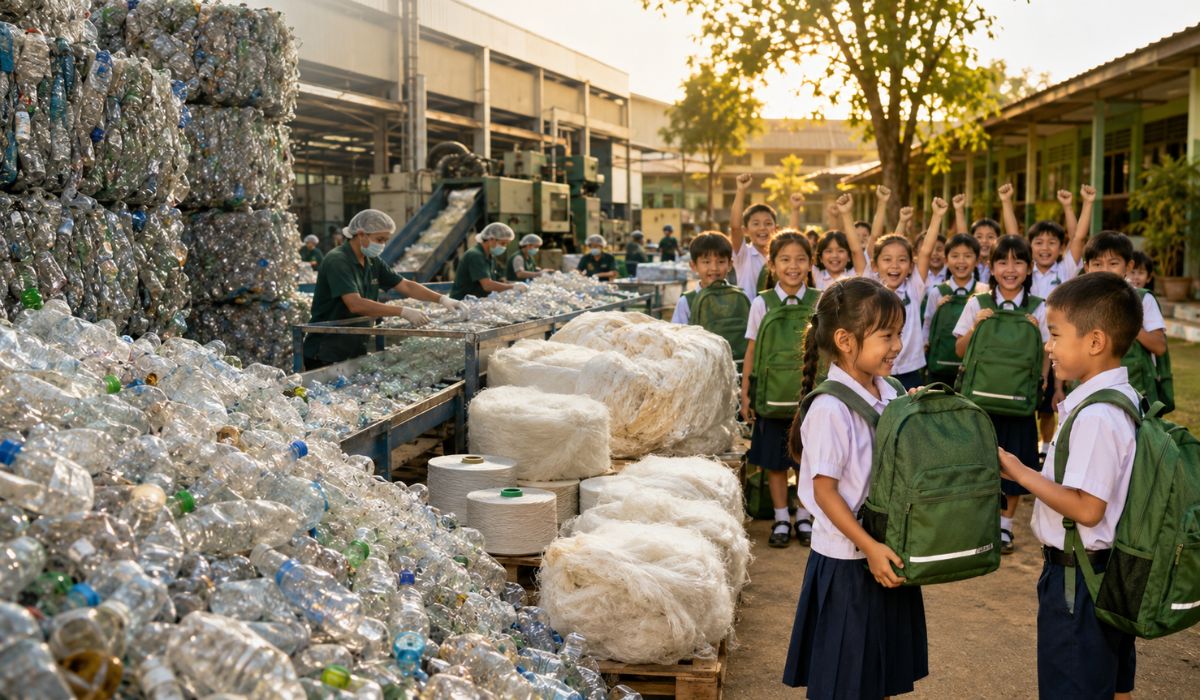

Program in Thailand uses discarded PET bottles to produce school backpacks and brings recycling, companies, and schools closer to a concrete example of circular economy applied to the routine of local students in industrial communities.
What happens to a PET bottle after it leaves the consumer’s hand can determine whether it becomes accumulated waste or raw material for a new product.
In Thailand, a program created by Indorama Ventures in partnership with Amata Corporation uses this path to transform used plastic packaging into school backpacks intended for children from communities near industrial hubs.
The initiative, called “Re-No-Waste: Eco-friendly for Sustainable Future”, was launched in January 2025 with the goal of collecting 8 tons of post-consumer PET bottles in AMATA network factories.
-
Mysterious Bats Spotted in Paris’s Père Lachaise Cemetery, Drawing Tourists to the “Vampire Cemetery”

-
From Selling Street Food to Leading a $300 Million Construction Firm: The Journey of a Brazilian Entrepreneur

-
Abandoned Penthouse in Houston Reveals Million-Dollar Suite with 24-Karat Gold, Tiffany Crystals, and Opulence Even Elvis Might Have Snubbed
-
Architecture Students Design 8×12-Foot Microhouse for Homeless in Newark, Proposing Compact Shelter as Urban Solution Amid Housing Crisis

The material would be transformed into recycled polyester yarn for the production of 3,500 school backpacks, intended for local schools.
The case was updated in May 2025, when corporate social responsibility teams from Indorama Ventures and Amata Corporation distributed more than 200 backpacks in two schools in the provinces of Rayong and Chonburi.
According to Indorama Ventures, the items were produced with recycled polyester yarn, within the same waste separation and PET recycling program.
The action included the delivery of school supplies and educational activities.
During the event, more than 200 students, as well as 20 educators and school leaders, participated in guidance on PET recycling, waste separation at the source, and circular economy.
The proposal, according to the companies’ communication, was to bring the environmental theme closer to the students’ routine.
For this, the program used a common object of the school day as an example of the reuse of plastic waste.
From discarded PET bottle to school backpack
The core of the program is in transforming a discarded package into a daily use product.
Post-consumer PET bottles go through stages of separation, cleaning, and recycling until they become raw material for new items.
In the case of backpacks, the plastic is converted into recycled polyester yarn, used in fabric manufacturing.
This process allows the material to return to the production chain in another form, instead of going directly to disposal.
The project’s dynamics relate to the concept of circular economy.
In this model, materials that have already been used return to the production process as input, reducing the need for new raw materials and increasing the use of waste.
Indorama Ventures, a global company in the chemical sector with operations in PET and polyester, presented the program as part of its recycling and social responsibility actions.
Amata Corporation participates through its network of industrial parks in Thailand, involving companies located in the AMATA City Chonburi and AMATA City Rayong complexes.
According to Indorama Ventures, more than 40 factories were mobilized at the beginning of the project to collect post-consumer PET bottles.
In a later update, the company reported that 50 companies from the AMATA network had already participated in the collection, with 2.6 tons of PET collected in five months.
Program involves companies, schools, and recycling
The partnership was formalized on January 30, 2025, during a memorandum of understanding signing ceremony between Indorama Ventures and Amata.
On the occasion, Indorama was represented by Naweensuda Krabuanrat, the company’s global head of corporate social responsibility, while Amata was represented by Akkhararet Chuchuay, community relations advisor.
Also participating as witnesses were Weerapong Duangpiboon, director of Amata City Chonburi, and Sermpong Sukhko, director of Amata City Rayong.
The presence of representatives from the two industrial hubs indicates that the action was structured to involve companies located in the complexes and surrounding communities.
The program’s operation depends on a coordinated chain between collection, recycling, and distribution.
The factories separate and deliver used PET bottles, the material goes for recycling and transformation into yarn, and this input is applied in the making of backpacks.
After production, the items return to the communities in the form of school supplies.
In this way, the waste collected within the industrial network undergoes processing and reaches schools as an everyday use product.
The action also has an educational component, according to Indorama Ventures.
By receiving a backpack made from recycled plastic, the student sees the result of a process that usually remains distant from the classroom.
In this context, recycling ceases to appear merely as an environmental guideline and becomes represented by an object used every day.
The relationship between disposal, reuse, and the final product becomes more direct for students and teachers.
Why PET becomes recycled fabric
PET, short for polyethylene terephthalate, is a plastic widely used in beverage bottles, food packaging, and other consumer products.
One of its characteristics is the possibility of mechanical recycling, a process that allows discarded packaging to be transformed into new materials.
After being collected and separated, the bottles can be shredded into small flakes, washed, and processed until they become granules or fibers.
When destined for the textile industry, the recycled material can be transformed into polyester yarns used in fabrics, clothes, bags, and backpacks.
In the Re-No-Waste program, Indorama Ventures reported that the backpacks were made with recycled polyester yarn.
The data shows that the project involves more than just waste collection, as it includes the conversion of plastic into textile input and its application in a final product.
Separation at the source is an important step in this process.
When PET bottles are discarded along with organic waste or contaminating materials, recycling tends to become more difficult, more expensive, or unfeasible.
Therefore, organized collection within companies can facilitate sorting and improve the quality of the reused material.
This step also reduces mixing with other waste and allows PET to reach the recycling process in better conditions.
Rayong and Chonburi enter the route of recycled backpacks
The backpacks distributed in May 2025 were delivered to two local schools in the provinces of Rayong and Chonburi, important industrial regions of Thailand.
The two areas host Amata complexes and concentrate business activities capable of generating a significant volume of recyclable waste.
The choice of these communities is related to the project’s design.
Since the bottles were collected in AMATA network companies, the distribution of the backpacks took place in schools near the involved hubs.
With this structure, the material cycle is associated with the territory where the waste was generated and collected.
The program connects companies located in industrial parks, recycling processes, and schools located in surrounding communities.
Amata also registered the program in its sustainability area as “AMATA Re-No-WASTE: From PET Plastic Bottles to School Bags”.
The company claims that the project was implemented in collaboration with Indorama Ventures and a network of industrial partners, focusing on systematic reduction and reuse of plastic waste in the Chonburi and Rayong complexes.
According to Amata, the program resulted in the production of over 3,000 school backpacks distributed to schools in communities near the industrial parks.
The information indicates progress in relation to the initial phase of the goal, although the company does not detail, in the consulted section, whether the complete goal of 3,500 backpacks was achieved.
Circular economy appears in the school routine
The program connects industry, recycling, and education in a single chain.
Instead of treating the circular economy only as a concept, the initiative presents a school product as a result of waste reuse.
The execution of this type of project depends on the participation of different actors.
Companies need to separate the material, the recycling chain needs to process the PET, the industrial stage transforms the recycled yarn into a product, and the schools receive the backpacks.
The operation functions as a practical demonstration of a circular chain on a local scale.
The bottle consumed in an industrial or community environment returns in another form to children living around these areas.
The result does not eliminate the plastic problem but shows a way of reuse within an organized system of collection, processing, and distribution.
The initiative operates in a specific part of waste management, without replacing broader policies of reduction, selective collection, and recycling.
Indorama Ventures stated that the initiative seeks to use internal capabilities and partnerships to generate environmental and social impact.
Amata, in its sustainability communication, relates the project to the reduction of plastic waste, the circular economy, and the environmental awareness of young people and local communities.
Environmental education goes beyond the delivery of backpacks
The delivery of the backpacks was accompanied by awareness activities.
According to Indorama Ventures, students, teachers, and school leaders participated in actions on PET recycling, waste separation at the source, and the circular economy.
This educational component relates to the functioning of recycling itself.
For plastic packaging to be reused, it needs to be correctly separated, directed to appropriate collection, and processed by chains capable of transforming the waste into new material.
The presence of educators at the event increases the possibility of continuing the topic within the schools.
Teachers and managers can relate the content to science, environment, consumption, waste, and collective responsibility in future activities.
Indorama Ventures’ public communication also records other training actions on recycling aimed at students, teachers, and communities.
These programs were not presented as a direct part of Re-No-Waste, but they show that the company maintains educational initiatives related to PET reuse.
In the case of backpacks, the pedagogical component is linked to the object itself delivered to the students.
The school material starts to function as a physical example of a chain that begins with disposal and ends in a reused product.
PET Recycling Shows Path to New Products
The backpack program shows a way to transform a common waste into a product with social use.
PET bottles are part of the daily life of millions of people, but their fate after consumption depends on infrastructure, selective collection, and participation from companies and consumers.
When plastic becomes a backpack, the transformation becomes visible to students and communities.
The received object also carries a message about waste separation, recycling, and material reuse.
For the companies involved, the project appears as a social responsibility action associated with waste management.
For schools, the program combines material delivery with educational activities about consumption and disposal.
The scale of the program is limited when compared to the global volume of discarded plastic, but the numbers help to size the proposal.
The goal of 8 tons of PET and 3,500 backpacks shows how common waste can generate useful products when there is organized collection and a recycling chain.
At the same time, the initiative should not be presented as the sole solution for plastic waste.
Recycling depends on consumption reduction, proper packaging design, logistics, a market for recycled materials, and public policies.
The project operates within a part of this system: collection, transformation, and environmental education.
Therefore, its relevance lies less in isolated scale and more in demonstrating how waste can circulate between companies, industry, and schools.
The case of Thailand places recycling in a concrete part of school life.
The backpack ceases to be just study material and starts to represent the journey of a bottle that did not end up in a landfill, river, or urban environment.