






 Portuguese
  Spanish


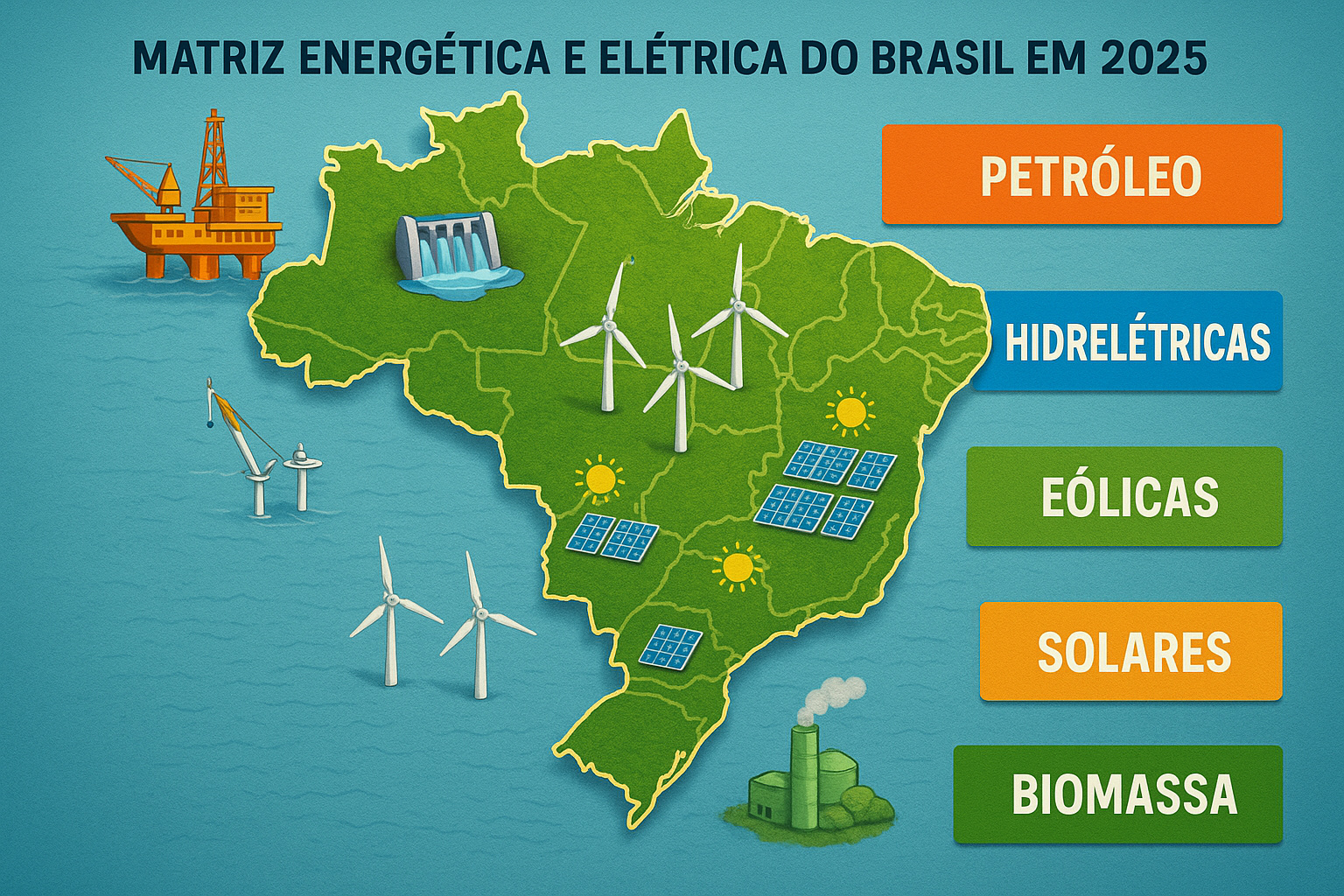


Complete Overview of the Sources That Power the Country: Fossil Fuels, Biomass, Hydropower, Wind, and Solar; Participation in Electricity Generation, Champions by State, Regional Consumption Profiles, and Annual Trends, with Updated Maps and Numbers.
Brazil is among the largest energy consumers on the planet and has a complex energy matrix that combines different sources to meet the needs of a population of over 200 million people. This diversity ensures not only the functioning of the economy but also the expansion of national infrastructure.
Before diving into the numbers, it is essential to understand the difference between energy matrix and electricity matrix. The former is formed by all energy sources used for different purposes, such as oil that powers cars or biomass that generates heat in industrial processes. The electricity matrix, on the other hand, corresponds only to the sources used to generate electricity, such as hydropower plants, wind farms, or solar plants. Thus, the entire electricity matrix is within the energy matrix, but not all energy consumed in the country is converted into electricity.
Another key concept is the distinction between renewable and non-renewable sources. The former, such as sunlight, wind, and water, are naturally replenished and tend to be sustainable in the long term. Non-renewable sources — such as oil, coal, and uranium — are depleted more quickly than they can regenerate.
-
Billionaire says the most valuable skill will help overcome job elimination caused by AI, following Bill Gates’ fears

-
A Dutchman created a ‘box’ that makes trees grow in the desert almost without water and without irrigation: the invention has already brought seedlings to dozens of countries and achieves up to 90% survival where common planting did not exceed 10%.

-
Abandoned warehouse hid a giant collection of rare computers, with over 2,000 artifacts from the 1930s to the 1980s.
-
Scientists warn that melting ice is triggering an alarming chemical transformation in preserved areas, and the first signs are already concerning researchers worldwide.




How Brazil Stands Out in the Global Scenario
Worldwide, about 85% of the energy consumed still comes from non-renewable sources, while only 15% originates from renewable sources. Brazil, however, presents a different and more balanced scenario: 45% of the national energy matrix is renewable, compared to 55% non-renewable.
When looking solely at the electricity matrix, the country becomes a global reference: approximately 85% of the electricity generated in Brazil comes from renewable sources, against only 15% from non-renewable sources. This fact positions the country prominently when compared to major global powers.
Despite this, oil remains Brazil’s primary source of energy. It accounts for about 36% of all energy consumed in the national territory. This includes derivatives such as gasoline and diesel, which are fundamental for the transportation of goods and people.
Oil: The Backbone of the Brazilian Matrix
In addition to being a large consumer, Brazil is also a significant global oil producer. Currently, it ranks eighth in the global ranking, responsible for almost 4% of global production. For comparison, the United States leads with 17%, followed by Russia, with just over 12%.
Internally, ten Brazilian states produce oil, but Rio de Janeiro dominates the scene, accounting for 35% of national production. In second place is São Paulo, with just over 8.8%, followed by Espírito Santo, with about 4.5%. Together, these three states concentrate 70% of the oil extracted in the country, mainly due to the pre-salt reserves located in deep waters.
Another striking fact: 97% of national oil comes from the sea, compared to only 3% from land. In this small land fraction, the highlights are the fields in the Northeast, especially in Rio Grande do Norte and Bahia.
Sugarcane: Renewable Energy That Powers Vehicles and Generates Electricity
The second largest source of energy in Brazil is sugarcane and its derivatives, responsible for 15% of all energy consumed in the country. In addition to being the raw material for ethanol, widely used as automotive fuel, sugarcane also plays a significant role in electricity generation.
São Paulo is the largest national producer, followed by Goiás, Minas Gerais, and Mato Grosso do Sul. In the Northeast, states like Alagoas and Pernambuco also stand out. The ethanol produced in these hubs supplies both the internal and external markets, consolidating Brazil as a global leader in this sector.
Sugarcane also accounts for about 5% of the electricity generated in the country, mainly through the burning of sugarcane bagasse in biomass plants. To give you an idea, 80% of biomass electricity in Brazil comes from this source, which shows its strategic importance to the electricity matrix.
Hydroelectric Plants: The Backbone of Brazilian Electricity
Even occupying the third position in the energy matrix, hydropower is by far the largest contributor to electricity generation in Brazil. Alone, it contributes just over 12% of all energy in the country, but represents about 62% of the entire national electricity matrix.
With 12% of the world’s surface freshwater, Brazil takes advantage of this resource with large plants spread across the territory. The Paraná River basin concentrates the greatest installed capacity, being also the region of highest demand.
The largest plant in the country is Itaipu, located on the Paraná River. Half of the energy generated there is destined for Paraguay, as a result of a binational cooperation agreement. Another giant is Belo Monte, on the Xingu River in the Amazon. Despite its energy relevance, its construction was surrounded by controversies due to forest flooding and the displacement of local communities.
Natural Gas, Wind, and Solar: Sources on the Rise
Natural gas appears as the fourth main source of energy in Brazil, responsible for 10% of national production and about 6% of electricity. Rio de Janeiro again leads, with 70% of production, followed by São Paulo (12%) and Amazonas (10%).
Next come the wind and solar energies, which together account for only 3.5% of the energy matrix, but already make up nearly 16% of the electricity matrix.
- Wind energy: accounts for about 12% of national electricity, with the Northeast producing 90% of the total, in states like Rio Grande do Norte, Bahia, and Piauí.
- Solar energy: now accounts for 4% of national electricity, with Minas Gerais leading production, followed by São Paulo, Rio Grande do Sul, and Bahia.
Nuclear Energy and Coal
The nuclear plants in Angra dos Reis (RJ) are responsible for 2% of national electricity, in a context where nuclear energy accounts for 10% of global generation. Despite emitting few greenhouse gases, it carries risks of accidents, such as Chernobyl and Fukushima.
On the other hand, coal, which is highly polluting, is still used as a primary source of electrical energy in states like Rio de Janeiro and Espírito Santo.
Who Consumes the Most Energy in Brazil?

The Southeast leads electricity consumption in the country, with 49% of the national total, followed by the South (18%), Northeast (17%), Midwest (8.8%), and North (7%).
By sector, industry consumes 36%, households 30%, commerce 17%, and public lighting and rural areas consume another 16%. Within the industry, metallurgy, food, and chemical products are the most energy-intensive segments.
As reported by the Mapalogia channel, these numbers vary annually, as new plants are built, old ones lose capacity or are decommissioned. The main challenge, however, is to reconcile economic growth with energy security and environmental preservation.
After learning in detail about where the energy consumed in Brazil comes from, which point caught your attention the most? Share your thoughts in the comments.





