





 Portuguese
  English
  Spanish
  5 min of reading
  0 comments


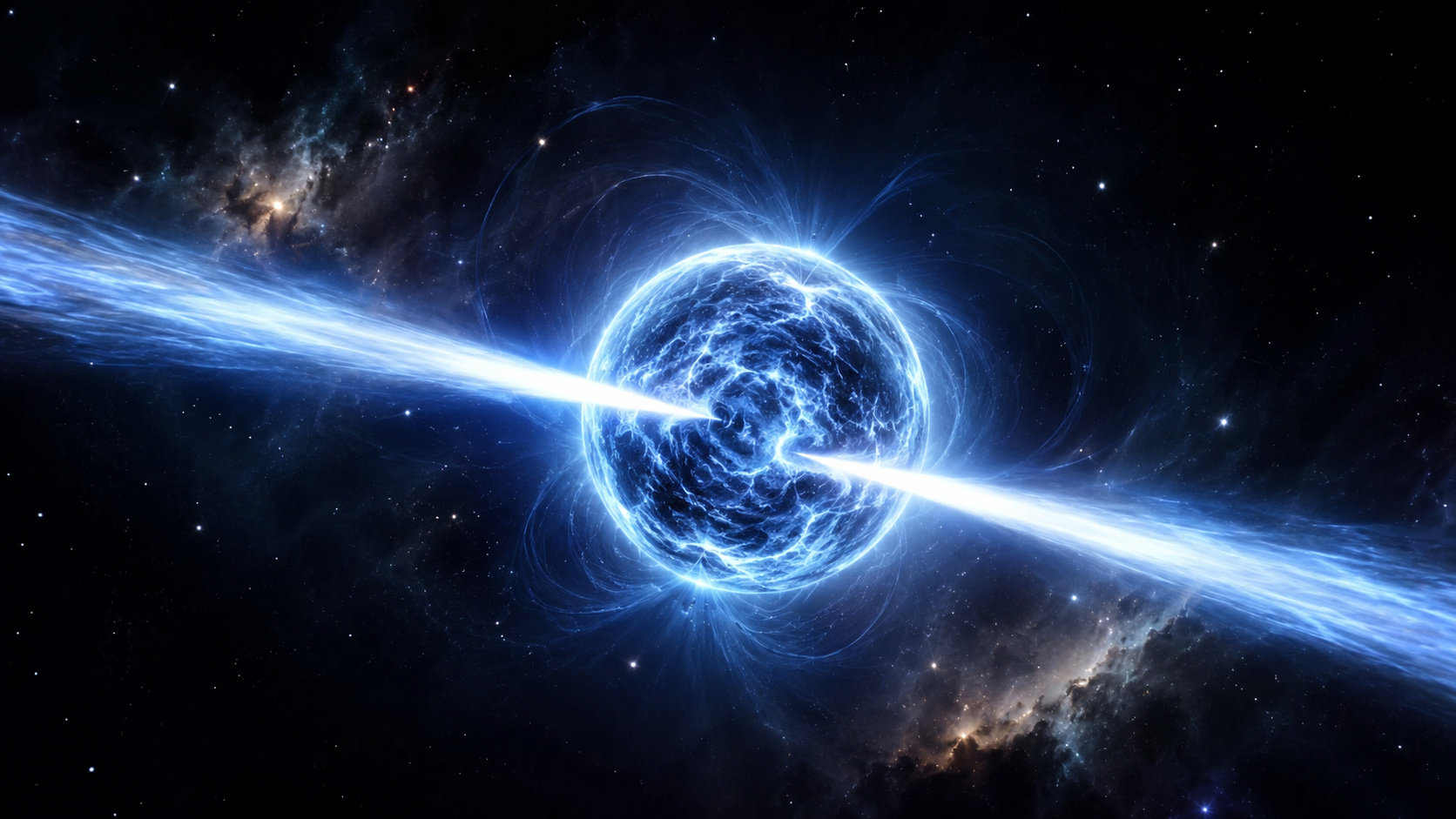
Dead star reveals hidden structures in the deep space of the Milky Way and helps scientists investigate regions of the invisible universe.
A study published in the journal Astronomy & Astrophysics on May 1st revealed an important breakthrough for modern astronomy. Scientists were able to identify invisible structures scattered throughout interstellar space after analyzing signals emitted by a dead star located about 7,000 light-years from Earth.
The object studied was the pulsar PSR B1508+55, located in the constellation Draco. During observations, researchers noticed that the radio waves emitted by the pulsar experienced unusual distortions while traversing the deep space of the Milky Way.
The discovery drew attention because the pulsar appeared elongated, forming a kind of luminous line. This behavior deviates from the circular pattern normally expected by current astronomical models and may reveal unprecedented details about the so-called invisible universe.
-
Ship with 1.7 tons of humanitarian aid from Mexico and Uruguay arrived in Havana this Monday as Cuba faces blackouts of up to 22 hours a day following the cut in energy supply by the United States, and tensions between the two countries increase with the possible indictment of Raúl Castro.

-
The United States, China, and the Emirates are funding a race for solar satellites capable of capturing light 24 hours a day in space and sending energy back to Earth via microwave beams.

-
Scientists discover “chemical fingerprint” that could help reveal extraterrestrial life without finding microbes or fossils, just by analyzing hidden patterns in amino acids and fatty acids from Mars, icy moons, and meteorites.

-
Reaching Mach 2.25 in supersonic flight and carrying 9 tons of weapons on 13 hardpoints, the Eurofighter Typhoon has become the European fighter jet that combines brutal speed, advanced radar, and extreme agility to dominate the skies.


What scientists discovered during the analysis of deep space
The researchers used an innovative technique to analyze the scintillation of the radio waves emitted by the dead star. The effect is similar to the twinkling of stars seen from Earth at night.
However, instead of the Earth’s atmosphere causing the distortions, it was the particles scattered through deep space that altered the pulsar’s signals. This allowed scientists to observe invisible structures existing between the stars of the Milky Way.
Among the main points revealed by the study are:
- Pulsar appeared elongated instead of circular;
- Radio waves experienced distortions in the interstellar medium;
- Structures may be extremely thin filaments;
- Region analyzed is about 430 light-years from Earth;
- Observations used two of the largest radio telescopes on the planet.
The results reinforce the hypothesis that the invisible universe may have regions much more organized than scientists previously imagined.
How a dead star transforms into a “cosmic beacon”
Pulsars are extremely compact remnants of giant stars that exploded in supernovae. After the explosion, a highly dense dead star remains, capable of concentrating a mass similar to that of the Sun in a body approximately the size of a city.
These objects spin rapidly and emit beams of radio waves at regular intervals. When the signals point towards Earth, radio telescopes can detect them with precision.
It was precisely this behavior that allowed astronomers to investigate the invisible universe present in the deep space of the Milky Way. Each small alteration in the radio waves provides clues about the environment that exists between the stars.
According to researchers, small irregularities observed along the detected line suggest that the interstellar medium may be more complex than current models can explain.


Invisible universe may hide gigantic filaments in the Milky Way
Scientists believe that the observed distortions may have been caused by extremely thin parallel filaments scattered throughout deep space. Another possibility involves narrow layers of plasma aligned in a specific direction.
Although these structures cannot yet be observed directly, the data collected by the telescopes indicate that they do indeed exist. This is because the pattern found does not correspond to the random distortions normally expected in the interstellar medium.
The research also revealed that the cloud responsible for the observed effect is located approximately 430 light-years from Earth. On an astronomical scale, this is a relatively close region within the Milky Way.
Researchers emphasize that understanding these invisible structures is important because the interstellar gas directly influences:
- The formation of new stars;
- The distribution of matter in the galaxy;
- The propagation of radio waves;
- The magnetic behavior of the cosmos;
- The evolution of deep space.
Giant radio telescopes allowed the observation of unprecedented details
The study used two observatories considered world references in radio astronomy. One of them was the Effelsberg radio telescope in Germany. The other was FAST, located in China and currently recognized as the largest and most sensitive radio telescope in the world.
The enormous distance between the two pieces of equipment was essential to achieve extremely detailed resolution. Additionally, the scientists took advantage of the Earth’s own movement to record small differences in the arrival of signals emitted by the dead star.
With this data, the researchers were able to reconstruct a kind of map of the distortions existing in the invisible universe of the Milky Way.
Another important detail is that the methodology used was considered relatively simple compared to more complex techniques in modern radio astronomy. According to the authors of the study, part of the processing could be carried out using conventional computers.

Deep space still holds invisible regions never explored
The discovery involving the pulsar PSR B1508+55 represents only the beginning of a new stage for astronomy. After the success of the experiment, scientists intend to analyze other pulsars scattered throughout the Milky Way using the same methodology.
Each new dead star observed could help reveal more details about the invisible universe present among the stars. This includes possible plasma regions, cosmic turbulences, and still unknown magnetic structures.
Radio astronomy has been gaining importance precisely because many phenomena of deep space cannot be seen by traditional optical telescopes. In many cases, only radio waves can pass through certain regions of the cosmos.
Researchers believe that future analyses could significantly expand the understanding of how matter organizes itself within the Milky Way.

Discovery opens a new phase for mapping the cosmos
The observation of the dead star PSR B1508+55 showed that the invisible universe can hide extremely organized structures in deep space. Using radio signals and high-precision radio telescopes, scientists were able to detect unprecedented distortions in the interstellar medium.
In addition to expanding knowledge about the Milky Way, the discovery may aid future research on star formation, radio wave propagation, and the distribution of matter in the cosmos.
With new observations scheduled for the coming years, astronomers hope to transform pulsars into even more efficient tools for mapping hidden regions of the Universe and revealing details that have remained invisible for decades.
With information from Astronomy & Astrophysics (A&A)





Be the first to react!