






 Portuguese
  Spanish


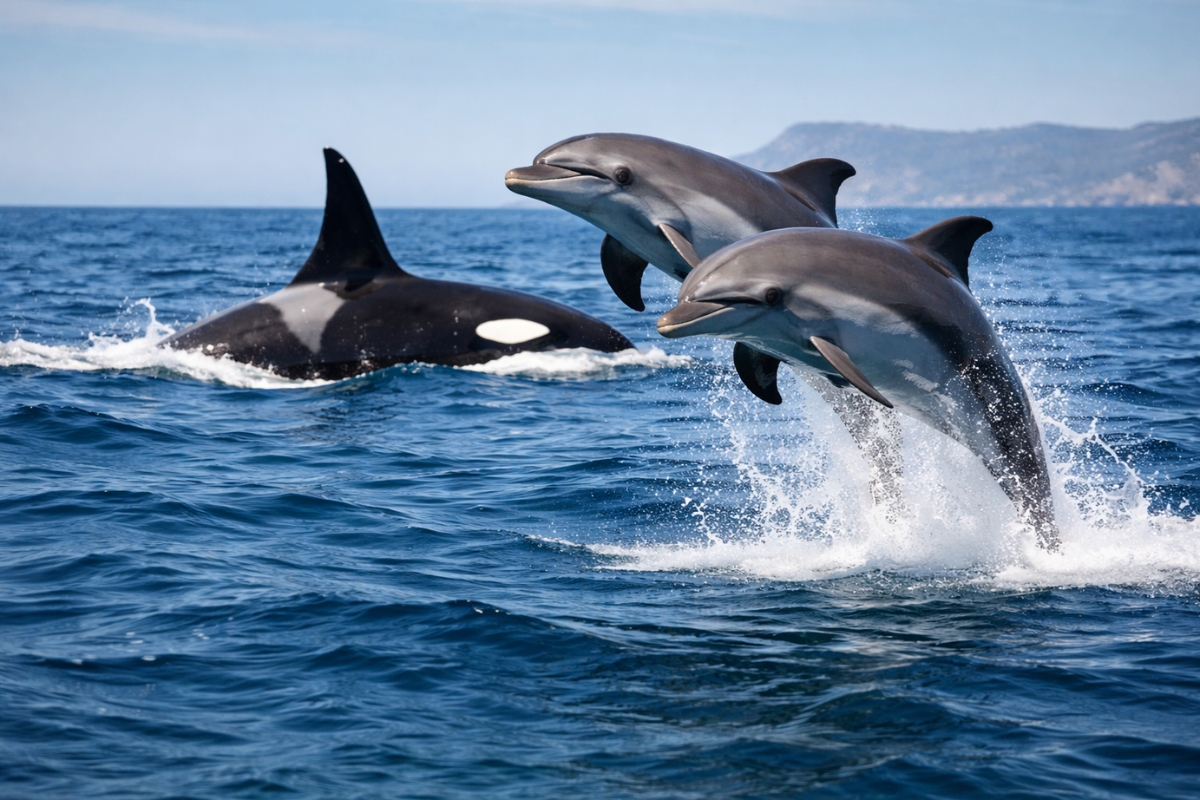


Adaptation to the Sea Has Become an Irreversible Path, with Direct Impacts on the Survival of These Mammals in Oceans That Are Increasingly Pressured
The scene is common, dolphins accompanying boats or orcas appearing with their fins above the surface, and yet it is surprising to think that their ancestors once walked on solid ground.
The question that remains is straightforward: if the ocean becomes hostile, could they return to land? The answer is firm, no.
These mammals have crossed a point of no evolutionary return, becoming trapped in a wholly marine lifestyle.
-
São Paulo Unveils Latin America’s Largest Underground Reservoir, Holding 900 Million Liters, in the Greater São Paulo Area

-
Chinese Teen Wins Gold in Germany for Invention Turning Air Moisture into Underground Irrigation in Drought-Stricken Areas

-
Desertification Threatens Brazil’s Caatinga: 85% of Semi-Arid Region Affected, 30 Million at Risk, and Efforts Underway to Restore 10 Million Hectares by 2045
-
Few People Realize Earth Spins at 1,670 km/h Unnoticed: Explained by Gravity and Brain Perception





Study of Thousands of Species Shows Where Evolution Has Stopped Being Reversible
Researchers from the University of Freiburg analyzed data from 5,635 species of extant and recently extinct mammals.
Each species was positioned on a continuum ranging from a wholly terrestrial environment to a wholly aquatic one.
Semi-aquatic forms, such as otters and seals, still maintain some ability to move on land.
The limit appears when adaptation to the sea is complete, a situation observed in dolphins, orcas, and large whales.
The Migration of Mammals to the Ocean Has Not Occurred in a Reversible Way

Exiting the water for land happened hundreds of millions of years ago, giving rise to tetrapods.
Much later, about 50 million years ago, some lineages of mammals returned to the ocean.
This transition gave rise to whales, dolphins, manatees, and other marine specialists.
Today, 97 percent of mammals remain strictly terrestrial, while only 3 percent returned to the water at some level.
Increase in Size and Change in Diet Solidified Dependence on the Marine Environment
Adaptation to the ocean has led to consistent body growth throughout evolution.
Semi-aquatic species gained about five percent of mass per million years.
Completely aquatic species reached about twelve percent, favoring heat retention and prolonged dives.
This elevated metabolism requires an energy-rich diet based on fish, squid, and, in the case of orcas, other marine mammals.
Transformation of Legs into Flippers Eliminated Locomotion on Land
As adaptation progressed, limbs that were once used for walking lost that function.
The legs transformed into flippers, while the spine and musculature were reorganized for efficient swimming.
This change enhances performance in the water but prevents support of their own weight on solid ground.
The process is linked to the Dollo’s Law, which indicates the extreme difficulty of recovering complex structures after their loss.
Warmer and Polluted Oceans Leave These Animals with No Alternatives

With no possibility of returning to land, the fate of dolphins and orcas depends entirely on the health of the oceans.
Global warming is already altering migratory routes, geographical distribution, and food supply.
Many species are moving to cooler areas and seeing traditional feeding grounds shrink.
Warnings from organizations like NOAA point to increasing risks to the health, reproduction, and survival of these mammals.
Experts Warn of an Evolutionary Success That Became a Trap
The comparative geneticist Virag Sharma assessed that the data reinforces the idea of evolutionary irreversibility.
He also emphasizes the importance of observing other groups of tetrapods to broaden understanding of the phenomenon.
Even with this caveat, the conclusion remains strong.
Orcas and dolphins have become so efficient in the aquatic environment that land is no longer a viable option.
The study identified as Dollo Meets Bergmann, Morphological Evolution in Secondary Aquatic Mammals, published in the Proceedings of the Royal Society B, reinforces this view.
Dolphins and orcas have reached a stage where life at sea is a definite commitment.
On a planet with oceans under increasing pressure, the impact is direct: there is no Plan B on land, and survival depends on more balanced seas, with available food and less pollution, noise, and toxins.
The complete study was published in the scientific journal Proceedings of the Royal Society B and is available in the work Dollo Meets Bergmann, Morphological Evolution in Secondary Aquatic Mammals





Pode até parecer estranho dizer isso, mas esses animais correm risco de extinção por sua eficiência. A evolução não avalia o quanto nós humanos iremos acabar com o planeta, cabe exclusivamente a nós revertermos ou deixaremos de existir também.