






 Portuguese
  Spanish


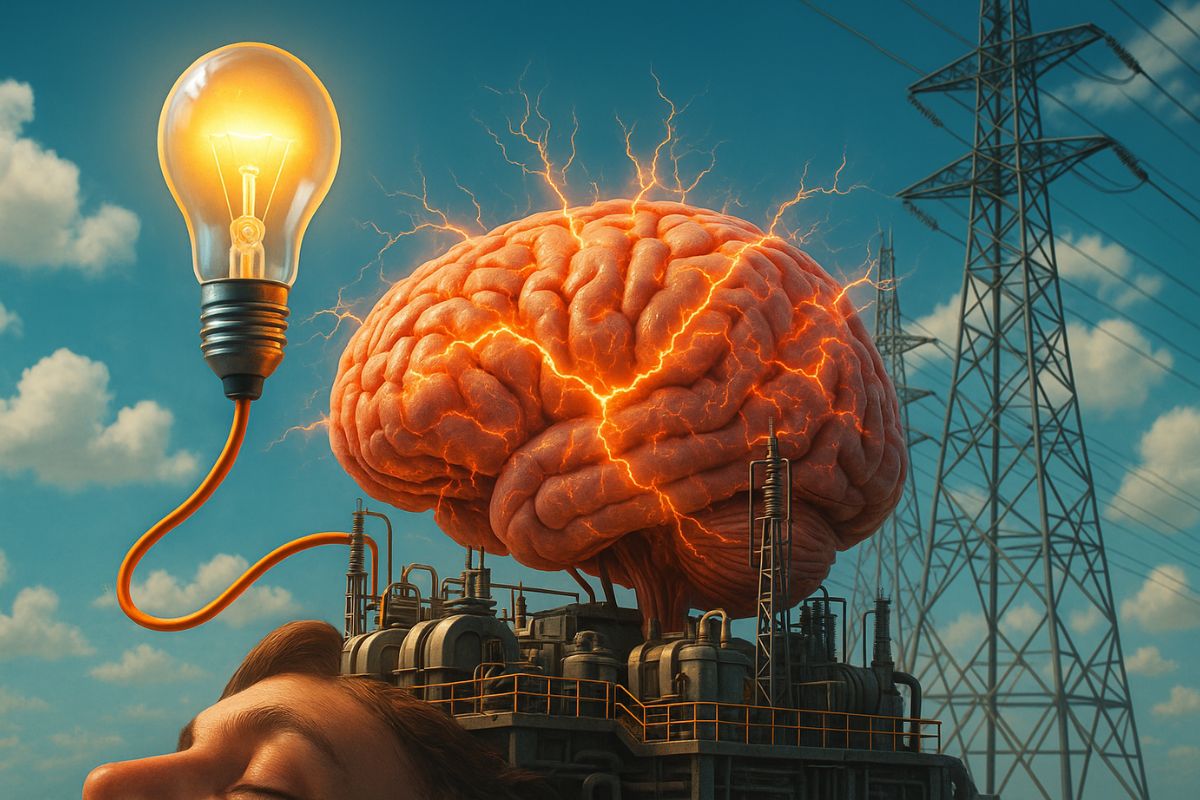

Even During Sleep, The Human Brain Produces A Constant Amount Of Electrical Energy, About 20 To 23 Watts, Resulting From The Activity Of 86 Billion Neurons That Remain Continuously Functioning And Consume A Significant Portion Of The Body’s Calories
The human brain is one of the most complex and demanding structures of the organism. Although it represents only 2% of body weight, it consumes about 20% of all available energy, which is equivalent to an average power of 20 to 23 watts, enough to light a small bulb.
This continuous production of energy is the result of communication between about 86 billion neurons, which generate incessant electrical impulses to keep the body functioning. Even at rest, the brain does not slow down: it continues processing information, consolidating memories, and coordinating vital functions while the body sleeps.
The Electricity That Arises Within The Brain
Brain energy is produced by bioelectric and electrochemical processes that involve the movement of sodium, potassium, calcium, and chloride ions across neuron membranes.
-
Before Japan Became a Football Powerhouse, Zico Transformed the Amateur League, Boosted the J.League, and Was Honored with a Statue at Kashima Antlers

-
House Left Isolated in the Middle of New Chinese Highway as Owner Refuses Compensation Deal, Construction Continues Around the Property

-
Venetian Factory Luigi Bevilacqua Crafts Velvet by Hand on 18th-Century Looms, Producing Just 30 Centimeters a Day

-
From Customer Service to Pipeline Welding: She Becomes the Second Female Welder in Utility’s History, Now Leading a Team in San Diego



This exchange creates small voltage differences, known as action potentials, which allow communication between cells.
Each neuron functions like a small generator.
When it receives a stimulus, its membrane depolarizes and triggers an electrical current that travels through the cell.
Billions of these impulses occur simultaneously, creating a complex electrical network that ensures brain activity even during the deepest sleep.
A Bioelectric Power Plant That Never Turns Off
The human brain never enters total pause mode.
Even while we rest, regions like the hippocampus and the cortex remain operational, storing memories and regulating automatic processes like breathing and heartbeats.
To maintain this uninterrupted activity, the brain requires constant fuel.
It uses glucose as its primary energy source and also depends on oxygen to convert this sugar into electrical and chemical power.
A simple drop in these elements can compromise the functioning of brain cells within seconds.
Mental Energy And Biological Consumption
Despite its small size, the brain is highly efficient. It performs trillions of operations per second with the same consumption as an LED bulb.
This efficiency is possible because the organ distributes energy selectively, intensively activating only the areas that are in use.
On average, an adult consumes about 2,000 calories a day, and approximately 400 of those are devoted exclusively to brain function.
This expenditure shows the high energy cost of the human mind and reveals that thinking, dreaming, and creating are activities that require a continuous consumption of energy.
The Electrical Language Of Thoughts
The electrical impulses that travel through the brain form patterns known as brain waves.
They vary according to mental state: beta waves predominate during concentration, alpha waves emerge during relaxation, and theta and delta waves mark deep sleep.
These oscillations are measurable by electroencephalography devices and represent the rhythm of the mind’s electrical activity.
Each thought, decision, or emotion is accompanied by a coordinated sequence of electrical discharges, highlighting that consciousness is, in essence, an energetic phenomenon in constant motion.
The Difference Between Brain Energy And Common Electric Energy
Although the brain produces enough energy to light a small bulb, this electricity cannot be used externally.
It is bioelectric energy, based on chemical reactions and ion flows, and not direct current like that used in household electrical circuits.
Each neuron operates in microvolts, but the sum of billions of active cells creates a measurable electric field capable of synchronizing the entire nervous system.
Brain energy does not illuminate environments, but rather consciousnesses. It is what sustains thinking, perception, and emotions, being the true driving force of human experience.


