






 Portuguese
  Spanish


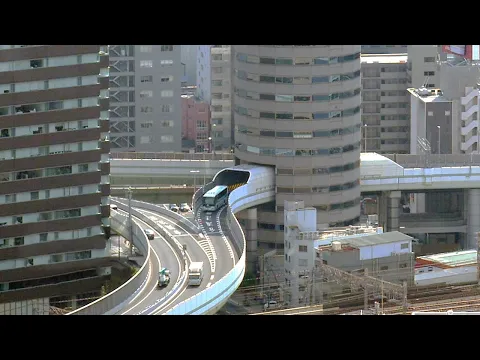
In Osaka, the Hanshin Expressway legally occupies floors of the Gate Tower, but passes through its own isolated tunnel, without supporting itself on the building. The solution emerged after years of negotiation over land, became an urban symbol of Japan, and continues to attract curious visitors between Fukushima Station and the city area.
The highway that passes through the Gate Tower in Osaka has become one of Japan’s most improbable urban images because it mixes engineering, property rights, and a negotiation that avoided the complete demolition of a real estate project. The 16-story building draws attention precisely because cars cross the construction through an isolated central lane, without the road structure directly touching the surrounding offices.
The visual effect seems absurd at first glance, but the arrangement has technical and legal logic. The road is not a common corridor within a commercial building. It passes through the region between the fifth and seventh floors in its own passage, surrounded by protection to reduce noise and vibration, while the other levels remain occupied by other activities.
How a highway ended up in the middle of a building in Osaka

The origin of the Gate Tower lies in a land dispute. The property was related to a company involved in the coal and wood sectors since the Meiji Era. Decades later, with the decline of the business and the deterioration of old constructions, the region came under the radar of a revitalization plan approved in 1983.
-
São Paulo Expands Healthcare and Housing in Southern Region with New Health Center, 374 Apartments, and Over 2,300 Property Titles

-
Rescue Teams Use Flashlights to Find 47 Dogs in Abandoned, Powerless U.S. Home, Offering Them a Fresh Start Through Responsible Adoption

-
Siblings Discover 1939 Superman Comic in Late Mother’s Attic, Sets Record at $9.12 Million Auction
-
12-Year-Old Discovers 80-Million-Year-Old Marine Tylosaurus Fossil During Kansas Field Trip



The owner, however, did not simply agree to hand over the area for the construction of the road. At the same time, he also faced restrictions in erecting a new building on the site. The solution appeared after five years of negotiation between the landowner and the highway company, in an unusual agreement that allowed the building and highway to share the same address.
Gate Tower became a rare case of urban engineering in Japan
The most important detail is that the highway does not support the Gate Tower and the Gate Tower does not support the highway. The expressway passes through a kind of independent tunnel, supported by its own structure, with insulation designed to separate the traffic from the building’s internal routine. Therefore, those working on the nearby floors are not above a common lane exposed to the direct noise of cars.
This separation explains why the case has become an urban engineering curiosity in Japan. The visual suggests that vehicles invade the building, but the actual operation is more controlled: the passage was fitted into the building’s volume, with solutions to protect stability, contain vibrations, and reduce disturbances.
The law that allowed two owners in the same space

The agreement only advanced because a legal change in 1989 paved the way for a highway and a building to occupy the same location under different rights. The rule was originally intended for situations involving underground roads, but it ended up serving to resolve the Osaka impasse in a much more visible way.
In practice, the Hanshin Expressway came to be treated as the legal occupant of floors 5, 6, and 7. These levels are associated with the highway, while the other floors of the building remain separate from the operation of the road. The result is an arrangement where real estate rights and public infrastructure meet in the same vertical slice of the city.
Inside, the highway floors do not function as offices
Those entering the Gate Tower find elevators and conventional areas, but the floors crossed by the road do not function as common rooms. The elevator does not take the visitor to an open track. The highway region is technical, isolated, and connected to the expressway structure, not to the daily use of the building’s occupants.
From nearby floors, what you see is the flow of vehicles in a concrete and metal box. The scene draws attention because the cars seem to emerge inside the building, but the engineering avoids direct contact with the main structure. The spectacle is more in the urban appearance than in any dangerous improvisation.
Curious attraction near Fukushima station
The building is located in the Fukushima area of Osaka, one stop from JR Osaka station on the circular line. This location helps explain why the Gate Tower has become a stop for curious visitors, tourists, and architecture fans seeking different angles of the Japanese city.
Another cited observation point is the Umeda Sky Building, about 1.5 kilometers away. From elevated areas, the shape of the highway becomes clearer: the road curves, passes through the building’s volume, and follows the urban layout without turning the offices into part of the track.
Why the case still draws so much attention
The fascination with Gate Tower doesn’t just come from the image of a highway crossing a building. What captures attention is the sequence of decisions that made it possible: a contested land, a revitalization project, years of negotiation, a legal change, and a technical solution designed to avoid direct contact between structures.
This combination makes the case different from a simple eccentric construction. The building became a concrete piece of Osaka’s urban history, because it shows how a dense city can negotiate space without completely erasing conflicting interests. In Japan, where central areas demand intense land use, Gate Tower became an extreme example of adaptation.
The highway in Gate Tower continues to draw attention because it seems to defy the basic logic of the city: instead of choosing between building or road, Osaka accepted a hybrid solution. The result became an urban attraction, a symbol of difficult negotiation, and proof that infrastructure can produce almost unbelievable scenes when it encounters limits of space, property, and engineering.
And you, do you think a highway crossing a building would be an intelligent solution for large Brazilian cities or a visually impressive risk too great to become a model? Share your opinion and say in which city in Brazil something like this would cause more controversy. Highway crosses a 16-story building in Osaka, passes between offices without touching the structure, and turns land dispute into a unique urban attraction in Japan seen by curious tourists.


